
Medical note: This article is for education only and does not replace medical advice from your pediatrician. Read our Medical Disclaimer.
Transformative Nanny Techniques are essential for caregivers aiming to improve toddler communication effectively.
Professional nannies possess an extraordinary toolkit of language development techniques that can transform your child’s communication abilities in ways that seem almost miraculous to parents. These dedicated childcare experts spend countless hours each day engaging with children during the most critical periods of language acquisition, developing refined strategies that accelerate speech development, expand vocabulary, and create strong foundations for lifelong communication success.
The remarkable difference lies in how experienced nannies understand that every interaction represents a precious opportunity for language learning. While parents may struggle to find time for focused communication activities between work demands and household responsibilities, professional nannies dedicate their entire attention to creating rich linguistic environments that immerse children in purposeful, educational conversations throughout each day.
This comprehensive guide reveals the professional secrets that transformative nannies use to accelerate language development, providing you with proven techniques that can revolutionize your child’s communication abilities and set them up for academic and social success that will benefit them throughout their lives.
Disclosure: This post contains affiliate links. If you make a purchase through these links, we may earn a small commission at no additional cost to you. This helps us keep providing free, quality content for parents everywhere.
Written by Kelly, Childcare Specialist, and Peter, Researcher and Child Development Advocate.
Table of Contents
Transformative Nanny Techniques for Early Language Skills
Experienced nannies bring unique advantages to language development that stem from their specialized training, dedicated focus, and deep understanding of early childhood development principles. Unlike parents who must balance multiple responsibilities, professional nannies can devote their complete attention to creating optimal learning environments that maximize every communication opportunity.
Research from the American Speech-Language-Hearing Association demonstrates that children who receive consistent, high-quality language stimulation during the first five years show significantly better communication outcomes throughout their educational journey. Professional nannies understand this critical window and structure their entire day around maximizing language learning opportunities.
Additionally, the experienced nannies often work with multiple families over their careers, allowing them to observe and refine techniques across different children with varying learning styles and developmental timelines. This breadth of experience enables them to quickly identify what works best for each individual child and adapt their approach accordingly. This is exactly why professional nanny strategies place so much weight on the first few years, when the brain is most receptive to language input.
That focused, one-on-one narration is precisely what helps accelerate child speech faster than passive exposure ever could. This attentive, one-on-one style is what most people picture when they imagine communication miracles childcare in action.
Take a look at this article: ➡️ American Speech-Language-Hearing Association
The Science Behind Nanny Language Development
One of the most powerful techniques nannies employ involves providing continuous, purposeful narration of daily activities that transforms routine moments into rich language learning experiences. This goes far beyond simple descriptions to include sophisticated linguistic strategies that accelerate vocabulary acquisition and communication skills.
Detailed Action Narration: Expert nannies describe every action as it happens, using varied vocabulary and sentence structures. Instead of simply saying Let’s eat lunch, they might say, Now we’re going to enjoy our nutritious lunch together. I’m placing your colorful vegetables on the bright blue plate. Look how the orange carrots contrast with the green broccoli.
Emotional and Sensory Language: Professional nannies systematically incorporate emotional vocabulary and sensory descriptions into their narration. They might say, This soft, warm blanket feels cozy against your skin. I can see you’re feeling peaceful and content as we snuggle together for story time.
Predictive and Planning Language: Experienced nannies use future tense and planning language to help children understand sequence and anticipation. After we finish building this tall tower with blocks, we’ll wash our hands and prepare for our delicious snack time.
Problem-Solving Narration: When challenges arise, professional nannies verbalize their thinking process, demonstrating how language can be used for reasoning and problem-solving. Hmm, this puzzle piece doesn’t seem to fit here. Let me look at the colors and shapes to find where it belongs.
Consistent narration like this is one of the simplest ways to accelerate child speech without needing any special materials or training. Narration like this, repeated daily, is a quiet but powerful form of communication miracles childcare. This is one of the professional nanny strategies that costs nothing and takes no special training to start today.

Creating Communication Miracles Childcare
Professional nannies master the art of asking questions that encourage children to think deeply and express themselves clearly. These sophisticated strategies challenge children’s communication abilities while maintaining engagement and confidence.
Open-Ended Exploration Questions: Instead of asking Did you like the story? experienced nannies ask What was your favorite part of the story and why did it make you feel that way? These questions require children to formulate complex thoughts and express them clearly.
Hypothetical and Imaginative Questions: If you could invite any character from our book to have lunch with us, who would you choose and what would you serve them?
Comparison and Analysis Questions: Experienced nannies help children develop analytical thinking through questions like How are these two animals similar and different? or What do you think would happen if we tried this activity in a different way?
Reflective and Memory Questions: Professional nannies strengthen memory and reflection skills by asking children to recall and describe previous experiences in detail. Can you tell me about the interesting insect we discovered in the garden yesterday? What did it look like and how did it move?
Questions like these are a cornerstone of transformative nanny techniques because they invite real thinking, not just a one-word reply. These same exploratory questions also support nanny language development at a much deeper level than simple vocabulary drills.
Take a look at this article: ⬇️
Understanding Developmental Milestones and Monitoring Child Development – ZERO TO THREE
How to Accelerate Child Speech Daily
Expert nannies employ systematic vocabulary-building strategies that introduce new words in meaningful contexts while providing multiple exposures and practice.
Thematic Vocabulary Building: Professional nannies organize learning around themes that allow for natural vocabulary clustering. During a week focused on transportation, they might introduce words like vehicle, passenger, destination, journey, navigate, and accelerate within relevant contexts and activities.
Sophisticated Synonym Introduction: Rather than using simple vocabulary, experienced nannies introduce more sophisticated alternatives while maintaining understanding. They might say Let’s examine this beautiful flower instead of Let’s look at this pretty flower, gradually expanding the child’s expressive vocabulary.
Multisensory Vocabulary Learning: Professional nannies engage multiple senses when introducing new vocabulary, making words more memorable and meaningful. When teaching about textures, they provide actual objects to touch while introducing words like smooth, rough, bumpy, silky, or coarse.
Context-Rich Repetition: Expert nannies ensure that new vocabulary appears in multiple contexts throughout the day, reinforcing learning through varied applications. A new word introduced during morning art activities might reappear during lunch conversation and afternoon outdoor exploration.
Woven into daily routines this way, nanny language development happens almost invisibly, without ever feeling like a lesson. Vocabulary themes are one of the more structured transformative nanny techniques, since they build depth instead of just breadth. It is also one of the professional nanny strategies parents can adopt most easily, since it just means talking more, not differently.
Professional Nanny Strategies for Vocabulary Growth
Professional nannies transform reading time into active communication experiences that build comprehension and expression skills.

Predictive Reading Techniques: Experienced nannies pause during stories to ask children to predict what might happen next, encouraging them to use story clues and logical thinking to formulate responses. Based on what we know about this character, what do you think she’ll do when she discovers the surprise?
Character Analysis and Discussion: Professional nannies guide children in analyzing character motivations, feelings, and actions, developing emotional vocabulary and critical thinking skills. Why do you think the main character felt worried in this part of the story? Have you ever felt that way?
Story Extension Activities: Expert nannies extend stories beyond the book through dramatic play, art projects, and creative storytelling that encourage children to express their understanding and imagination. Children might act out favorite scenes or create alternative endings.
Real-World Connections: The techniques help children connect story elements to their own experiences, encouraging personal expression and comprehension. The character in our story visited a library, just like we did last week. Can you tell me about our library adventure?
Reading time handled this way becomes one of the clearest examples of communication miracles childcare in action. Vocabulary growth like this is a direct path to helping accelerate child speech during everyday conversation.
Take a look at post: ⬇️
The Power of Talking to Your Baby: Unlock Your Child’s Amazing Potential
Communication Miracles Childcare: Scaffolding Conversations
Experienced nannies create genuine conversations by using scaffolding techniques that support and gradually extend children’s communication abilities.
Expansion and Extension: When children make simple statements, professional nannies model more complex versions while acknowledging the child’s contribution. If a child says Dog big, the nanny might respond, Yes, that’s a very large, fluffy dog. I noticed he has beautiful brown and white spots on his fur.
Wait Time and Processing: Expert nannies provide adequate wait time for children to formulate responses, resisting the urge to fill silence immediately. This patience allows children to process questions and develop more thoughtful, complete responses.
Clarification Techniques: Professional nannies ask for clarification in supportive ways that encourage children to elaborate and refine their communication. Can you tell me more about that? I want to understand exactly what you mean.
Reciprocal Conversation: Experienced nannies engage in genuine back-and-forth exchanges where they share their own thoughts and experiences appropriately, modeling how conversations work and encouraging children to ask questions and show interest in others.
Scaffolding conversations like this is one of the professional nanny strategies parents can borrow most easily at home. This kind of back-and-forth is where nanny language development really accelerates, more than any flashcard or app ever could.
Multi-Language Exposure and Cultural Communication
Many professional nannies bring multilingual abilities that expose children to different languages and cultural communication styles.
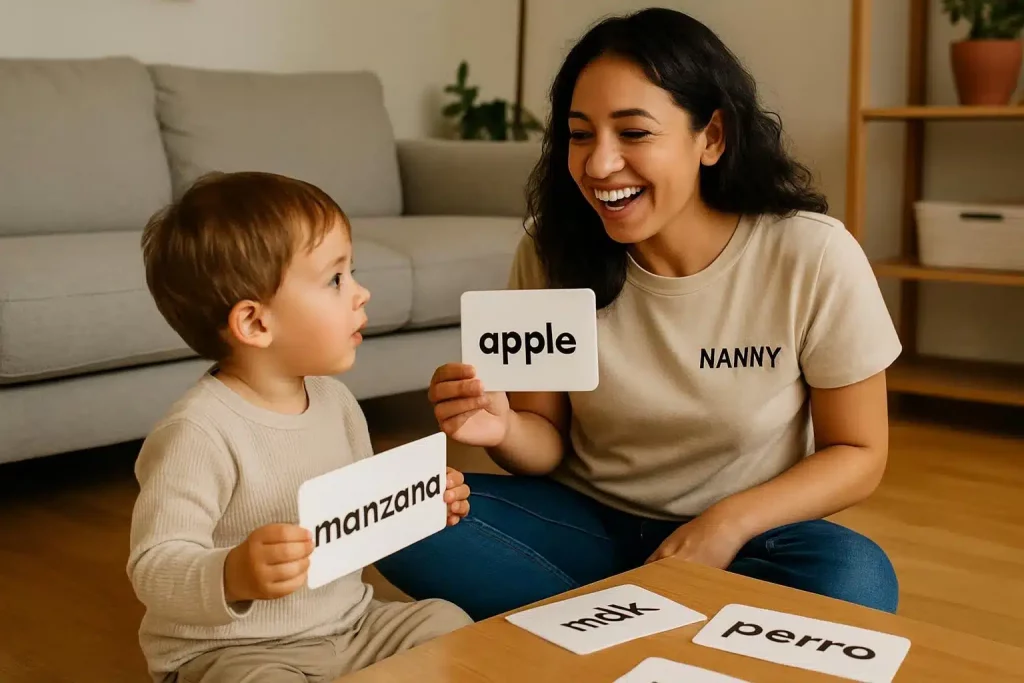
Natural Language Switching: Bilingual nannies often introduce vocabulary in multiple languages within natural contexts, helping children understand that communication can take different forms while conveying the same meanings.
Cultural Communication Styles: Experienced nannies from diverse backgrounds introduce children to different ways of expressing ideas, greeting others, and engaging in social interactions, broadening their communication competence.
Cognitive Flexibility Benefits: Exposure to multiple languages through professional caregivers enhances children’s cognitive flexibility, problem-solving abilities, and metalinguistic awareness that supports overall language development.
Global Awareness: Professional nannies often incorporate cultural stories, songs, and communication traditions that expose children to the rich diversity of human expression and communication.
Multilingual exposure is one of the more advanced transformative nanny techniques, and it supports nanny language development in ways that benefit children long after early childhood.
Technology Integration for Enhanced Learning
Modern professional nannies skillfully integrate educational technology to enhance language learning without replacing human interaction.
Educational App Selection: Experienced nannies choose high-quality educational applications that encourage interactive language use rather than passive consumption, often participating alongside children to maximize learning potential.
Video Communication Skills: Professional nannies help children develop digital communication competence by facilitating video calls with family members or friends, teaching appropriate online interaction skills while expanding communication opportunities.
Digital Storytelling: Expert nannies create digital stories with children, encouraging them to narrate experiences, describe pictures, and engage with technology as a tool for creative expression.
Balanced Screen Time: Professional nannies understand how to balance technology use with hands-on activities, ensuring that digital tools enhance rather than replace the crucial human interactions that drive language development.
Used this way, technology becomes a tool to accelerate child speech rather than a substitute for real conversation. Apps chosen this way still support nanny language development instead of quietly replacing it.
Assessment and Progress Monitoring Techniques
Professional nannies use informal assessments to track language development and adapt techniques to each child’s needs.
Developmental Milestone Awareness: Experienced nannies understand typical language development timelines and can identify when children are progressing appropriately or might benefit from additional support or enrichment activities.
Communication Sampling: Professional nannies observe and mentally note children’s communication attempts, vocabulary usage, and sentence complexity, using this information to tailor their interaction strategies.
Parent Communication: Expert nannies maintain regular communication with parents about language development observations, sharing specific examples of progress and suggesting home activities that reinforce learning.
Individualized Adaptation: Professional nannies continuously adjust their techniques based on each child’s interests, learning style, and developmental stage, ensuring that language learning remains engaging and appropriately challenging.
The transformative power of professional nanny techniques lies not in any single strategy, but in the consistent, purposeful application of multiple evidence-based approaches throughout each day. These techniques create immersive language learning environments that accelerate development while maintaining the joy and wonder that make communication learning naturally engaging for young children.
By understanding and implementing these professional strategies, parents can supplement their nanny’s work or apply these techniques themselves to create rich linguistic environments that support their child’s communication development and set the foundation for lifelong learning success.
Tracking progress like this is one of the quieter professional nanny strategies that keeps nanny language development on course without turning it into a test.
Environmental Language Enrichment Strategies
Professional nannies understand that the physical environment plays a crucial role in language development success. Expert caregivers intentionally design spaces that encourage verbal interaction, label objects to support vocabulary acquisition, and create communication-rich zones that naturally prompt conversation and language practice.
Experienced nannies strategically place labeled items throughout the home at child eye level, using both pictures and words to reinforce vocabulary connections. They create themed learning centers such as kitchen play areas with labeled utensils, reading nooks with categorized book collections, and art stations with color and shape vocabulary displays that make language learning tangible and accessible.
Professional caregivers implement conversation corners featuring interesting objects, mirrors, puppets, and telephones that encourage children to engage in pretend communication scenarios. These dedicated spaces signal to children that language exploration and practice are valued activities deserving special attention and time.
Expert nannies rotate environmental elements regularly to maintain novelty and interest while systematically introducing new vocabulary themes. They understand that familiar objects presented in new contexts or arrangements spark curiosity and conversation, creating natural opportunities for language expansion and experimentation.
A home set up this way becomes fertile ground for the kind of communication miracles childcare providers work toward every day. This kind of environmental design is one of the professional nanny strategies most parents overlook, even though it can accelerate child speech simply by changing what’s within reach.
Music and Rhythm Integration for Language Development
Professional nannies leverage music’s powerful connection to language learning by incorporating songs, rhymes, and rhythmic activities throughout daily routines. These musical elements enhance memory, reinforce vocabulary, develop phonological awareness, and make language learning joyful and engaging.
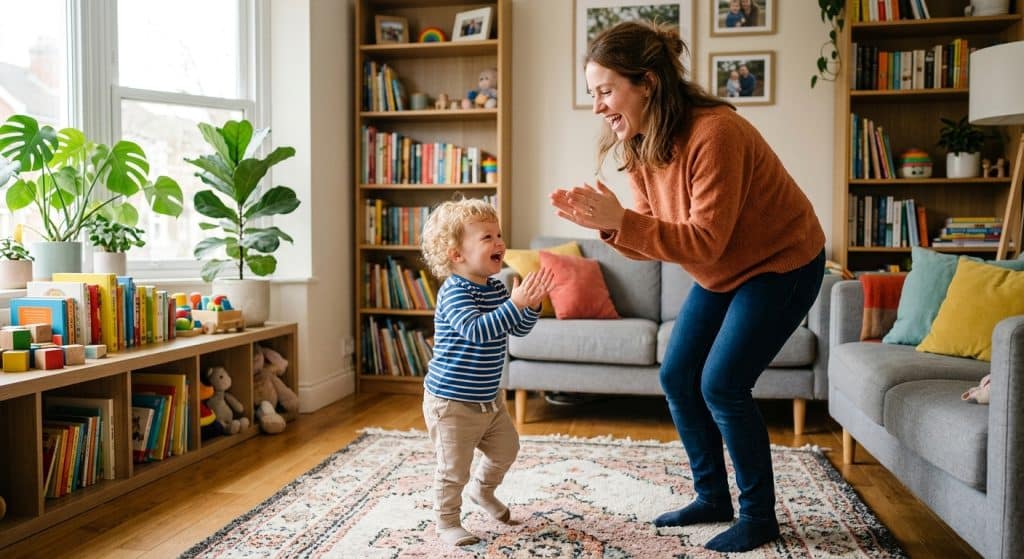
Experienced nannies select songs that emphasize target vocabulary, grammatical structures, or phonetic patterns children are currently developing. They might use counting songs to reinforce number words, action songs to teach verbs and body parts, or rhyming songs to develop sound awareness crucial for later reading success.
Expert caregivers create personalized songs about daily routines, incorporating children’s names and favorite activities to make transitions smooth while building vocabulary. These custom compositions might describe getting dressed, washing hands, or cleaning up toys, turning mundane activities into memorable language learning experiences.
Professional nannies encourage children to create their own songs and rhymes, supporting creative language expression and experimentation. They model how familiar tunes can receive new lyrics, demonstrating language’s flexible and playful nature while building confidence in verbal creativity and expression.
Music is often an overlooked piece of transformative nanny techniques, yet it does as much for vocabulary as any structured lesson. Music is one of the most enjoyable paths to nanny language development, since children absorb new words without any pressure to perform.
Social-Emotional Language Development
Expert nannies recognize that language development extends beyond vocabulary and grammar to include emotional expression and social communication competence. Professional caregivers systematically teach children to identify, label, and express emotions verbally rather than through physical behaviors or tantrums.
Experienced nannies model emotional vocabulary by narrating their own feelings appropriately and helping children understand the connection between internal experiences and verbal expression. They might say, I’m feeling frustrated because the puzzle piece won’t fit. I’m going to take a deep breath and try a different approach.
Professional caregivers use reflective listening techniques that help children develop self-awareness and emotional vocabulary. When children display emotions, expert nannies verbalize what they observe: I see you’re feeling disappointed that playtime is ending. It’s hard to stop doing something fun. Can you use your words to tell me how you’re feeling?
Expert nannies teach children prosocial communication skills including polite requests, expressing gratitude, offering compliments, and resolving conflicts through words rather than physical actions. These sophisticated language applications prepare children for successful social interactions throughout their lives.
Teaching children to name their feelings out loud is a surprisingly direct way to accelerate child speech alongside emotional growth. Naming emotions out loud, modeled consistently, is itself a form of communication miracles childcare. This emotional vocabulary work is very much part of nanny language development too, not a separate skill.
Parent Partnership and Communication Continuity
Professional nannies understand that language development succeeds best when caregiving approaches align between nanny and parents. Expert caregivers maintain regular, detailed communication with families about language development strategies, vocabulary being introduced, and specific techniques parents can reinforce at home.
Experienced nannies provide parents with concrete examples of language expansion techniques, demonstrating during pickup how they model more complex language in response to children’s simple statements. They share the vocabulary themes currently being emphasized, suggesting how parents can naturally incorporate these words during evening and weekend family time.
Professional caregivers create language development journals documenting new words, emerging grammatical structures, and communication milestones that help parents appreciate progress and identify areas where additional support might benefit their child. These detailed records facilitate continuity across caregiving settings.
Expert nannies encourage parents to share family vocabulary, cultural phrases, and communication traditions they want incorporated into daily learning. This collaborative approach ensures children’s language development reflects their complete cultural and family context rather than only nanny-chosen content, keeping language learning rooted in the family’s own culture and daily life.
This kind of handoff is what makes professional nanny strategies sustainable, since nanny language development only sticks when it continues at home.
Take a look at this post: ⬇️
Incredible Alphabet Teaching Secrets That Transform Babies Into Early Readers
Conclusion
The most powerful language development tool your child will ever have is not a technique, an app, or a structured program. It is a caregiver who talks to them. Who narrates the world. Who waits patiently for a response instead of filling the silence. Who reads aloud even when the child seems distracted, and asks one more question at the end of the day even when everyone is tired.
The 9 techniques in this post work because they formalize what the best caregivers already do naturally: treat every ordinary moment as worth narrating, every babble as worth answering, and every child as someone with something real to say. You do not need to implement all of these at once. Start with the one that fits most naturally into your day. The language will follow.
Looking for comprehensive guidance on caring for your baby? Our book ‘How to Care for Children: From Birth to Age 2’ combines professional childcare expertise with evidence-based child development research. Written by Kelly and Peter, this guide provides clear, reliable advice rooted in real-world childcare. Available in English, Spanish, and Portuguese on Amazon.
Click the link below your preferred language to get your copy!

1. At what age should I start implementing professional language development techniques?
Begin from birth, since babies process language and respond to tone and rhythm long before they understand specific words. Focus on narrating activities and responding to coos and babbles in the first six months, then intensify vocabulary labeling from 6 to 12 months, and introduce open-ended questions after 12 months. This is the foundation every one of these transformative nanny techniques builds on later.
2. How much talking is too much when trying to support language development?
There’s no such thing as too much quality conversation, as long as it’s responsive rather than constant background noise or one-sided talking. Aim for genuine back-and-forth: respond to your child’s attempts to communicate, pause to let them process, and balance conversation with quiet time for their own internal language processing. Keep your language developmentally appropriate and attuned to what actually interests them in the moment.
3. What should I do if my child isn’t responding to language development techniques?
First, check that the technique matches your child’s current stage and interests, since something too advanced often gets ignored rather than resisted. Give more wait time than feels natural, some children need it. If your child isn’t responding to their name by 12 months, has no words by 18 months, or loses skills they once had, talk to your pediatrician about a speech-language evaluation. Adjusting pace rather than abandoning the approach is one of the core professional nanny strategies for children who need more time.
4. How can I support language development when my child has limited verbal output?
Keep providing rich language input regardless of how much your child says back, since comprehension develops before expression. Gestures, sign language, or picture cards can reduce frustration while you wait for speech to catch up. Respond enthusiastically to every attempt at communication, and avoid pressuring verbal production, which tends to increase anxiety rather than speed things up. Many late talkers catch up fully with continued support, so keep celebrating progress in whatever form it takes.
5. Should I correct my child’s grammatical errors or pronunciation mistakes?
Skip direct corrections, which tend to create self-consciousness rather than better grammar. Instead, model the correct form naturally: if your child says ‘I goed to the park,’ respond with ‘Yes, you went to the park! What did you do there?’ This technique, called recasting, fixes the error without interrupting the conversation or knocking their confidence. Most children refine grammar naturally through this kind of exposure; if issues persist well past typical milestones, a speech-language pathologist can assess whether more support is needed.
6. How do I balance screen time with language development activities?
Keep passive screen time to a minimum, and be more flexible about interactive content used alongside an adult. The American Academy of Pediatrics recommends avoiding screens except video chatting under 18 months, and capping high-quality programming at one hour daily for ages 2 to 5. Used sparingly and always alongside conversation, screens don’t have to work against efforts to accelerate child speech.
7. Can bilingual exposure confuse young children or delay language development?
No. Research consistently shows bilingual children reach the same language milestones as monolingual peers, even though they may mix languages at first or lean stronger toward one depending on exposure. If concerns do come up, look for an evaluator experienced specifically with bilingual development, since typical bilingual patterns are easy to mistake for delays. Keep both languages going rather than dropping one; bilingualism itself isn’t the cause of any genuine delay.
8. What’s the role of reading in supporting language development beyond vocabulary?
Reading exposes children to grammar, narrative structure, and vocabulary that rarely come up in everyday conversation. Board books introduce labels and basic concepts, picture books build storytelling ability, and chapter books stretch attention and comprehension as children grow. Interactive reading, where you ask questions and discuss the pictures, does far more for language development than passive page-turning ever will. This is exactly why reading sits at the center of nanny language development, well beyond simple vocabulary counts.