
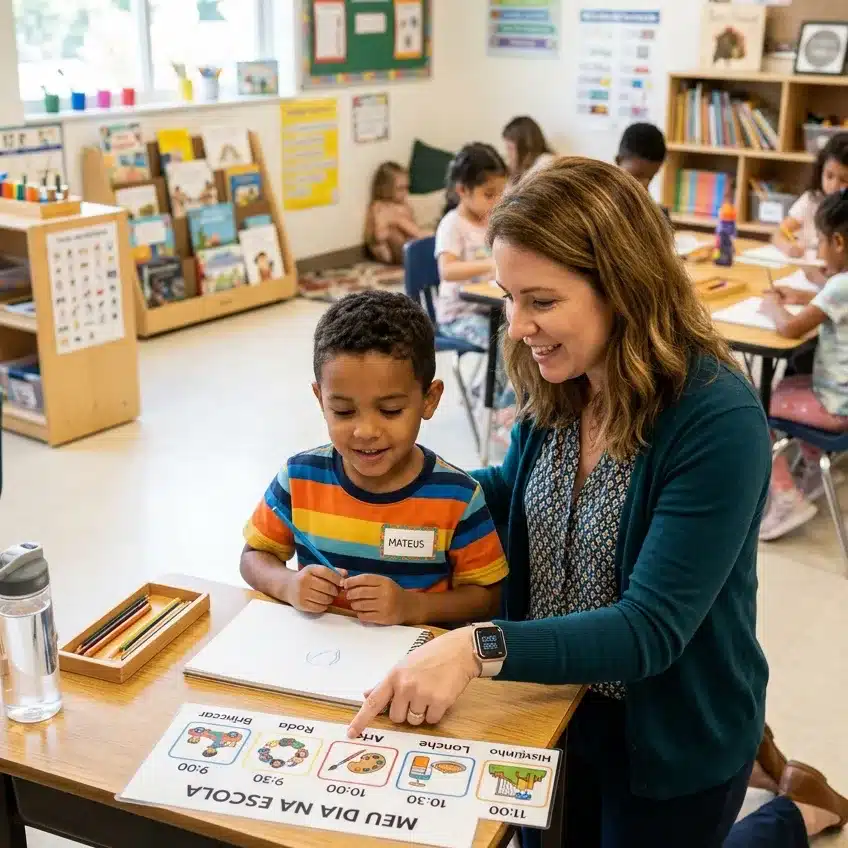
Starting school is a milestone that brings excitement for many families. For parents of autistic children, it brings something more layered. The classroom environment, with its noise, social complexity, unpredictable transitions, and sustained demands across multiple subjects and settings, is one of the most challenging spaces an autistic child will ever navigate. And yet with the right critical school strategies for autistic children in place, many of these children do not just manage. They genuinely thrive.
The key is understanding that appropriate school support is not a favor extended by a well-meaning teacher. It is a legally protected right. Grounded in decades of educational research and federal law, there is a framework of accommodations, an IEP plan for autistic child support, evidence-based teaching methods for autism, and collaborative structures that every autistic child is entitled to access. This post explains what those supports are, how they work in practice, and how to become the advocate your child needs inside the school system.
As a specialist, I see every day how children exhaust their energy just trying to “survive” the school day. While many autistic children appear calm at school, they are often using all their energy to adapt, leading to emotional breakdowns or meltdowns the moment they arrive home. Clear, proactive communication between parents and the school team is essential so both sides stay aligned and prevent the child from becoming overwhelmed.
👩🏻💻 👨🏻💻 This is Part 4 of a 6-part series on autism in children.
👩🏻💻 👨🏻💻 If you are still building your foundation of understanding about autism, of this series, Autism in Children: 3 Levels, Warning Signs and How Diagnosis Works (Part 1), is the place to start before diving into school strategies.
👩🏻💻 👨🏻💻 If you have already covered the daily basics, Autism in Children: 9 Proven Tips: Daily Routine (Part 2), pairs naturally with the strategies in this post.
👩🏻💻 👨🏻💻 And if feeding is also part of your family’s experience, Part 3, Autism in Children: 11 Proven Feeding Strategies (Part 3) covers that piece of the puzzle.
Disclosure: This post contains affiliate links. If you make a purchase through these links, we may earn a small commission at no additional cost to you. This helps us keep providing free, quality content for parents everywhere.
Written by Kelly, Childcare Specialist, and Peter, Researcher and Child Development Advocate.
Table of Contents
Why School Is Harder for Autistic Children Than It Looks
A child who appears calm at their desk is not necessarily a child who is managing well. Many autistic children spend the school day in a sustained state of sensory and social overload, working extraordinarily hard to hold themselves together in an environment that was not designed with their neurological profile in mind. The exhaustion this produces often does not surface until the child gets home, which is why so many parents describe their child keeping it together at school and falling apart the moment they walk through the front door.
Your child is not misbehaving. They are surviving an environment that was not built for their brain.
The school environment presents several simultaneous challenges for autistic children. Auditory processing demands are high: a classroom with 25 students, background noise from the hallway, overlapping instructions, and an air conditioning unit humming requires significant sensory filtering that the autistic nervous system often cannot perform automatically.
Executive function demands are equally intense. Following multi-step instructions, shifting between subjects, transitioning between classrooms, and managing materials all require the kind of flexible cognitive organization that is genuinely difficult for many autistic learners regardless of their intellectual ability. This is exactly why critical school strategies for autistic children need to target executive function directly, rather than treating every stumble as a behavior problem.
The social demands of school, lining up, sharing materials, navigating group work, managing lunch and recess without explicit guidance, are in many ways the most exhausting component of the day. Unstructured time, which most neurotypical children experience as a relief, is often the most anxiety-provoking part of the day for an autistic child, because it removes the predictable structure that helps them feel regulated. Even the small, unremarkable school transitions for autistic children, walking to the gym, lining up for lunch, moving between two lessons, can carry this same weight.
Understanding these challenges is not about lowering expectations. It is about knowing exactly where that support should be aimed, so a child’s energy goes toward learning rather than survival. The good news is that federal law already gives you a formal tool for directing exactly that kind of support, starting with a document every parent needs to understand.
Managing School Transitions and Social Challenges That Catch Parents Off Guard
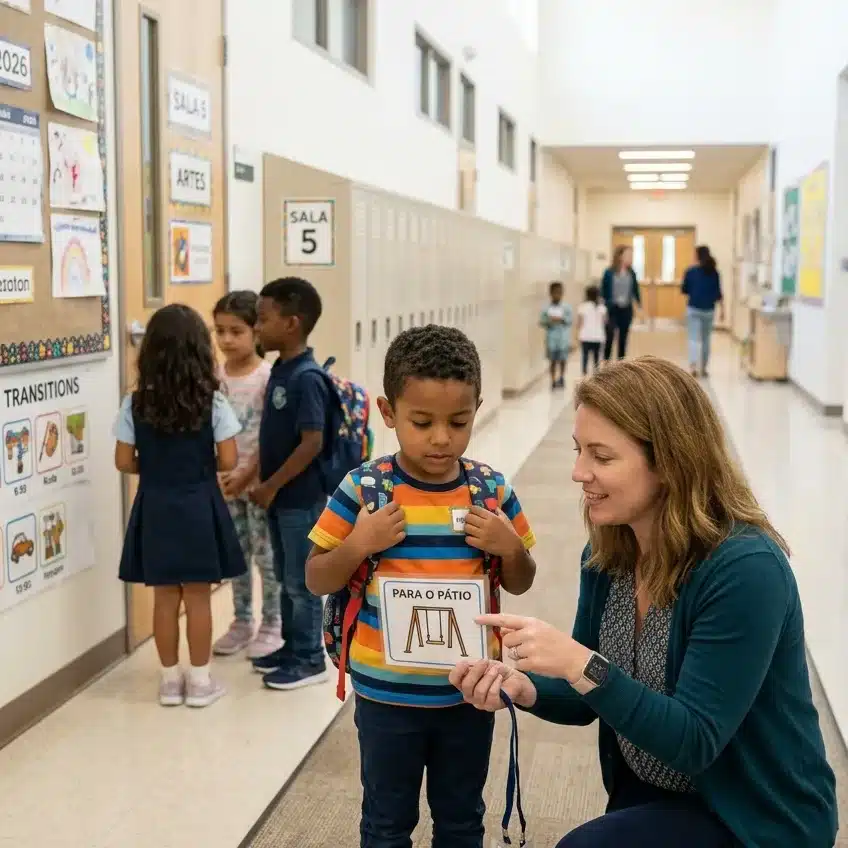
Few things catch parents off guard as much as school transitions for autistic children, and the hardest ones are rarely the big ones. It is often the daily micro-transitions that accumulate the most difficulty: the shift from the classroom to the gym, the five-minute warning before recess ends, the moment the class routine changes because of an assembly, a substitute teacher, or a fire drill. These are the school transitions for autistic children that rarely make it into an IEP meeting, even though they happen a dozen times a day.
For each of these predictable disruptions, preparing for school transitions for autistic children in advance is the strategy that actually works, not damage control after the fact. Social stories for substitute teacher days. A visual card that explains what a fire drill involves and what the child is expected to do. A consistent script for what happens at the beginning and end of recess. These preparations feel like a lot of work until you compare them to the cost of a meltdown that disrupts an entire school day.
Of all the school transitions for autistic children, the transition to a new school year deserves the most particular attention. A visit to the new classroom before the school year begins, a meeting with the new teacher before the first day, and a social story about the new room, new schedule, and new peers are investments that pay off in the first weeks of school. The post on preparing children emotionally for school covers the emotional readiness dimension of school transitions in ways that apply directly to autistic children with appropriate framing.
Social challenges at school rarely resolve on their own. A child who is consistently isolated at lunch, targeted by peers, or struggling with the social dynamics of group work needs direct support, not a let them figure it out approach. Social skills groups, peer mentoring programs, and adult-facilitated play opportunities are all tools the school can provide within the IEP framework. Ask for them specifically.
What an IEP Plan for an Autistic Child Actually Means
An Individualized Education Program, the IEP, is a legally binding document that outlines the specific educational goals, services, and accommodations a child with a disability is entitled to receive in the school setting. In the United States, the IEP is protected under the Individuals with Disabilities Education Act (IDEA), federal legislation that guarantees children with qualifying disabilities the right to a Free Appropriate Public Education in the least restrictive environment. Understanding what an IEP plan for autistic child support actually includes will change how you walk into every school meeting.
A strong IEP plan for autistic child services is one of the most powerful tools a family has inside the school system. It specifies annual academic and developmental goals, the specific services the school must provide (such as speech therapy, occupational therapy, or social skills support), the accommodations the child receives in the classroom (such as extended time, reduced distraction testing, or a sensory break schedule), and the setting in which instruction will occur.
The U.S. Department of Education’s IDEA overview explains the full scope of the law and the rights it protects, and every parent of an autistic child should be familiar with it before their first IEP meeting.
A 504 Plan is a different but related document available to children whose disability does not require specialized instruction but does require the kind of autism classroom accommodations described throughout this post. A child with autism at Level 1 who is fully included in general education may qualify for a 504 rather than an IEP, depending on the specific nature of their support needs.
You have the right to attend every IEP meeting, to request an independent educational evaluation if you disagree with the school’s assessment, and to bring a support person or advocate to any meeting. These rights exist and you are entitled to use them. If you want broader developmental context to bring into conversations about an IEP plan for autistic child, the information in developmental delays in children can help you frame your child’s profile in terms the school team will recognize.
Once you understand your rights, the next question becomes what actually happens inside the classroom, and which teaching approaches genuinely move the needle.
The Teaching Methods for Autism That Work Best
Not all teaching methods for autism produce equal results, and knowing which approaches have the strongest evidence base helps you ask the right questions when evaluating your child’s educational program.
Structured teaching, the core of the TEACCH (Treatment and Education of Autistic and related Communication-handicapped Children) approach, is one of the most established teaching methods for autism, and it organizes the physical environment, schedule, and task presentation in ways that reduce ambiguity and support independent work. Visual structure, physical organization of the workspace, and a clear sequence for completing tasks are its defining features. Schools that use TEACCH principles typically show strong outcomes for autistic learners across a range of ability levels.
Applied behavior analysis in educational settings focuses on breaking skills into small, teachable steps and using systematic reinforcement to build competence. When implemented with fidelity and individualized to the child, ABA-based instruction has one of the strongest evidence bases in autism education research. The key phrase is with fidelity: poorly implemented ABA can be counterproductive, which is why the quality of training and supervision matters.
Social Stories, developed by educator Carol Gray, are short, personalized narratives that describe a social situation from the autistic child’s perspective, explain what typically happens, and offer the child a framework for responding. They are particularly effective for preparing children for transitions, new experiences, or recurring social situations they find difficult to navigate. A well-written social story does not tell a child what to do; it helps them understand what is happening around them, making social stories one of the most versatile teaching methods for autism available to any classroom.
The AAP’s guidance on autism educational approaches recommends early, intensive, and individualized educational intervention as the most effective approach for improving outcomes across communication, behavior, and academic domains. The NIMH’s overview of autism therapies and school programs offers a similar picture, pointing to structured, individualized intervention as the common thread across the approaches with the strongest evidence.
Visual supports, the use of pictures, symbols, written words, and physical schedules to supplement or replace verbal instruction, cut across all of these teaching methods for autism. Visual supports reduce the cognitive load of language processing and give autistic learners a consistent, accessible reference that does not disappear the moment a verbal instruction is finished. All of this research translates into concrete, everyday critical school strategies, and that is exactly where we go next.
13 Autism Classroom Accommodations to Help Children Thrive
These 13 critical school strategies for autistic children work best when they are formalized in the IEP or 504 Plan rather than applied informally at a single teacher’s discretion. An accommodation that lives only in one teacher’s goodwill disappears the following school year, along with all the progress your child made while it was in place. Some of these autism classroom accommodations cost nothing beyond a conversation with the teacher, while others require a written plan and a small budget for materials.
What they all share is a foundation in how autistic children actually process the world: through structure, predictability, and reduced sensory demand rather than through willpower or discipline. Reading through this list, you will likely notice that several strategies overlap and reinforce one another, which is exactly the point. A single accommodation rarely changes a school day on its own, but a coordinated set of critical school strategies for autistic children, applied consistently across every classroom and every adult your child interacts with, changes almost everything.
1. A Visual Daily Schedule for the School Day
A visual representation of the school day, posted at the child’s desk or workspace, showing each subject, transition, and activity in sequence, is one of the single most effective autism classroom accommodations available. It reduces the anxiety of the unknown, gives the child a way to orient themselves when feeling overwhelmed, and supports the executive function demands of transitioning between activities. When an unexpected change occurs, the schedule can be updated visually, which reduces the distress of disruption significantly.
In practice, this works best as a shared routine rather than a poster the teacher sets up once and forgets. Reviewing the schedule together at the start of the day, even briefly, gives the child a moment to ask questions before the demands of the day begin. Removable icons or velcro cards, rather than a printed grid, allow the schedule to flex when a fire drill or an assembly changes the plan.
Occupational therapists are often willing to help design the visual format during an evaluation, so it is worth asking whether one is already involved in your child’s support team before building a schedule from scratch. Like most accommodations on this list, this one improves the moment it becomes a shared habit rather than a one-time setup, echoing the same principle behind effective teaching methods for autism generally.
➡️ A magnetic or velcro visual schedule board makes it easy to build and update this routine at home too, reinforcing the same structure your child uses at school. Check the top-rated visual schedule boards for kids on Amazon.
2. Scheduled Sensory Breaks
Proactive sensory breaks, built into the schedule before the child reaches overload, are far more effective than reactive accommodations offered after a behavioral escalation. A 5-minute sensory break between demanding academic blocks, allowing the child to move, use a calm-down space, or engage in a regulating sensory activity, lowers the cumulative load and extends the child’s available capacity for the rest of the day. Scheduled breaks are among the easiest critical school strategies to trial for a week before making them permanent.
A useful break does not need special equipment. Standing to hand out papers, a short walk to refill a water bottle, or a minute of wall push-ups all give the nervous system a chance to reset. The timing matters more than the activity: a break placed after math and before a transition into a noisier subject prevents the two demands from stacking on top of each other.
Ask the teacher to watch for your child’s early signs of overload, fidgeting, going quiet, or covering their ears, so the break happens before the escalation rather than as a response to it, which is what separates proactive autism classroom accommodations from purely reactive ones.
3. A Classroom Calm-Down Space
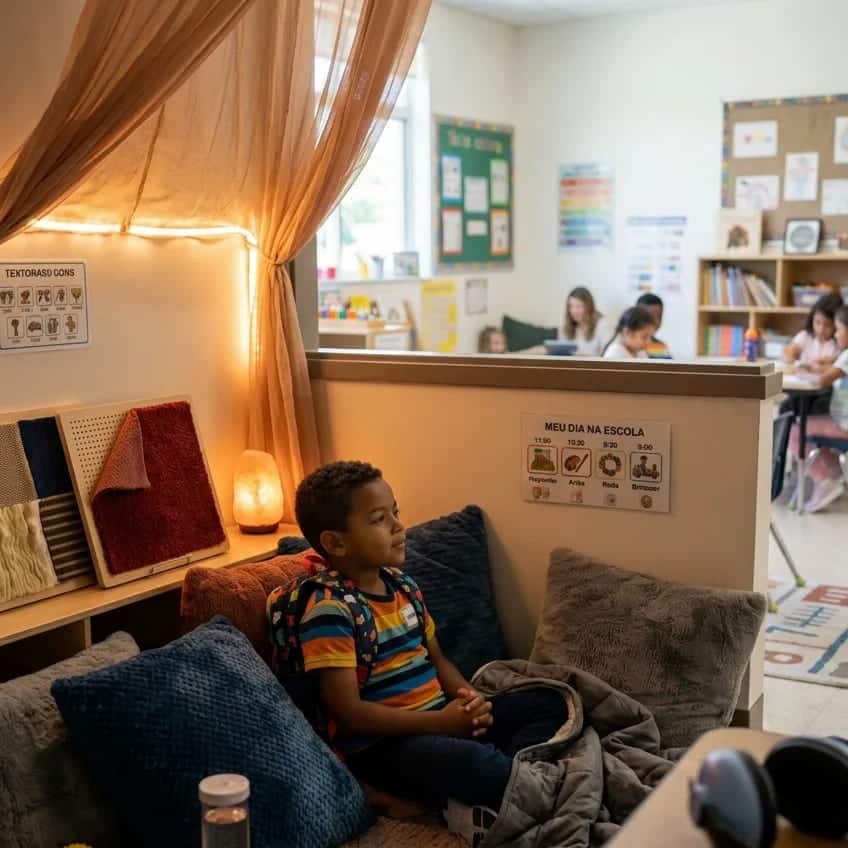
A designated, non-punitive space in the classroom where the child can go voluntarily when feeling overwhelmed gives the child agency and a regulated exit before a full meltdown occurs. It should contain a small number of consistent sensory tools: a weighted lap pad, a fidget, soft seating. The teacher’s role is to help the child recognize when they need it and to honor the request without friction, which makes this one of the more relationship-dependent autism classroom accommodations on this list.
Giving the child a simple, low-attention way to request the space, a card placed on the desk, a hand signal agreed on in advance, or a single word, matters more than the physical setup itself. A visit should have a rough expected length, often just a few minutes, with a clear and unceremonious way back into the lesson so the space never starts to feel like a consequence. When teachers frame it as a tool the child is trusted to use, rather than a place children are sent, students tend to use it earlier and more independently, which is the whole goal behind accommodations built on agency rather than control.
4. Visual Timers for All Activity Transitions
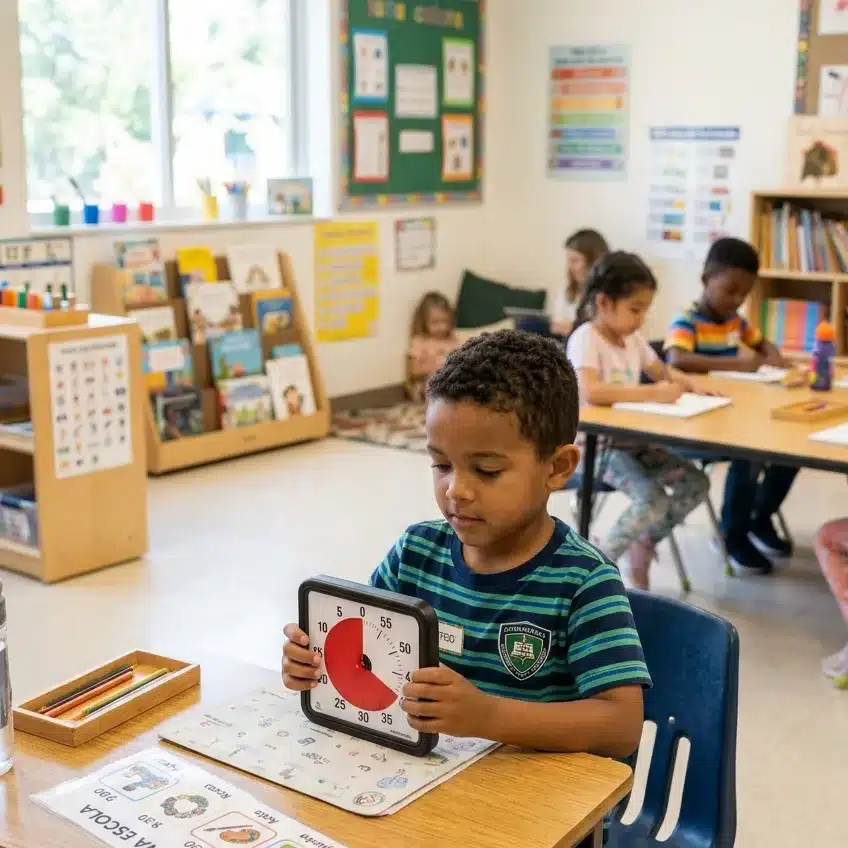
A visual countdown timer the child can see, rather than a verbal announcement that time is almost up, gives the child an independent way to monitor transitions without relying on auditory processing. For many autistic children, seeing time pass visually reduces the anxiety of transitions by making the endpoint concrete and predictable, which is exactly what makes visual timers so useful for managing school transitions for autistic children throughout the day.
➡️ A visual timer designed for classroom use gives your child independent control over transitions and reduces the anxiety of activity endings. Check the top-rated visual timers for children on Amazon and read teacher and parent reviews to find a format appropriate for your child’s age and classroom setting.
Consistency across the school day amplifies the effect. If the timer at the child’s desk uses a shrinking red disc, using that same visual language on the classroom’s main countdown display or the timer used at home reduces the amount of new learning the child has to do just to understand what the tool means. A brief verbal cue paired with the visual, such as “five minutes left, then we clean up,” helps younger children connect the image to the language over time without relying on either one alone, and it reinforces the same school transitions for autistic children skill in every setting where it is used.
5. Written and Visual Instructions Alongside All Verbal Directions
Multi-step verbal instructions are among the most significant barriers to independent functioning for autistic learners. Providing written or visual versions of instructions, posted on the desk or delivered as a card, reduces the processing demand and gives the child a reference to return to independently rather than repeatedly asking the teacher to repeat, which matters just as much during school transitions for autistic children as it does during independent work. This is one of the simplest requests to make, and one most teachers will implement the same week you ask.
A simple format works best: a small card or sticky note listing each step in order, ideally paired with an icon, such as “1. Get out math book, 2. Open to page 12, 3. Complete problems 1-5.” Teachers can prepare these in a few minutes once they get used to breaking an instruction into its component steps, and many find the habit improves clarity for the whole class, not just for the autistic student it was written for. This is one more example of how the right autism classroom accommodations tend to help everyone in the room, not only the child they were designed for.
6. Reduced Sensory Load in the Physical Environment
Is your child’s desk sitting directly under a flickering fluorescent light, three feet from the pencil sharpener traffic jam? Small environmental changes like these carry more weight than most schools realize. Wherever possible, reducing unnecessary sensory input in the immediate workspace supports regulation throughout the day. This includes seating away from high-traffic areas, positioning near natural light rather than flickering fluorescent lighting, and allowing headphones during independent work time.
These are low-cost modifications that many teachers are willing to implement once they understand their neurological basis, and they are often the first critical school strategies for autistic children worth requesting because they cost nothing and help immediately.
A short walk-through of the classroom, ideally before the school year even starts, is the easiest way to spot these issues. Stand at your child’s assigned desk and notice what they will notice: the hum of a vent, a direct line of sight to a busy hallway, a flickering bulb overhead. Noise-cancelling headphones or earplugs during independent work, a desk lamp instead of overhead fluorescent lighting, and a seat away from the pencil sharpener or the classroom door are all small requests that rarely require a formal meeting to approve, and together they form some of the most overlooked autism classroom accommodations available.
➡️ A comfortable pair of noise-cancelling headphones designed for kids can make a noisy classroom far more manageable. See the best-reviewed noise-cancelling headphones for children on Amazon.
7. Social Stories for New Situations and Recurring Challenges
Before a field trip, a new classroom routine, a substitute teacher, or any other transition that disrupts the expected school day, a social story written collaboratively by the parent and teacher prepares the child’s nervous system for what is coming. The story describes the situation, explains what will happen, and gives the child language or a behavioral framework for navigating it.
Read together a few days before the event and again on the morning of, it reduces the novelty threat significantly. Of everything on this list, social stories may do the most to soften school transitions for autistic children specifically.
The strongest social stories are written together by the parent, who knows how the child talks and thinks about the world, and the teacher, who knows the actual layout and routine of the classroom. Using real photos of your child’s specific classroom, gym, or cafeteria rather than generic stock illustrations makes the story far more useful, because the child is previewing the exact environment they will encounter rather than a stand-in for it, which is especially important for school transitions for autistic children involving an unfamiliar space.
8. Structured Peer Interaction Opportunities
Recess and lunch, among the most demanding school transitions for autistic children face each day, are often the most socially and sensorially overwhelming. Structured peer interaction opportunities, such as a lunch group facilitated by a counselor, a structured game at recess with clear rules and adult support, or a classroom job that creates a natural role alongside peers, give the autistic child a way to participate socially without the ambiguity of open-ended social initiation. These social supports are requested less often than sensory ones, but they matter just as much.
A counselor or aide facilitating a small lunch group, sometimes called a Lunch Bunch, gives a handful of students a predictable, low-pressure place to eat and talk with light adult support nearby. A recess buddy system, where two or three children rotate through a shared classroom job together, creates a natural reason to interact without requiring the open-ended social initiation that recess otherwise demands.
Ask the school specifically whether either option already exists before assuming one needs to be built from nothing, since many of the strongest autism classroom accommodations for social skills are already sitting in a counselor’s toolkit, unused.
9. Communication with Parents That Happens Daily
A brief daily communication system between the teacher and the parent closes the gap between school and home. It can be as simple as a written note, a color-coded behavior chart, or a quick text through the school’s communication platform. A note as short as rough morning, extra sensitive today changes how a teacher responds to that same child’s first stumble of the class. Parents who know how the day went can support the child’s regulation at home more effectively, and teachers who hear about a difficult morning or a family stressor can adjust their approach accordingly.
This daily loop is one of the cheapest and most effective autism classroom accommodations available, even though it rarely gets written into the IEP itself. Keep the format brief and neutral rather than turning it into a running behavior report. As your child gets older, involving them in what gets shared, rather than reporting on them without their knowledge, respects their growing autonomy and often makes the information more accurate, which matters for teaching methods for autism that depend on the child’s own self-awareness.
10. Extended Time and Flexible Pacing on Assignments
Extended time is one of the most common items in an IEP plan for autistic child support, and it applies to far more than testing. Many autistic students need additional time to process written instructions, organize a written response, or transition between the steps of a multi-part assignment. Flexible pacing, rather than a fixed deadline applied uniformly to the whole class, reduces the anxiety that comes from racing a clock while also managing sensory and executive function demands.
Extended time works best when it is paired with a way to actually use it, since sitting alone in a room with more time can be just as overwhelming as the original deadline. Breaking a larger assignment into smaller checkpoints, each with its own short deadline, often serves an autistic student better than one long stretch of unstructured extra time, because it rebuilds the same predictable structure that makes the rest of an IEP plan for autistic child support effective in the first place. Pairing time with structure like this is one of the more overlooked critical school strategies available.
11. A Consistent Paraprofessional or Aide for High-Need Transitions
For students whose IEP plan for autistic child support includes one-on-one help, consistency in who provides that support matters as much as the support itself. A child who works with the same aide during the most demanding parts of the day, lunch, recess, and transitions between classrooms, builds a level of trust and predictability that a rotating roster of substitutes cannot replicate. When staffing changes are unavoidable, a short, structured handoff period with the new aide reduces the disruption considerably.
A written handoff sheet covering the child’s current triggers, preferred calming strategies, and communication style saves a new aide weeks of trial and error, and it saves your child from having to re-explain themselves to yet another unfamiliar adult. Ask that this document be updated at least once a year, since the strategies that worked at age six often need adjusting by age eight.
12. Alternative Testing Environments
A quiet, low-stimulation room for assessments, separate from the noise and movement of a full classroom, allows many autistic students to demonstrate what they actually know without the score being distorted by sensory overload. This is a low-cost autism classroom accommodation that schools can typically implement immediately once it is written into the IEP, without requiring additional staffing or equipment. Among everything covered here, this is one of the fastest to put in place once the IEP team agrees.
The logistics matter as much as the accommodation itself. A resource room, the school library during a quiet period, or a counselor’s office can all work, as long as the space is used consistently and framed to the child as a normal part of how they test best, not as a separate or lesser experience. Whoever supervises the room should be someone the child already knows, since introducing an unfamiliar adult during a testing situation can undo much of the benefit of the quiet space, and undermine one of the more effective autism classroom accommodations on this entire list.
13. A Clear, Written Behavior Support Plan Tied to the IEP
When a student’s IEP plan for autistic child support includes significant behavioral goals, a written Behavior Intervention Plan (BIP) that spells out specific triggers, early warning signs, and agreed-upon staff responses keeps everyone working from the same playbook. Without this document, individual staff members often improvise inconsistent responses to the same behavior, which undermines the very predictability that helps autistic students regulate at school. Of all the critical school strategies for autistic children covered here, this one is the least glamorous and among the most protective.
A behavior support plan works best when it is built by the people who actually see the behavior, typically a school psychologist or behavior specialist, the classroom teacher, and you, rather than handed down from a single evaluation. Revisit it whenever a pattern changes noticeably, rather than waiting for the next scheduled IEP review, since a plan written for a six-year-old rarely fits the same child two years later without adjustment. Like every entry on this list, this one only works when someone owns it.
None of these critical school strategies for autistic children work in isolation, though. They depend on a strong, ongoing relationship between you and the people spending six hours a day with your child.
How to Build a Partnership with Your Child’s School Team
The relationship between you and your child’s school team will be one of the most important relationships in your child’s educational life, and it shapes how well critical school strategies actually get implemented. It deserves deliberate investment.
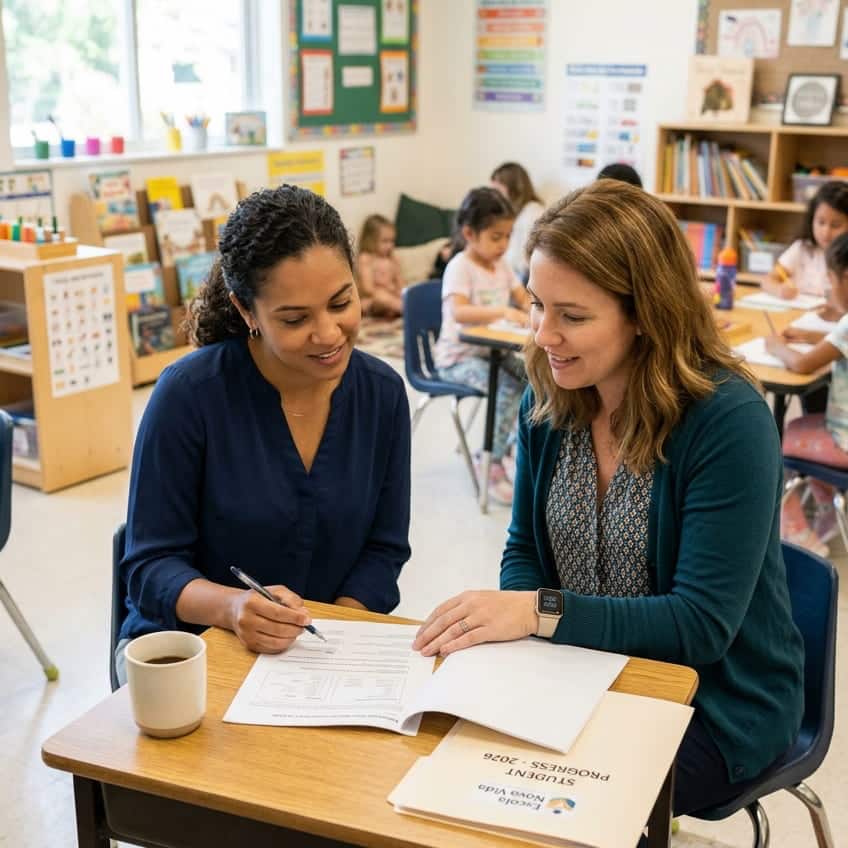
Come to every IEP plan for autistic child meeting prepared, and ask specifically which teaching methods for autism and which classroom accommodations are actually being used day to day, not just written on paper. Know your child’s current levels. Know which goals from the previous year were met and which were not. Bring specific observations from home, not just concerns, but concrete examples of what your child can and cannot do across settings. The school team sees your child for hours each day, but you see them in every other context, and that information is irreplaceable.
Keep a communication log. Document IEP meetings, phone calls, and email exchanges, including dates, participants, and what was agreed upon. This is not adversarial. It is the documentation habit that protects your child’s access to services if staff changes, misunderstandings arise, or the school’s implementation falls short of what the IEP specifies.
Request progress monitoring data regularly, not just at annual IEP reviews. Goals in an IEP should be measured and reported periodically throughout the year, and you are entitled to that data. If a goal is not progressing, the team needs to know that before the annual meeting, when there is still time to adjust the approach.
The tone of your relationship with teachers matters. A teacher who feels supported and respected by a parent is a teacher who goes further for a child. That does not mean accepting inadequate services without pushing back. It means choosing collaboration over confrontation whenever the situation genuinely allows it, and reserving direct advocacy for the situations that require it. That partnership becomes especially important during the moments that are hardest to plan for: the transitions.
Conclusion
No school system, however well-intentioned, will automatically provide everything an autistic child is legally entitled to receive. That gap is not a reflection of your child’s needs; it is a reflection of overstretched staff, tight budgets, teaching methods for autism that were never fully implemented, and IEPs that were written once and never revisited with the attention they deserve. The parents who see the strongest outcomes are the ones who treat advocacy as an ongoing part of the job, not a one-time meeting in September.
Every visual schedule, every calm-down space, every well-supported IEP plan for autistic child exists because a parent asked for it, followed up on it, and refused to accept less. These critical school strategies for autistic children only work when someone keeps asking for them. Your child does not need a perfect school. They need one parent in their corner who never stops asking the right questions.
Looking for comprehensive guidance on caring for your baby? Our book ‘How to Care for Children: From Birth to Age 2’ combines professional childcare expertise with evidence based child development research. Written by Kelly and Peter, this guide provides clear, reliable advice rooted in real world childcare. Available in English, Spanish, and Portuguese on Amazon.
Click the link below your preferred language to get your copy!




1. At what age should I start requesting school support?
As early as possible. Critical school strategies for autistic children work best when they start before kindergarten, not after a crisis. In the United States, children with disabilities are entitled to services from age 3 through the school system, transitioning from Early Intervention services that cover birth to age 3. If your child is approaching 3 and has an ASD diagnosis or developmental concerns, contact your local school district before the third birthday to initiate the evaluation and transition process. Early educational support produces significantly better outcomes than support that begins at kindergarten or later.
2. What is the difference between an IEP and a 504 Plan?
An IEP plan for autistic child support is a comprehensive, legally binding document that provides specialized instruction and related services under the IDEA. It is appropriate for children whose disability requires a modified or adapted educational program. A 504 Plan provides accommodations within the general education classroom under the Rehabilitation Act of 1973, without specialized instruction. It is appropriate when the child can access the general curriculum with modifications but does not require a separate program. Both are legal protections; the IEP is more comprehensive and covers a wider range of services.
3. What if the school says my child doesn’t qualify for an IEP?
You have the right to request an independent educational evaluation at public expense if you disagree with the school’s eligibility determination, and to keep pushing for an IEP plan for autistic child support if you believe your child needs one. You also have the right to bring a parent advocate or special education attorney to any IEP meeting. Document all communications in writing.
Many families find that an autism diagnosis alone is not automatically sufficient for IEP eligibility in some districts; the team must also show that the disability adversely affects educational performance. If you believe the school’s determination is incorrect, pursue an independent evaluation before accepting it.
4. How do I explain my child’s autism to their teacher?
Provide a one-page all about my child document that covers your child’s specific strengths, their specific challenges in the school environment, their triggers and early escalation signs, the teaching methods for autism that work for them, and the things that make situations worse. Keep it practical and specific rather than diagnostic. Teachers appreciate knowing what to expect and what to do; a clinical description of ASD is less useful to them than knowing that your child calms down with five minutes of quiet drawing and escalates when given verbal multi-step instructions without a visual reference.
Pair this document with a short list of the specific autism classroom accommodations already written into your child’s IEP.
5. What accommodations are most common in an IEP?
The most frequently requested and implemented autism classroom accommodations include extended time on assessments, preferential seating away from high-traffic areas, access to a sensory break schedule, visual schedule support, written instructions alongside verbal ones, access to a calm-down space, reduced-stimulation testing environments, and flexibility in assignment format to accommodate sensory and motor differences. Which critical school strategies your child needs specifically depends on their individual profile and should be driven by the evaluation data rather than a generic checklist.
6. Can my child get support if they struggle socially, not academically?
Yes. Academic performance is not the only criterion for IEP eligibility. If your child’s autism is adversely affecting their social-emotional functioning, their ability to participate in the school environment, or their access to extracurricular aspects of education, they may qualify for social skills support, counseling services, or accommodations that address those specific areas. Social impairment is explicitly recognized within the ASD diagnostic criteria and within IDEA as a basis for educational support.
7. How does co-occurring ADHD affect the school support plan?
Co-occurring ADHD and autism are very common, and the combination often requires a more layered support plan than either diagnosis alone. Both conditions affect attention, impulse control, and executive function, but in somewhat different ways, and the teaching methods for autism that help with one do not always address the other. The IEP or 504 Plan should reflect both diagnoses and include accommodations that address the specific way the combination presents in your individual child.
The post on ADHD signs in children covers the critical distinctions between the two conditions and the overlap that makes a combined profile challenging to support.
8. What if the school isn’t implementing my child’s IEP?
Document everything first. Keep records of what the IEP plan for autistic child specifies and specific instances where the autism classroom accommodations or services were not provided. Then request a meeting with the IEP team to address the gap directly, putting your concerns in writing before the meeting. If the issue is not resolved, you can file a state complaint with your state’s department of education or request mediation.
The IEP is a legally binding document, and failure to implement it is a violation of federal law. Most schools resolve implementation gaps when parents raise them in writing with specific documentation, before the process reaches a formal complaint.
9. How do I prepare my child for a new school year?
Preparing for school transitions for autistic children, whether it is a new classroom or an entirely new school, starts weeks in advance, not the night before. Request a classroom visit during the summer if the school will allow it. Photograph the new room, the hallways, the bathrooms, and the gym. Build a social story using those photos that walks your child through exactly what the first day will look like. Introduce the new teacher via a brief in-person meeting or a video call before school begins. Establish the morning routine for the new school year at home before the first day so the sequence is familiar.
The goal is to remove as many unknowns as possible before the first morning, so your child can direct their energy toward the new experience rather than the anxiety of the unfamiliar. For broader guidance on emotional school readiness, preparing children emotionally for school covers the emotional preparation dimension that often gets overlooked in the logistics of back-to-school preparation.
