

Medical note: This article is for education only and does not replace medical advice from your pediatrician. Read our Medical Disclaimer.
If mealtimes in your household have become a daily source of conflict, you are not alone and you are not failing. Feeding children with autism is one of the most consistently reported challenges among families navigating an ASD diagnosis, and it runs far deeper than what most people picture when they hear the word picky. Understanding why your child refuses most foods, gags at certain textures, or will only eat the same four items every day is the foundation of changing that pattern without turning every meal into a standoff. These feeding strategies work because they respect that reality instead of fighting it.
Research on pediatric feeding shows that food selectivity affects most autistic children to some degree, and in the majority of cases it is not a behavioral choice. It is a sensory experience the child has not yet developed the tools to manage.
This post covers eleven feeding strategies that produce real results, organized into three practical stages: preparing the environment, working with your child’s senses, and expanding the menu. You will also find guidance on how to build a mealtime routine that reduces anxiety, how to expand your child’s food repertoire without a battle, and when professional support is the right next step.
👩🏻💻 👨🏻💻 This is Part 3 of a 6-part series on autism in children.
👩🏻💻 👨🏻💻 If you are still building your foundation of understanding about autism, Part 1 of this series, autism in children: levels, warning signs, and how diagnosis works, is the place to start before diving into the specifics of feeding.
👩🏻💻 👨🏻💻 If you have already covered the daily basics, Part 2, daily routine for autistic child, pairs naturally with the feeding strategies in this post.
Written by Kelly, Childcare Specialist, and Peter, Researcher and Child Development Advocate.
Disclosure: This post contains affiliate links. If you make a purchase through these links, we may earn a small commission at no additional cost to you. This helps us keep providing free, quality content for parents everywhere.
Table of Contents
Why Feeding Children with Autism Is About More Than Picky Eating
Every parent of a neurotypical picky eater has heard some version of the advice: just keep offering it, they will eat when they are hungry. For an autistic child, that advice is not just unhelpful; it can actively worsen the situation. The distinction matters enormously, and most families do not have it explained to them until they are already deep in the struggle.
Autistic children often have heightened sensory processing, and the look, smell, texture, and temperature of food can each trigger a response before a single bite is taken.
Food neophobia, the intense fear of new or unfamiliar foods, is significantly more common in autistic children. An unfamiliar food on the plate registers as a genuine threat, not mere dislike, which is why rewards and bribes so often backfire.
The AAP guidance on feeding difficulties in children recognizes these feeding differences as rooted in sensory and developmental differences rather than behavioral choices, which is why the interventions that work for typical picky eating often produce no results and sometimes make things worse when applied to autistic children.
Understanding this does not make mealtimes easy. But it does change where you direct your energy. Pressure, negotiation, and reward systems address the wrong problem. What works is a sensory-informed, pressure-free, and systematically structured approach, which is exactly what the feeding strategies later in this post provide.
The Most Common Food Challenges Autistic Children Face at Mealtimes
Every autistic child is different, and autism food sensitivities present differently from one child to the next. But several patterns appear consistently across families and across research, and recognizing which ones apply to your child is what makes the difference between feeding strategies that work and ones that backfire.
Texture aversion is the most commonly reported challenge. Some children will only accept smooth, uniform textures and cannot tolerate anything with lumps, strings, or mixed consistencies. Others will only accept crunchy foods and gag on anything soft. The texture preference is not arbitrary; it reflects the child’s specific oral sensory profile and what their nervous system can process without triggering a defensive response.
Temperature sensitivity is also common: a child who will eat a food cold may refuse it warm, or vice versa.
Limited food repertoire, sometimes called a restricted food list or safe foods list, is the pattern where a child will reliably eat only a small number of specific foods, often the same items every day without variation. Families frequently report that these safe foods tend to be calorie-dense, uniform in texture, and low in strong aroma, a pattern that shows up again and again in food selectivity in autism cases.
Mealtime anxiety is often overlooked as a driver of food refusal. That anxiety, not the food itself, becomes the primary barrier to eating. Reducing mealtime anxiety is often the first intervention needed before any food expansion strategy will work, which is why the feeding strategies in this post begin with the environment rather than the food.
The CDC autism resources for families note that feeding differences in ASD are among the most common quality-of-life concerns reported by parents, and that identifying the specific pattern behind a child’s food refusal, rather than treating it as generic pickiness, is what makes early support effective.
How to Build a Mealtime Routine That Reduces Anxiety Before the First Bite

A child who arrives at the table already anxious is not available for the work of trying new foods or tolerating familiar ones in new forms. Reducing anxiety before the meal begins is not a preliminary step; it is the strategy itself, and it is often the missing piece parents overlook when feeding children with autism. Building a mealtime routine autism families can rely on starts long before the food ever reaches the table.
The mealtime routine starts before the food appears. Give a simple transition warning 10 minutes before the meal, letting your child know lunch is coming soon. This is not a reminder so much as a sensory preparation signal. It gives the child’s nervous system time to shift from whatever they were engaged in toward the incoming sensory experience of eating.
The physical environment matters just as much as timing. The same seat and table setup every day lower the sensory load your child brings to the table before the food is even served.
Reduce ambient sensory input during meals: turn off background television, lower kitchen noise, and dim overly bright lighting if your child is light-sensitive. The less the nervous system manages from the environment, the more capacity it has for the food itself.
A brief sensory activity before sitting down, such as deep pressure input or a bounce on a therapy ball, can lower sensory defensiveness enough to make the meal more accessible. This mealtime structure connects directly to the broader daily routine discussed in daily routine for autistic child, where the principles of predictability and transition management apply across every part of the day, including mealtimes.
The 11 Feeding Strategies That Actually Make a Difference

These eleven strategies for autism food sensitivities are not a checklist to implement all at once. They are grouped into three stages that build on each other: preparing the environment, working with your child’s senses, and expanding the menu. Choose two or three that apply most directly to your child’s current challenges, implement them consistently for several weeks, and evaluate before adding more.
Stage 1: Preparing the Environment
Before any feeding strategy can work, the environment around the meal has to stop working against your child. This is where a consistent mealtime routine autism specialists recommend becomes essential: children who know what to expect, where they will sit, and what the meal will look like arrive at the table with more capacity to handle the food itself. In practice, this is often the very first thing that shifts when a family starts feeding children with autism using a structured approach.
1. Build a Predictable Mealtime Structure
Serve meals and snacks at roughly the same times every day, in the same location, using the same seat and the same basic setup. Families who commit to this mealtime routine autism specialists recommend for at least two to three weeks often report that mealtime resistance drops before a single new food is even introduced, simply because the meal itself has stopped being a surprise.
2. Use Visual Schedules and a Visual Menu at the Table
A simple visual menu, a card or small board showing pictures of what will be served, posted before the meal begins, removes the surprise element from the food experience. A child who knows in advance what is coming reacts far less defensively than one who is surprised by an unfamiliar item on the plate, and many parents find that simply pointing to the visual menu before sitting down reduces protest before it starts.
Visual tools like this are one of the easiest pieces of a mealtime routine autism families can set up in a single afternoon, with no special equipment required, and it is one of the mealtime routine autism tools parents report keeping the longest.
3. Reduce Ambient Sensory Input Before and During the Meal
Turn off the television, close doors to reduce kitchen noise, and consider dimming bright overhead lighting if your child is sensitive to light. The goal is to leave as much of your child’s sensory bandwidth as possible available for the food itself, and this simple change is often the fastest win in any mealtime routine autism families put together.
Stage 2: Working With the Senses
Once the environment is calmer and more predictable, the next layer of work is addressing autism food sensitivities directly at the plate. These feeding strategies target the sensory experience of the food itself, not the child’s willingness or motivation. This stage is where feeding children with autism starts to look genuinely different from managing ordinary picky eating, because the trigger is sensory rather than behavioral.
4. Use a Divided Plate to Prevent Foods from Touching
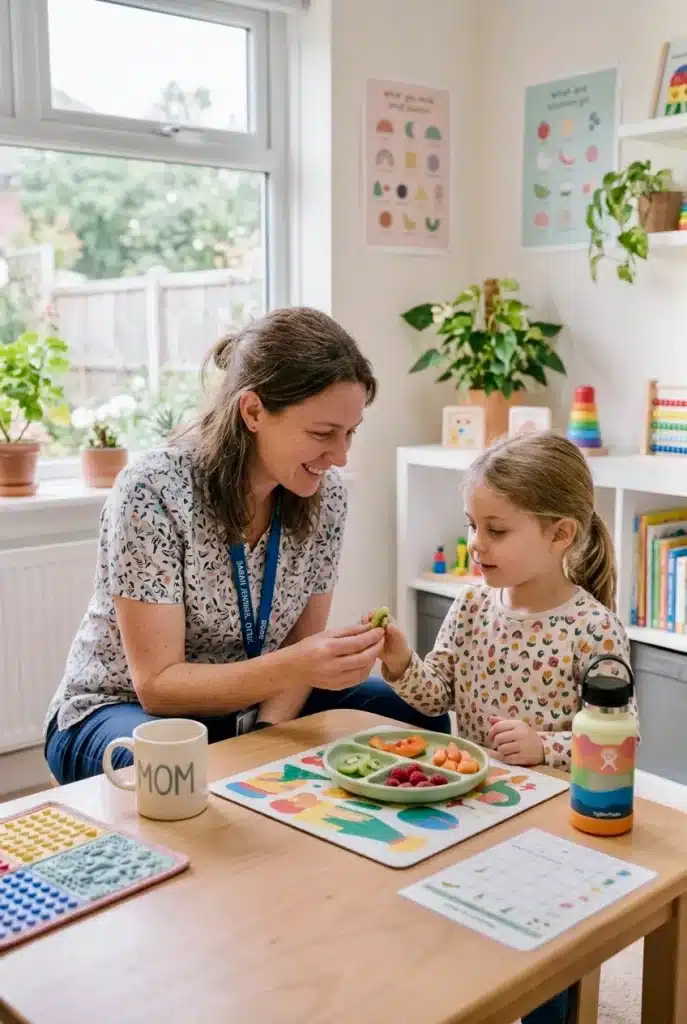
For many autistic children, foods touching each other on the plate is a dealbreaker before tasting even begins. A divided plate removes that sensory trigger entirely. It is a simple environmental modification that costs very little and often reduces mealtime conflict immediately, sometimes within the first meal it is used. Of all the tools available for managing autism food sensitivities at home, this is usually the least expensive and the fastest to show results, which makes it a natural first step for anyone just starting out with feeding children with autism.
➡️ A divided plate designed for children keeps foods completely separate throughout the meal, which removes one of the most common mealtime triggers for autistic children. Check the O’doe™ Silicone Baby Feeding Set, 17-Piece Baby Weaning Set BPA-Free | Thick & Soft Suction Plates, Baby Bowls, Wooden Fork & Spoon, and More, Make Mealtime Fun and Easy on Amazon and read parent reviews to find a durable, easy-to-clean option your child will actually use.
5. Introduce New Textures Gradually, With a Sensory Warm-Up
Some children benefit from brief oral sensory input before eating, such as chewing on a food-grade chew tool, drinking a thick smoothie through a straw, or brushing the gums with a vibrating oral tool if recommended by a therapist. These activities prepare the mouth’s sensory receptors for the incoming experience of eating and can reduce the gagging and hypersensitivity responses that make new textures difficult. Once the mouth is a little more regulated, introduce a new texture in the smallest possible amount, a single grain of rice, a sliver of banana, rather than a full bite, so the sensory information stays manageable.
6. Remove All Pressure From the Table
This is the hardest strategy for most parents to implement, because it feels counterintuitive. No encouragement to just try a bite, no praise for eating more than yesterday, no consequences for refusing. The meal is placed on the table. The child does what they do. The adult stays calm and neutral. Pressure, even gentle or positive pressure, raises anxiety and reduces the likelihood of food acceptance over time.
Removing it consistently lowers the baseline anxiety that blocks expansion, and it is often the single change that makes every other strategy on this list actually work. If you take only one lesson from this guide on food selectivity in autism, this is the one worth prioritizing.
7. Serve Safe Foods Alongside New Foods, in Small Consistent Portions
A child who knows their safe food will always be at the table is a child who can afford to glance at the new food without panic. When safe foods are withheld as leverage, told that a new food must be tried before crackers are allowed, the anxiety around meals increases and safe food status itself can destabilize. Reliable access to at least one safe food at every meal is a non-negotiable foundation for any food expansion work.
Keep portions small and consistent on both sides of the plate: a large portion, even of a safe food, can be overwhelming for a child with oral sensory sensitivity, while a teaspoon of a new food is a far more achievable target than a tablespoon. Portion size is a sensory variable just like texture and temperature, and it is one of the easiest autism food sensitivities to accommodate without any special products, making it one of the simplest changes to start with.
Stage 3: Expanding the Menu
With a calmer environment and a lower-pressure plate, the final stage is gradually widening what your child eats. This is the stage where food selectivity in autism patterns actually begin to shift, and it is almost always slower than parents expect, which is a normal part of the process rather than a sign that something is wrong.
8. Apply Food Chaining
Food chaining is a systematic feeding strategy used by feeding therapists to expand a child’s diet by moving incrementally from a safe food toward a new one. If your child eats plain crackers, the next step might be crackers with the same texture but a slightly different shape or brand. From there, a cracker with a very mild topping. Progress is measured in months, not days, and skipping steps to move faster almost always backfires. Food chaining is one of the most extensively studied approaches for food selectivity in autism specialists use, precisely because it respects how slowly sensory tolerance actually builds.
9. Introduce New Foods Through Playful Exploration, Not Eating
Place a new food on the table near the plate, not on it. The goal is exposure without demand. Over multiple sessions, the food moves closer: first on the table, then on the edge of the plate, then in a separate small dish beside the plate. The child’s only job is to tolerate its presence. A food exploration basket, a small container of novel foods introduced outside of mealtimes in a low-stakes, playful context such as smelling, arranging, or cooking with the food, is used by many occupational therapists for exactly this purpose.
In this context the food is a sensory object, not a meal, and the goal is curiosity rather than consumption, which is the foundation of most food selectivity in autism programs.
10. Involve Your Child in Food Preparation
Children who participate in food preparation, washing vegetables, stirring, choosing between two options at the grocery store, are more likely to tolerate the presence of those foods at the table. Involvement builds familiarity, and familiarity reduces the novelty threat. Keep the participation sensory-appropriate: a child with tactile sensitivity may handle a spoon before they handle raw food, and that is still real progress, one of the quieter feeding strategies that builds trust over time.
11. Model Eating the New Food Yourself
Sit at the table and eat the new food yourself, calmly and without commentary or invitation. There is no invitation to try it and no eye contact that signals expectation. The goal is simply for your child to witness a trusted adult interacting with the food in a relaxed, ordinary way. Modeling works because it lowers the perceived threat of a food through repeated, low-pressure observation rather than direct instruction.
It is part of the same gradual desensitization process that food chaining and exploration rely on, just delivered socially instead of individually, and it is a feeding strategy many feeding therapy for autism programs use as well.
Across all eleven feeding strategies, the single most important habit is tracking progress over months rather than meals. Measuring success meal by meal guarantees discouragement, because expansion in autistic children is genuinely slow. Photograph what your child eats at regular intervals and compare month to month instead of day to day. Growth that is invisible on a daily scale becomes visible over time, and that long view is what sustains both your own motivation and an accurate picture for your child’s clinical team.
How to Expand Your Child’s Food Repertoire Without a Battle

Expansion happens through repeated, pressure-free exposure over time. This principle is well-supported in pediatric feeding research, and it runs directly counter to the instinct most parents have to push for a taste. Progress with food selectivity in autism patterns is measured in small, repeatable steps rather than single breakthroughs, and the steps themselves matter more than the speed at which they happen.
Parents who are new to feeding children with autism often expect a clear before-and-after; in practice, expansion looks more like a slow widening of the safe list over many months, which is exactly why a patient approach to food selectivity in autism outperforms quick fixes. Food play, handling, smelling, or arranging foods without any expectation of eating them builds the familiarity that eventually makes tasting possible, even when no bite happens at all.
For families who are at the early stages of solid food introduction and want to understand the developmental foundation of healthy eating habits, the guide on starting solid foods for babies provides relevant context on how flavor and texture exposure in infancy shapes later food acceptance, which is useful background even when your child is well past the infant stage. Progress is not linear. A food your child tolerated last week may be refused this week without any apparent reason. That is a normal part of the process, not a sign that the feeding strategy is failing. Regression during high-stress periods, illness, or transitions is expected. The trajectory over months is what matters, not any single meal.
When to Seek a Feeding Therapist
Food selectivity that is severe enough to affect your child’s nutritional status, growth, or daily functioning goes beyond what home feeding strategies alone can address. Knowing when to escalate to professional support is one of the most important skills in feeding children with autism, and waiting too long rarely makes the process easier. A feeding therapy referral for autism is not a last resort; it is simply the next tool in the same toolbox as everything covered in this post.
Seek a feeding therapist, one of the most important feeding strategies for severe cases, if your child eats fewer than 20 different foods across all categories. Seek one if any of their safe foods are lost and not being replaced, a pattern called food jag, which progressively narrows the diet. Seek support if your child’s growth is below the expected range, if they are experiencing significant nutritional deficiencies, or if mealtimes are causing self-injurious behavior or extreme distress.
Feeding therapy for autism programs typically bring together speech-language pathologists and occupational therapists with specialized training in pediatric feeding, working as a team to address the sensory, oral-motor, and behavioral pieces of eating. The ASHA resources on pediatric feeding disorders note that food selectivity affects roughly seven in ten autistic children and adolescents to some degree, and provide a directory of certified professionals along with an accessible explanation of what pediatric feeding therapy actually involves.
It is also worth screening for co-occurring medical factors that can contribute to feeding difficulties in autistic children. Gastrointestinal issues are significantly more prevalent in this population than in neurotypical children, and undiagnosed GI discomfort can present as food refusal. If you have concerns about a possible food allergy or intolerance alongside autism, the information in cow’s milk allergy symptoms in babies can help you identify patterns worth raising with your pediatrician.
👩🏻💻 👨🏻💻 And once mealtimes feel more manageable, Part 4, Autism in Children: 13 Critical School Strategies, covers what comes next: the classroom.
Conclusion
Feeding children with autism is rarely about a single breakthrough moment. It is built meal by meal, week by week, through a calmer table, a lower-pressure plate, and small steps that add up slowly. The eleven feeding strategies in this guide work because they meet your child’s sensory reality where it is, instead of asking them to push through it.
Some weeks will feel like real progress. Others will feel like standing still, or even sliding backward, and that is a normal part of the process, not a sign that something is wrong. What matters most is the direction over months, not the outcome of any single meal, and that is true of every one of these feeding strategies.
If mealtimes are still feeling heavier than they should after working through these strategies, that is exactly the moment to bring in a feeding therapist. A feeding therapy for autism referral does not mean you failed to figure this out alone; it is simply the next tool in the same toolbox.
Looking for comprehensive guidance on caring for your baby? Our book ‘How to Care for Children: From Birth to Age 2’ combines professional childcare expertise with evidence-based child development research. Written by Kelly and Peter, this guide provides clear, reliable advice rooted in real-world childcare. Available in English, Spanish, and Portuguese on Amazon.
Click the link below your preferred language to get your copy!




1. Is food selectivity in autism medical or behavioral?
For most autistic children, food selectivity is rooted in sensory processing differences rather than behavioral choice. The texture, smell, temperature, and appearance of food can all trigger a genuine sensory defense response that is involuntary and not within the child’s conscious control. In some cases, co-occurring gastrointestinal conditions also contribute to food refusal.
A thorough evaluation by both a feeding therapist and a pediatric gastroenterologist is the most complete approach when the origin is unclear. This is exactly why every feeding strategy in this guide to feeding children with autism starts with the senses and the environment rather than with willpower or rewards.
2. Should I ever force my child to eat a new food?
No. Forced feeding strategies, including holding a child’s hand over a food or requiring a bite before leaving the table, consistently produce worse outcomes in autistic children over time. The research on this is clear, and a pressure-free approach is the non-negotiable foundation of any serious plan for feeding children with autism.
3. Is eating the same five foods every day a problem?
That depends on whether those foods provide adequate nutrition and whether the list is stable or continuing to narrow. A stable list of five foods that meet basic nutritional needs, while certainly not ideal, is different from a list of five foods that is actively shrinking. Consult with your pediatrician about nutritional supplementation if needed, and begin working with a feeding therapist to expand the repertoire gradually and sustainably. A narrowing list is the clearest early warning sign that families should not wait out food selectivity in autism on their own.
4. What supplements help with a very limited diet?
Supplementation should always be guided by your child’s pediatrician based on specific lab results rather than assumed deficiencies. That said, autistic children with very restricted diets commonly show deficiencies in vitamin D, calcium, iron, zinc, and omega-3 fatty acids, all of which play roles in development, behavior, and immune function. A nutritional blood panel through your pediatrician gives you specific information rather than guesswork. For a foundation on what optimal infant and toddler nutrition looks like, the healthy foods for babies nutrition guide provides useful context, and it pairs naturally with the feeding strategies covered throughout this guide.
5. Why does my child only eat beige or white foods?
Color is a genuine sensory variable for many autistic children, and adjusting for it is one of the more overlooked feeding strategies. The beige foods only pattern is very commonly reported by parents and is recognized by feeding therapists as one of the more visually obvious autism food sensitivities within the broader sensory picture. Food chaining from familiar beige foods toward lightly colored versions of similar textures is one of the feeding strategies therapists use most often for this specific pattern.
6. Can occupational therapy help with feeding difficulties?
Yes, and it is often the most appropriate first referral when sensory processing is the primary driver of food selectivity. Occupational therapy is one of the most effective tools available for feeding children with autism whose main barrier is sensory rather than behavioral. Occupational therapists with pediatric feeding training address the sensory components of eating directly, including oral sensory hypersensitivity, tactile defensiveness around food handling, and the proprioceptive and vestibular factors that affect a child’s readiness to sit and eat.
Many feeding therapy for autism programs involve both an OT and a speech-language pathologist working together on the same case.
7. How do I handle family meals with picky eating?
Parallel eating, where the autistic child’s safe foods are served in their preferred format alongside the family meal without comment or comparison, is the most practical and effective approach for family settings. Over time, as the child’s repertoire expands through a structured program, family meals become less bifurcated naturally. In the short term, preserving a calm mealtime atmosphere serves everyone better than insisting on uniformity, and it keeps the mealtime routine autism families depend on intact for everyone at the table.
8. At what point should I request a feeding therapy referral?
Request a referral when food selectivity is affecting your child’s nutritional status or growth, when the list of accepted foods is narrowing rather than stable or growing, when mealtimes are causing significant distress for the child or the family on a daily basis, or when your child is approaching school age and a limited diet will begin to affect their ability to participate in school lunches and social eating situations.
The earlier a feeding therapy for autism referral happens, the more time the child has to expand their repertoire before those social demands arrive.
9. Is there a link between gut health and feeding challenges?
Research is ongoing in this area, but gastrointestinal problems are significantly more prevalent in autistic children than in the general pediatric population. Constipation, reflux, and other GI issues can contribute to food refusal, restricted intake, and mealtime anxiety by making the physical experience of eating uncomfortable or painful.
If your child shows any signs of gastrointestinal discomfort alongside food refusal, a referral to a pediatric gastroenterologist is worth pursuing alongside any feeding therapy for autism plan already in place. Treating the underlying physical discomfort often changes the feeding picture considerably, and it often makes every other feeding strategy in this guide work faster.
