
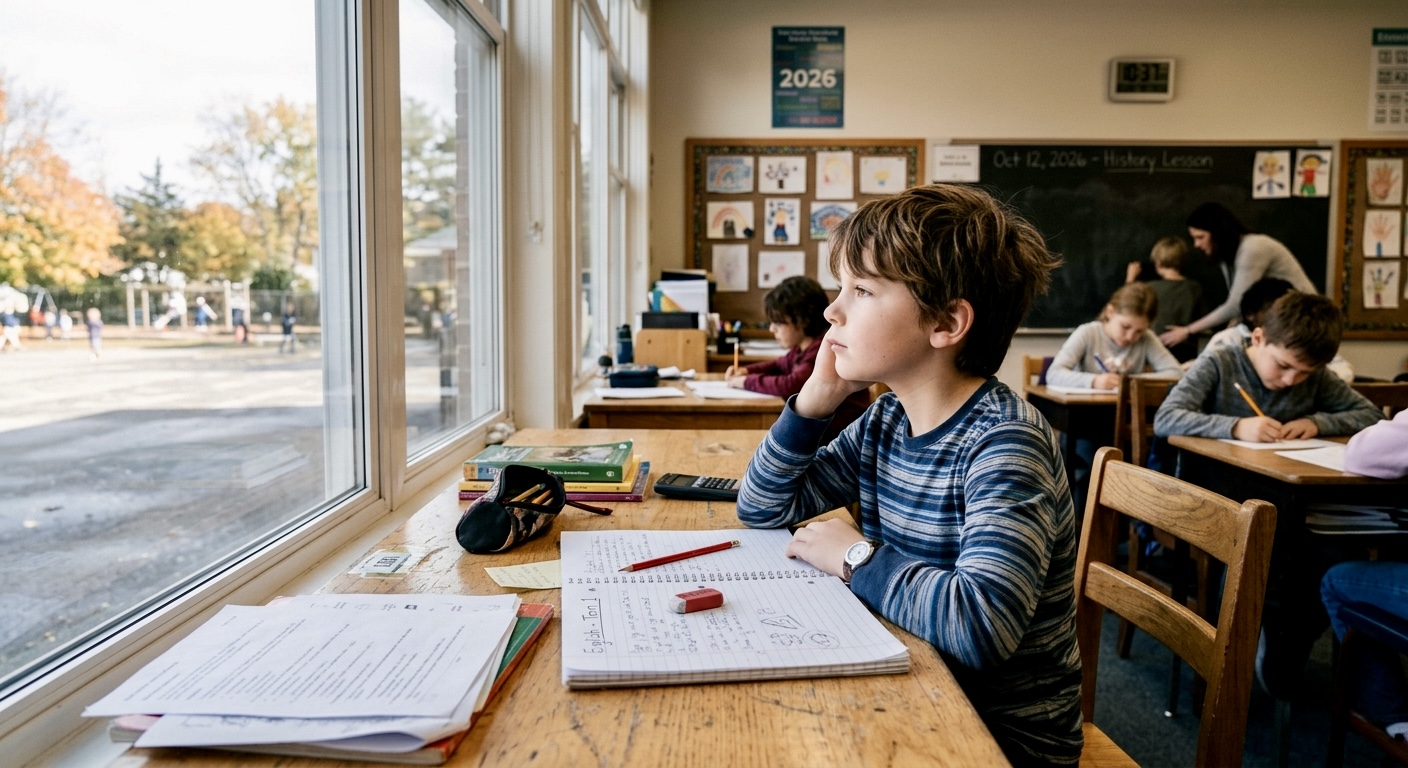
Is my child just energetic, or is something else going on? Could this be ADHD in children, or am I reading too much into things? If these questions sound familiar, you are not imagining it, and you are not alone.
ADHD in children is one of the most misunderstood conditions in childhood. Most people picture a hyperactive boy bouncing off walls, but the reality is much more varied than that. Some children with ADHD are quiet and dreamy. Some are girls who fly under the radar at school for years. Some do fine at home but struggle the moment a structured environment demands something from them.
This post walks you through everything you need to know in plain language. The signs of ADHD in kids that most parents miss, how the diagnosis process actually works, and the strategies that genuinely help at home. No complicated medical terms, just honest guidance for families who are trying to figure out what is going on and what to do about it.
Disclosure: This post contains affiliate links. If you make a purchase through these links, we may earn a small commission at no additional cost to you. This helps us keep providing free, quality content for parents everywhere.
Written by Kelly, Childcare Specialist, and Peter, Researcher and Child Development Advocate.
Table of Contents
What ADHD in Children Actually Means (And Why It Is Not About Bad Behavior)
The first thing I always tell parents is this: ADHD in children is not a parenting problem. It is a brain wiring difference, and understanding that changes everything about how you respond to your child.
Children with ADHD have a brain that genuinely struggles to regulate attention, impulse control, and activity levels. The part of the brain responsible for planning, organizing, and self-control develops more slowly than in other children. That means the child who cannot sit still, forgets instructions the moment you finish giving them, or cannot stop talking during dinner is not being deliberately difficult. Their brain simply does not yet have the tools to do what you are asking.
There is also a chemical piece to this. Dopamine, the brain signal that makes tasks feel rewarding and worth doing, works differently in children with ADHD. This is why the same child who spends two hours completely absorbed in building something can fall apart trying to do five minutes of homework. It is not selective. It is neurological.
According to the Centers for Disease Control and Prevention, approximately 9.4% of children in the United States have received a diagnosis. That number keeps growing, mostly because awareness has improved and parents are no longer being told to just wait it out.
ADHD in children comes in three forms: predominantly inattentive, predominantly hyperactive-impulsive, and combined type. Each one looks different at home and at school, and each one needs a slightly different approach. But before you get to that conversation with a doctor, you need to know what to look for. That is exactly what the next section covers.
The 8 Signs of ADHD in Kids That Parents Most Often Miss
The signs of ADHD in kids are not always obvious or dramatic. What makes them clinically significant is not just their presence but how often they happen, how intense they are, and how much they get in the way of everyday life across more than one setting. Every child forgets things sometimes. Every child loses focus. The difference with ADHD is that these things happen at a level that consistently stands apart from other children the same age, and no amount of reminding, consequences, or patience seems to change the pattern.
1. Focusing Only Works When Something Is Exciting
One of the most confusing signs of ADHD in kids is what looks like selective attention. The child who cannot sit through five minutes of reading can spend three uninterrupted hours building something or playing a game they love. Parents often say to me, But they can focus when they want to. That is exactly the point. The brain is not refusing to focus. It genuinely cannot direct attention toward tasks that do not deliver immediate stimulation or reward. A boring worksheet and an exciting game are not equally accessible to a child with ADHD the way they are to other children.
This is not a choice, not laziness, and not defiance. It is the core of how ADHD works at a neurological level, and understanding that changes everything about how you respond.
2. Acting Before the Brain Has a Chance to Catch Up
Impulsivity in ADHD shows up in ways that can feel genuinely embarrassing in public. Your child grabs a toy from another child at the park without asking. They shout out the answer before the teacher finishes the question. They run ahead in a parking lot before you can reach for their hand. They say exactly what they are thinking regardless of who is listening or what the consequences might be. In those moments it is natural to feel like you are failing as a parent, or like your child is simply being rude.
But what you are seeing is a brain that cannot apply the brief half-second pause between wanting something and acting on it. Most of us do that automatically without thinking. For a child with ADHD, that pause is not consistently available yet, and no amount of reminding or discipline will install it before the brain is developmentally ready.
3. A Body That Has No Off Switch
Some children with ADHD cannot stop moving. They squirm out of chairs at dinner, leave their seat at school without permission, climb on furniture at completely the wrong times, fidget with everything within reach, and talk almost without stopping. The movement is not intentional disruption. The body is seeking the stimulation the brain needs to stay regulated, and sitting still feels genuinely uncomfortable in a way that is hard for most adults to imagine.
Others, particularly girls with the inattentive type of ADHD, appear completely still on the outside but are entirely somewhere else in their minds. Both are valid signs of ADHD in kids, and the quiet daydreamer is just as likely to be missed and underserved as the child who cannot sit down.
4. Instructions That Disappear the Moment You Stop Talking
You give a clear three-step instruction. Your child looks you directly in the eye and nods. Three minutes later, nothing has happened and they look at you with genuine confusion, as if you never said a word. Working memory, which is the ability to hold information in mind long enough to actually use it, is frequently impaired in children with ADHD. It is not selective hearing. It is not a power struggle. The information simply did not stick long enough to be acted on. Treating this as defiance leads to a cycle of conflict that frustrates both the child and the parent without solving anything, because the root issue is neurological, not motivational.
5. Everything Is Always, Without Exception, Lost
Shoes before school. Homework the night before it is due. The water bottle that was definitely just here. The backpack that has not moved but somehow cannot be found. The chronic disorganization that comes with ADHD goes far beyond objects. It extends into time management, the ability to start tasks without being prompted, following through on multi-step activities, and keeping track of what needs to happen next. The child is not being careless or deliberately difficult. The internal organizing system that most people rely on without even noticing simply does not work as consistently for them, and external structure is what fills that gap.
6. Every Single Thing Is Equally Distracting
A child with ADHD in a classroom may spend an entire lesson tracking a fly on the ceiling, listening to a conversation happening two tables away, or fixating on the sound of a heating vent rather than following the teacher. The brain cannot filter out background information the way other brains do automatically. Everything competes equally for attention, and there is no reliable internal mechanism to decide what matters most right now. What looks like a child who is not trying is often a child who is genuinely overwhelmed by the volume of input their brain is receiving and has no way to turn it down.
7. Waiting Feels Like a Physical Emergency
Whether it is waiting for a turn in a game, waiting for a sibling to finish talking before jumping in, or waiting for dinner to be ready when they are hungry right now, children with ADHD experience delay as genuine distress. It is not impatience in the ordinary sense. It is a neurological sensitivity to the gap between wanting something and getting it, and it can escalate very quickly into tears, anger, or complete shutdown. This is not a sign of spoiling or poor limits. It is one of the signs of ADHD in kids that responds well to very specific strategies, which we will cover later in this post.
8. Emotions That Go From Zero to One Hundred With No Warning
This is the sign that exhausts families the most, and the one that is most often misunderstood. A small frustration explodes into a complete meltdown. A minor disappointment leads to a shutdown that lasts far longer than the original event. A transition that was handled fine yesterday sends everything sideways today. Children with ADHD feel emotions with the same intensity as any other child, but they have significantly less capacity to slow down, redirect, or manage those feelings once they are activated.
The meltdown is not manipulation and it is not a tantrum in the traditional sense. It is a child whose emotional regulation system is working at a deficit, and the overflow is real.
It is worth saying clearly: none of these eight signs make your child a bad kid. They make your child a child whose brain needs a different kind of support than what the standard environment provides. That is the starting point for everything that comes next.
If some of these behaviors overlap with meltdowns you have been managing for a while, the post on toddler tantrums and how to handle them covers practical strategies that work for both ADHD-related and typical emotional dysregulation.
Does My Toddler Have ADHD? What to Look For at Different Ages
This is the question I hear most from parents of very young children. Toddlers are impulsive. Toddlers cannot sit still. Toddlers have meltdowns. So how do you know when it is something more?
The honest answer is that reliable ADHD diagnosis in children is rarely possible before age four, and even then it requires careful observation across multiple settings over time. With toddlers, the difference lies in degree, not type. A child whose activity level, impulsivity, and emotional intensity are significantly and consistently beyond what same-age peers show, across every setting and over months, is worth evaluating.
By school age, the gap becomes easier to see. Academic demands reveal inattention. Social situations reveal impulsivity. Structured classrooms reveal hyperactivity that a free-play preschool setting never exposed. This is often when teachers raise concerns for the first time, which can feel jarring for parents who have been managing these behaviors at home for years without a name for them.
The signs of ADHD in kids shift in how they look as children grow older, but the underlying challenge, regulating attention, impulse, and emotion, stays consistent across every age.
Early support matters more than most parents realize. Children identified and helped before age six show significantly better outcomes across academic, emotional, and social measures. If your gut tells you something is off, trust it and bring it to your pediatrician now rather than waiting. Several early ADHD signs also overlap with other developmental concerns, and the post on developmental delays in children covers warning signs worth reading alongside this one.
How ADHD Diagnosis in Children Works, Step by Step
Many parents walk into this process expecting a brain scan or a specific test. There is none. ADHD diagnosis in children is a clinical process that pulls information from multiple people across multiple settings over time. Understanding each step removes a lot of the anxiety around it.
Starting With the Pediatrician
The first step is a detailed conversation with your child’s doctor. The pediatrician will collect a full developmental history, send standardized behavioral questionnaires to both you and your child’s teacher, and rule out other conditions that can look similar to ADHD. Anxiety, sleep disorders, learning disabilities, and even uncorrected vision or hearing problems can all produce symptoms that overlap significantly.
What the Diagnosis Actually Requires
ADHD diagnosis in children is based on DSM-5 guidelines. For children under 16, at least six symptoms from the inattentive or hyperactive-impulsive category must be present for at least six months, show up in more than one setting, be traceable to before age 12, and cause real impairment in daily life. These thresholds exist to make sure a temporary difficult phase or a single challenging environment is not mistaken for a neurodevelopmental condition.
Asking for a Second Opinion Is Always Okay
ADHD diagnosis in children is not always straightforward. Girls are frequently missed. Children from certain backgrounds are sometimes overlooked. If a diagnosis does not match what you observe or a dismissal contradicts what you and teachers are consistently reporting, a second evaluation from a developmental pediatrician or child psychologist is completely appropriate. You are your child’s most consistent advocate, and that matters.
If your child has recently started school and concerns are emerging alongside other emotional challenges, the post on children starting school emotionally covers what this transition looks like for children who need extra support.

How to Treat ADHD in Children: What Actually Works
When families ask me how to treat ADHD in children, the first thing I say is that there is no single answer and no quick fix. What works is a combination of approaches built around the child’s age, temperament, and the specific challenges they face every day.
Start With Behavior, Not Medication
For children under six, the American Academy of Pediatrics is clear: behavioral parent training comes before any medication is considered. This type of support teaches parents specific, evidence-based techniques for managing challenging behavior, building routines, and reinforcing the skills children with ADHD need to develop. Learning how to treat ADHD in children through behavior-first strategies is not about fixing what you are doing wrong. It is about adding the most effective tools to what you are already doing.
When Medication Becomes Part of the Plan
For school-age children with moderate to severe symptoms, stimulant medications have decades of solid research behind them and are considered safe when prescribed and monitored correctly. They help the brain regulate attention and impulse control more effectively. But medication is not a cure for ADHD in children. It creates a window of improved regulation within which therapy, structure, and skill-building can actually take hold. Therapy and routine still do the real work.
School Accommodations Are a Legal Right
Many families do not know that children with ADHD are entitled to formal academic accommodations under the Individuals with Disabilities Education Act and Section 504. Extended test time, preferential seating, movement breaks, organizational support, and reduced written workload are all options. Knowing how to treat ADHD in children means using every available resource, and the school system is one of the most powerful ones you have access to.
For a broader foundation on supporting child development alongside a diagnosis, the post on childcare basics and healthy child development covers principles that apply to any child who needs extra support.
ADHD Behavior Management Strategies That Work at Home
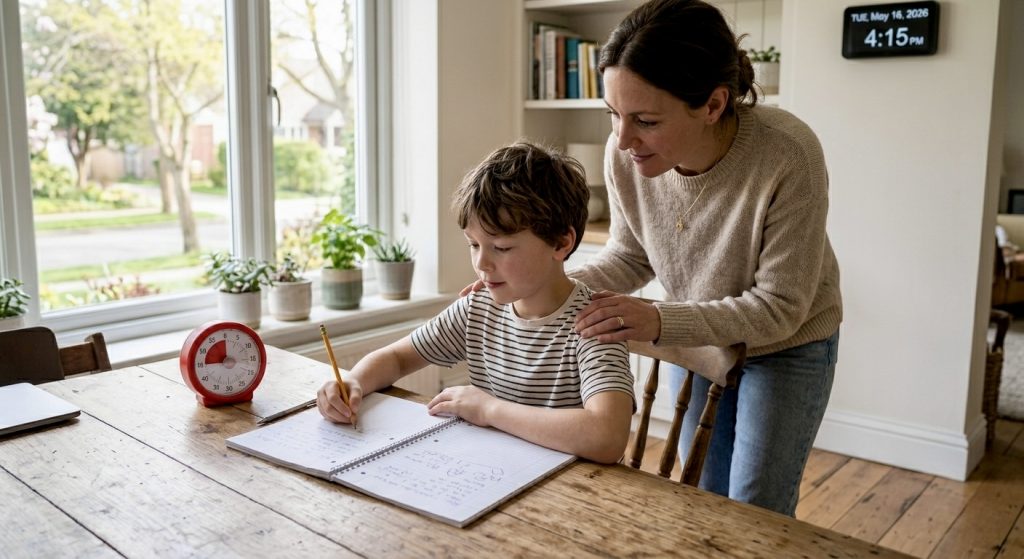
Of everything I have learned working with children over the years, this is the one I come back to most: structure is not a punishment for a child with ADHD. It is the single most important tool you have at home.
The best ADHD behavior management strategies share a few things in common. They are visual rather than verbal. They are predictable rather than spontaneous. They break every task into the smallest possible steps. And they reward effort and progress, not just perfect results.
Visual timers are one of the simplest and most effective ADHD behavior management strategies you can use at home. They make time concrete and visible. A child who cannot feel how long fifteen minutes is can see a timer counting down and plan around it. Transition warnings, giving five minutes notice before switching from a preferred to a non-preferred activity, dramatically reduce the resistance and emotional fallout that come with abrupt changes.
Reward systems work best when they are immediate. Children with ADHD do not respond reliably to rewards that are a week away. A same-day sticker, a short extra screen time, or specific verbal praise right after a behavior happens keeps the motivational connection alive.
The most important thing about ADHD behavior management strategies is consistency. The approach that works on Monday needs to be the same one used on Friday. Inconsistency is one of the fastest ways to undo progress with these children, and one of the most common reasons families feel like nothing is working.
The post on toddler activities for development includes structured play and sensory activities that pair naturally with the routine-building strategies covered in this section.
Products That Help Children with ADHD at Home
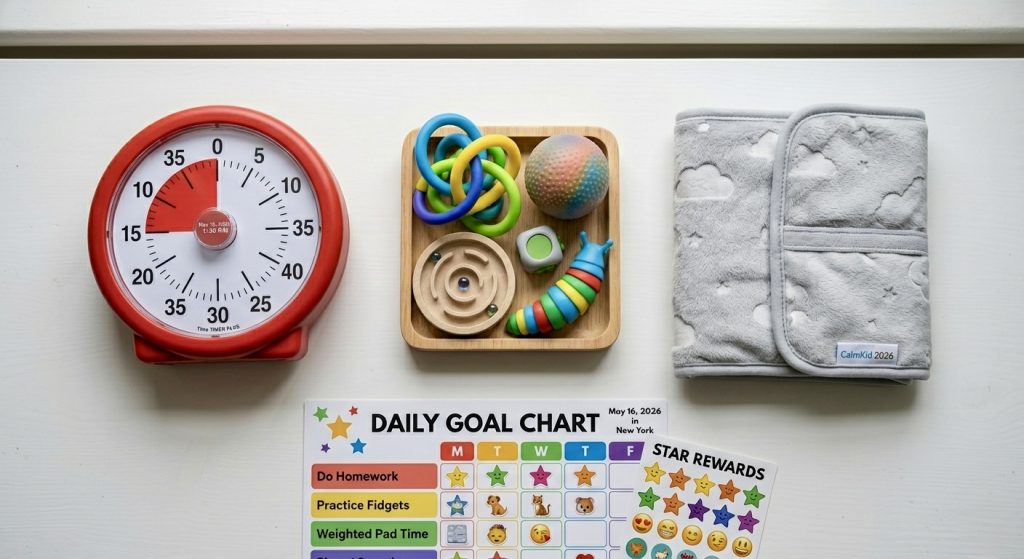
These are the products I recommend most often to the families I work with. Every one of them is grounded in occupational therapy principles and supported by consistent parent feedback.
A Weighted Lap Pad for Settling and Focus
Deep pressure input helps many children with ADHD settle during tasks like homework, meals, and reading. A weighted lap pad sits quietly on the child’s lap and provides the kind of gentle, consistent pressure that helps the nervous system calm down enough to stay present.
➡️ Help your child stay focused during homework without constant reminders to sit still. Check the best-rated weighted lap pads for kids on Amazon and see current pricing and weight options.
A Visual Timer That Makes Time Real
The Time Timer is the most widely recommended visual timing tool among teachers and therapists who work with ADHD. It shows remaining time as a shrinking colored disk so children can see exactly how much time is left. Parents consistently report that it reduces transition resistance and homework battles within the first few days of use.
➡️ Take the guesswork and the arguments out of transitions. See the Time Timer on Amazon and read reviews from parents of children with ADHD.
A Fidget Tool Set for Restless Hands
Giving the hands something quiet and productive to do frees the brain to focus. This sounds counterintuitive, but research consistently supports it. The key is choosing tools that are non-disruptive so they help rather than distract.
➡️ Give your child’s hands something useful to do during focus time. Find the top-rated fidget tool sets for kids on Amazon and see which options work best for home and school use.
An Omega-3 Supplement Formulated for Children
Several clinical studies have found a connection between omega-3 levels and ADHD symptom severity in children. While supplementation is not a replacement for treatment, it is a low-risk addition that some families find genuinely helpful. Always check with your pediatrician before introducing any supplement.
➡️ Support your child’s brain health from the inside. Check the top-reviewed omega-3 supplements for kids on Amazon and see what parents and pediatric nutritionists recommend.
Conclusion
If you recognized your child in several of these eight signs, take a breath. Recognizing a pattern is not a diagnosis, and it is not a failure on your part or your child’s.
What matters most is what you do next: bringing specific, documented observations to your pediatrician, and remembering that ADHD in children is a brain wiring difference, not a character flaw or a parenting outcome.
Your child is not broken. Their brain simply needs different tools.
With the right support, structured at home and advocated for at school, children with ADHD do not just cope. They thrive.
Looking for comprehensive guidance on caring for your baby? Our book ‘How to Care for Children: From Birth to Age 2’ combines professional childcare expertise with evidence based child development research. Written by Kelly and Peter, this guide provides clear, reliable advice rooted in real world childcare. Available in English, Spanish, and Portuguese on Amazon.
Click the link below your preferred language to get your copy!




1. At what age can ADHD in children be diagnosed?
ADHD in children can be reliably evaluated from around age four, though most diagnoses happen between six and twelve when school demands make symptoms more visible. If you are concerned about your preschooler, your pediatrician can begin the screening process now rather than waiting for school age. Early identification consistently produces better outcomes than delayed intervention, regardless of how mild or severe the symptoms appear at first.
2. What are the most common signs of ADHD in kids?
The most consistently reported signs of ADHD in kids include difficulty staying focused on non-preferred tasks, acting without thinking, constant movement or internal restlessness, forgetting instructions almost immediately, chronic disorganization, extreme distractibility, difficulty waiting, and emotional reactions that seem out of proportion to the situation. These signs need to appear consistently across multiple settings and for at least six months before a formal evaluation is pursued.
3. How does ADHD diagnosis in children actually work?
ADHD diagnosis in children involves behavioral questionnaires completed by parents and teachers, a detailed developmental history review, a physical exam to rule out other conditions, and in some cases neuropsychological testing. There is no single test. The process is designed to build a complete picture of the child across multiple environments, and it typically takes several weeks from the first appointment to a final determination.
4. Is medication safe for children with ADHD?
When prescribed and monitored appropriately, stimulant medications for ADHD in children are considered safe for school-age children and carry decades of clinical research behind them. The most common side effects are reduced appetite and difficulty falling asleep, both typically managed through dosing adjustments. The decision to use medication should always be made in close, unhurried conversation with your child’s physician.
5. How to treat ADHD in children without medication?
Behavioral parent training, structured daily routines, school accommodations, cognitive behavioral therapy adapted for children, and consistent ADHD behavior management strategies such as visual schedules, reward systems, and sensory tools are all evidence-based options that do not involve medication. For children under six, these are the explicit first-line recommendations from the AAP. For older children, these approaches produce meaningful results especially when applied consistently over time.
6. Do children with ADHD outgrow it?
Some children, particularly those with predominantly hyperactive presentations, see significant symptom reduction as the brain matures into early adulthood. For many others, ADHD in children continues into adolescence in a shifted form, often becoming more internal and less physically visible. Early skill-building and consistent support during childhood improve long-term outcomes regardless of whether the formal diagnosis persists.
7. What school accommodations should I request?
Under Section 504 and IDEA, children with ADHD may be entitled to extended test time, preferential seating, scheduled movement breaks, reduced written assignments, organizational support from school staff, and access to fidget tools in the classroom. Requesting a meeting with the school’s 504 coordinator and bringing documentation of your child’s diagnosis is the first step. Schools are legally required to respond to this request.
8. Can diet affect ADHD behavior in children?
Some research suggests that artificial food dyes and certain preservatives may worsen hyperactivity in susceptible children. Eliminating these from the diet is low-risk and worth trying. Omega-3 fatty acids have shown modest positive effects on attention in several peer-reviewed studies. Maintaining stable blood sugar through consistent mealtimes also supports the overall regulation children with ADHD need throughout the day. Attention to nutrition is one practical piece of a broader set of ADHD behavior management strategies that families can implement at home.
9. Is ADHD caused by bad parenting?
Absolutely not. ADHD in children is a neurodevelopmental condition with a strong genetic component. Parenting style does not cause it. That said, a warm, structured, and consistent home environment dramatically improves how well a child manages their symptoms over time. Parenting a child with ADHD is genuinely demanding work, and reaching out for parent training support is one of the best investments a family can make. For community resources and current clinical guidance, CHADD is the most trusted nonprofit dedicated to this condition.
10. What separates signs of ADHD in kids from normal childhood behavior?
The distinction lies in intensity, frequency, and impact. Signs of ADHD in kids become clinically significant when they are present in more than one setting, persist for at least six months, began before age twelve, and meaningfully interfere with the child’s daily functioning at home, at school, or in friendships. Every child loses focus and forgets things sometimes. The child with ADHD does these things at a level that consistently and noticeably stands apart from same-age peers, across every environment.
