
Medical note: This article is for education only and does not replace medical advice from your pediatrician. Read our Medical Disclaimer.
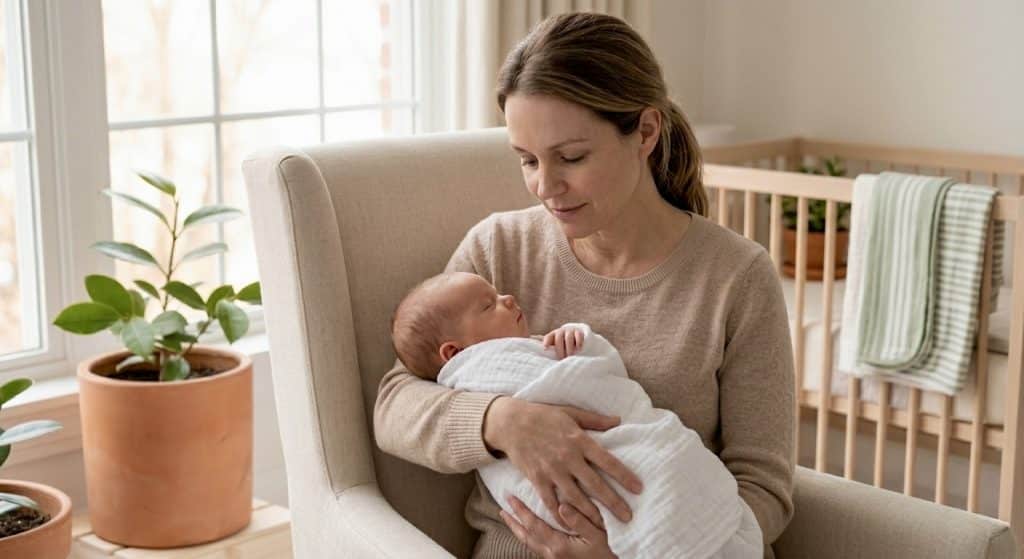
Every exhausted parent has heard it at least once. You’re holding that baby too much. You’re going to spoil them. It is one of the most persistent myths in parenting culture, and it causes real harm because it pushes parents away from one of the most effective baby sleep techniques available: responsive holding.
Baby sleep techniques are not one-size-fits-all, and no single approach works for every family. But the science is clear on one point. Responding consistently to your baby’s needs in the early months, including holding them when they cry, does not create spoiled, dependent children. It creates securely attached ones.
This guide covers 9 evidence-based baby sleep techniques, including a detailed look at the research that finally puts the spoiling myth to rest. Whether you are navigating the newborn stage or managing your first sleep regression, these strategies will help you build a sleep foundation that works for both your baby and your family.
Before you continue: if you are looking for the products that support better baby sleep alongside these techniques, see our complete guide to best baby sleep monitoring apps and gadgets that professional childcare specialists recommend.
These baby sleep techniques are grounded in decades of attachment research and real-world childcare experience. Whether you are a first-time parent or navigating sleep challenges with your second or third child, applying even two or three of these baby sleep techniques consistently can produce measurable improvement within two weeks.
Disclosure: This post contains affiliate links. If you make a purchase through these links, we may earn a small commission at no additional cost to you. This helps us keep providing free, quality content for parents everywhere.
Written by Kelly, Childcare Specialist, and Peter, Researcher and Child Development Advocate.
Table of Contents
The Truth About Holding Your Baby Too Much
For generations, parents, grandparents, and even some medical professionals warned that picking up a crying baby too quickly, or holding them too long, would produce a clingy, demanding child who could never sleep independently. This belief shaped decades of parenting advice and caused enormous guilt in parents who followed their instincts and held their babies anyway.
The research tells a completely different story.
What Dr. Alan Sroufe’s 45-Year Study Found About Secure Attachment in Babies
Dr. L. Alan Sroufe, Professor Emeritus of Child Psychology at the University of Minnesota’s Institute of Child Development, led the Minnesota Longitudinal Study of Risk and Adaptation, one of the longest and most comprehensive studies of human development ever conducted. Beginning in 1974, the study followed children from birth through adulthood, tracking how early caregiving experiences shaped their development across decades.
The findings directly contradict the spoiling myth. According to Sroufe’s research, infants who received consistent, warm, responsive care from their primary caregivers developed what attachment scientists call secure attachment. These children, when observed at preschool age and beyond, showed greater independence, stronger self-regulation, higher social competence, and more positive peer relationships than children whose early bids for comfort were frequently ignored or dismissed.
The counterintuitive finding was this: the children who appeared most independent at preschool age were often those who had been held and responded to most consistently in infancy, not those who had been left to self-soothe from the earliest weeks. The children with avoidant attachment histories, those whose parents had been encouraged to maintain emotional distance, were actually more dependent on teachers and caregivers in later childhood.
Sroufe summarized the principle this way: attending to a baby’s needs is not spoiling them. It is helping them build the internal resources they will eventually use to regulate themselves independently.
Why Infant Brains Cannot Be Spoiled in the First Months
Understanding why holding cannot spoil a young baby requires understanding how the infant brain develops. At birth, the prefrontal cortex, the region responsible for impulse control, delayed gratification, and rational decision-making, is profoundly immature. Babies are not capable of manipulation in any meaningful neurological sense during the newborn period. They cry because they need something, not because they are testing limits.
The American Academy of Pediatrics confirms that responding promptly to infant crying in the early months supports healthy neurological development. The stress hormone cortisol, when chronically elevated by unmet needs in early infancy, has measurable negative effects on brain architecture. Consistent responsiveness keeps cortisol at appropriate levels and supports the neural pathways associated with emotional regulation, a skill that directly affects your child’s ability to sleep independently later.
The practical implication for baby sleep techniques is significant. Holding your baby when they cry in the first four to six months is not a sleep training failure. It is the neurobiological foundation upon which healthy independent sleep is later built.
1. Build a Bedtime Routine That Signals Sleep Is Coming
The most universally effective of all baby sleep techniques is also the simplest: a consistent, predictable bedtime routine. Infant brains are pattern-recognition machines. When the same sequence of events precedes sleep every night, the brain begins to associate that sequence with the transition to sleep, releasing melatonin earlier and reducing the time it takes your baby to fall asleep. A consistent bedtime routine also plays a quiet but important role in infant sleep development overall, since predictable cues teach the nervous system when to downshift, not just for that night’s sleep but for the broader pattern of self-regulation your baby is building month by month.
What a Newborn Sleep Routine Should Look Like at Each Stage
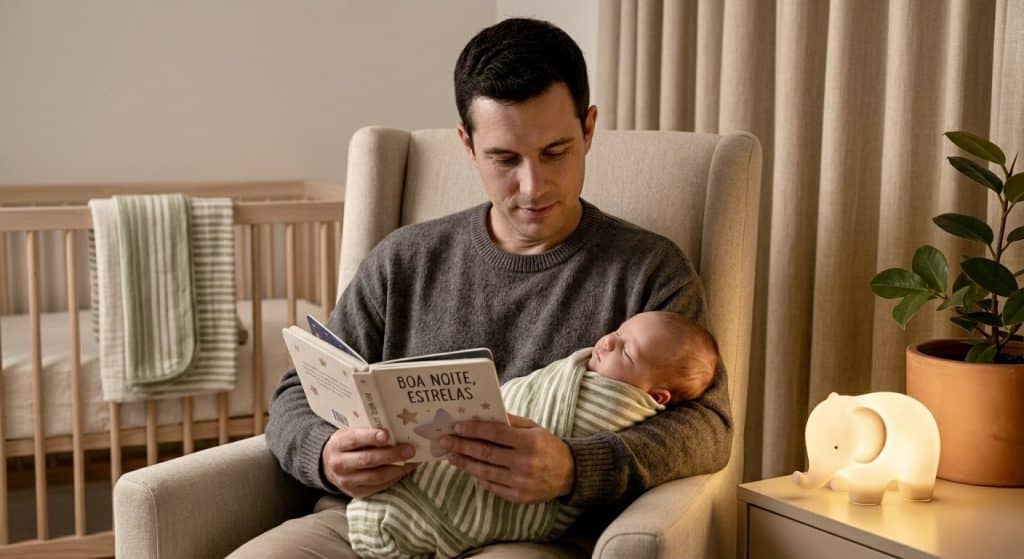
A newborn sleep routine does not need to be elaborate to be effective. For babies under three months, even a two-step routine of a warm bath followed by feeding and gentle rocking provides enough predictability to begin establishing cues. As babies grow toward four to six months, the routine can expand to include a quiet feeding, a short book or song, dimmed lights, white noise activation, and placement in the crib while drowsy but still awake.
The key principle is consistency over perfection. A routine that happens 90 percent of the time at roughly the same hour is significantly more effective than a perfect routine attempted occasionally. The brain builds sleep associations through repetition, and repetition requires showing up even on difficult days.
Internal tip: if you are working on building a consistent bedtime routine, the products in our 15 baby essentials guide include the sound machine and nightlight tools that make routine transitions easier and more reliable.
2. Responsive Holding and Contact Naps Aren’t the Enemy
Given everything the research shows about infant brain development and secure attachment, responsive holding belongs firmly in any evidence-based list of baby sleep techniques. Contact naps, where your baby sleeps on or against your body, are a particularly powerful tool during the newborn period and the early weeks of developmental leaps. This is exactly the technique parents are warned against when they hear that holding your baby too much will create bad habits. In practice, the opposite is true during the newborn period, responsive holding during naps and nighttime wake-ups is one of the most protective things you can do for both sleep and long-term emotional security.
When Contact Naps Support Healthy Sleep Development
Contact naps work because of two intersecting factors. The first is temperature regulation: newborn babies cannot thermoregulate independently, and proximity to a caregiver’s body maintains the stable warmth that supports deep, restorative sleep. The second is cortisol regulation: the scent and heartbeat of a primary caregiver suppress stress hormones that would otherwise cause brief arousals to become full wake-ups.
Parents who use contact naps strategically during the newborn period often report that their babies transition to independent sleep more easily once the developmental readiness is present, typically between four and six months. The contact nap is not a crutch. It is a biologically appropriate bridge to independent sleep.
The practical approach is to use contact naps freely in the first three months, begin introducing at least one crib or bassinet nap per day starting around three to four months, and gradually shift the balance toward independent sleep as your baby demonstrates the neurological readiness to settle without full physical contact.
3. White Noise Works, But the Setup Matters
White noise is one of the most well-researched baby sleep techniques available. A 1990 study published in the journal Archives of Disease in Childhood found that white noise helped 80 percent of newborns fall asleep within five minutes, compared to 25 percent in a control group. The mechanism is twofold: white noise masks the household sounds that cause light-sleeping infants to rouse, and it recreates the constant ambient sound environment of the womb that newborns find inherently calming.
Layered on top of a bedtime routine, white noise supports infant sleep development by reducing the number of full wake-ups triggered by ordinary household sounds, which means more of your baby’s sleep stays in the deeper, more restorative stages.
How to Use White Noise Safely and Effectively in the Nursery
The key safety consideration for white noise is volume. The American Academy of Pediatrics recommends keeping nursery sound levels below 50 decibels, roughly equivalent to the sound of a quiet conversation. Placing the white noise machine across the room from the crib rather than directly beside it helps maintain safe levels while still providing effective masking.
Choose machines that offer consistent pink or white noise rather than intermittent or musical sounds, which can become stimulating rather than soothing. Avoid setting white noise to turn off on a timer during the first six months, as the sudden silence can trigger arousal at light sleep transitions, which is exactly what you are trying to prevent.
4. Swaddling in the Early Weeks
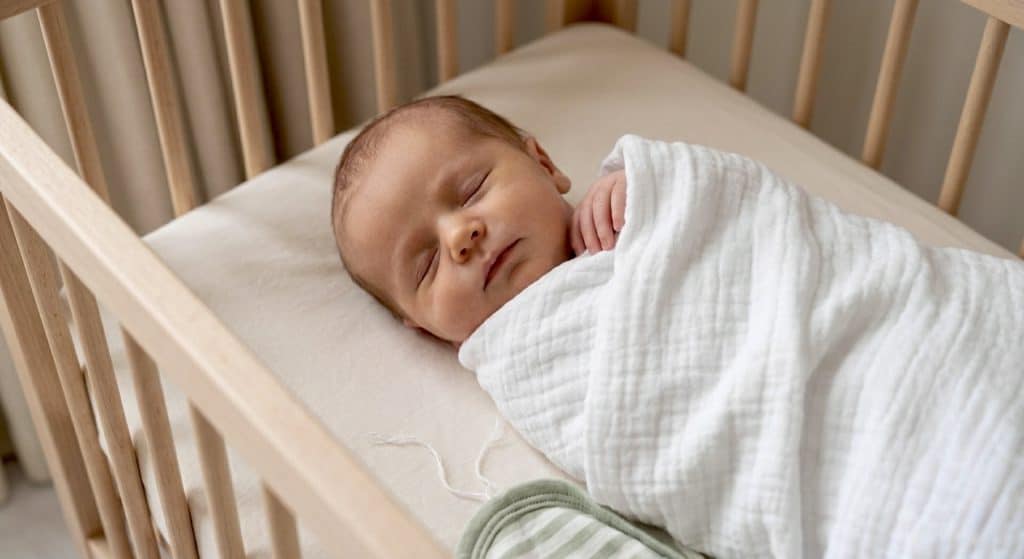
Swaddling is one of the oldest and most effective baby sleep techniques for the newborn period. It works by limiting the startle reflex, a normal neurological response in young infants where involuntary arm movements wake the baby from light sleep. A properly applied swaddle keeps the arms gently contained, reducing startle-induced wake-ups and significantly extending sleep duration in the first months. Because the startle reflex is such a normal part of infant sleep development in the first months, swaddling isn’t correcting a problem, it’s simply working with your baby’s neurology instead of against it until that reflex naturally fades.
When to Stop Swaddling and How to Transition Safely
The swaddle must be discontinued as soon as your baby shows any signs of attempting to roll, typically between two and four months of age. A swaddled baby who rolls to their stomach cannot reposition themselves safely, which creates a suffocation risk. The transition away from swaddling can be managed gradually by first freeing one arm for several nights, then both arms, before moving to a wearable sleep sack that provides similar warmth and containment without restricting movement.
5. Dream Feeding to Extend Your Longest Stretch
A dream feed is a feeding given to your baby while they are still asleep or in a very light sleep state, typically between 10 PM and midnight. The goal is to top up your baby’s caloric intake before your own longest sleep window, reducing the likelihood of a hunger-driven wake-up at 2 or 3 AM. Dream feeding isn’t one of the formal baby sleep training methods covered later in this guide, but it pairs well with them, since a baby who isn’t waking from hunger is far more likely to succeed with whichever training approach you eventually choose.
How to Introduce a Dream Feed Without Disrupting Sleep
The technique works best when introduced consistently starting around six to eight weeks of age. Gently lift your baby without fully waking them, offer the breast or bottle, allow them to feed in a semi-drowsy state for a full feed, burp gently, and return them to the crib. Most babies take a full feed without ever opening their eyes, and many parents report gaining an additional two to three hours of uninterrupted sleep as a result.
Dream feeds typically become less effective and can be dropped naturally between four and six months, as babies develop the capacity for longer overnight stretches without caloric supplementation.
6. Age-Appropriate Wake Windows
One of the most overlooked baby sleep techniques is timing. Every age has a developmentally appropriate wake window, the maximum amount of time a baby can comfortably remain awake before overtiredness begins to work against sleep rather than for it. A baby put to sleep within their optimal wake window falls asleep more easily, sleeps longer, and wakes less frequently than a baby who is either under-tired or overtired. Wake windows matter because they directly shape infant sleep development, a baby who is consistently put down within their window learns to associate the crib with easy, low-stress sleep, while a baby who is chronically overtired associates it with a harder transition.
Wake Window Guidelines by Age for Infant Sleep Development
General wake window guidelines for infant sleep development:
Newborns (0 to 6 weeks) tolerate approximately 45 to 60 minutes of wakefulness before needing to sleep again. Babies at 2 to 3 months manage approximately 60 to 90 minutes. At 4 to 5 months, wake windows extend to 90 to 120 minutes. By 6 to 8 months, most babies handle 2 to 3 hours comfortably between sleep periods. These are ranges rather than rigid rules, and individual babies vary. Learning to read your own baby’s tired cues, including eye rubbing, reduced engagement, and increased fussiness, is more reliable than clock-watching alone.
7. Gradual Sleep Training Methods That Respect Your Baby
Sleep training is one of the most debated topics in parenting, and the range of methods is wide. The evidence supports several baby sleep training methods as safe and effective when introduced at the appropriate developmental stage, typically no earlier than four to six months of adjusted age for full-term babies. Choosing among the baby sleep training methods below isn’t about finding the one ‘right’ answer, it’s about finding the version your family can apply consistently for at least two weeks, since consistency, not the specific method, is what actually predicts success.
The Most Evidence-Based Baby Sleep Training Methods
The graduated extinction method, commonly known as the Ferber method, involves responding to your baby at increasing intervals rather than immediately, giving the baby time to practice self-settling before parental intervention. Research consistently shows this approach is safe, effective, and does not cause long-term emotional or attachment harm when introduced after four months.
The chair method, sometimes called sleep fading, involves a parent sitting in the room and gradually moving their position further from the crib over a period of one to two weeks. This approach works well for parents who are uncomfortable with more extended crying but still want to reduce sleep associations.
The extinction method, commonly called cry-it-out, involves placing the baby in the crib awake and not returning until a set morning time. The evidence supports its effectiveness and safety for babies over six months, though it requires a high parental tolerance for crying and works best when parents are fully committed to consistency from night one.
Whatever baby sleep training methods you choose, consistency matters more than the specific technique. Partially implementing a method and abandoning it during the night teaches babies that sustained crying will eventually produce a response, which reinforces rather than reduces night waking.
8. The Sleep Environment Setup Worth the Investment
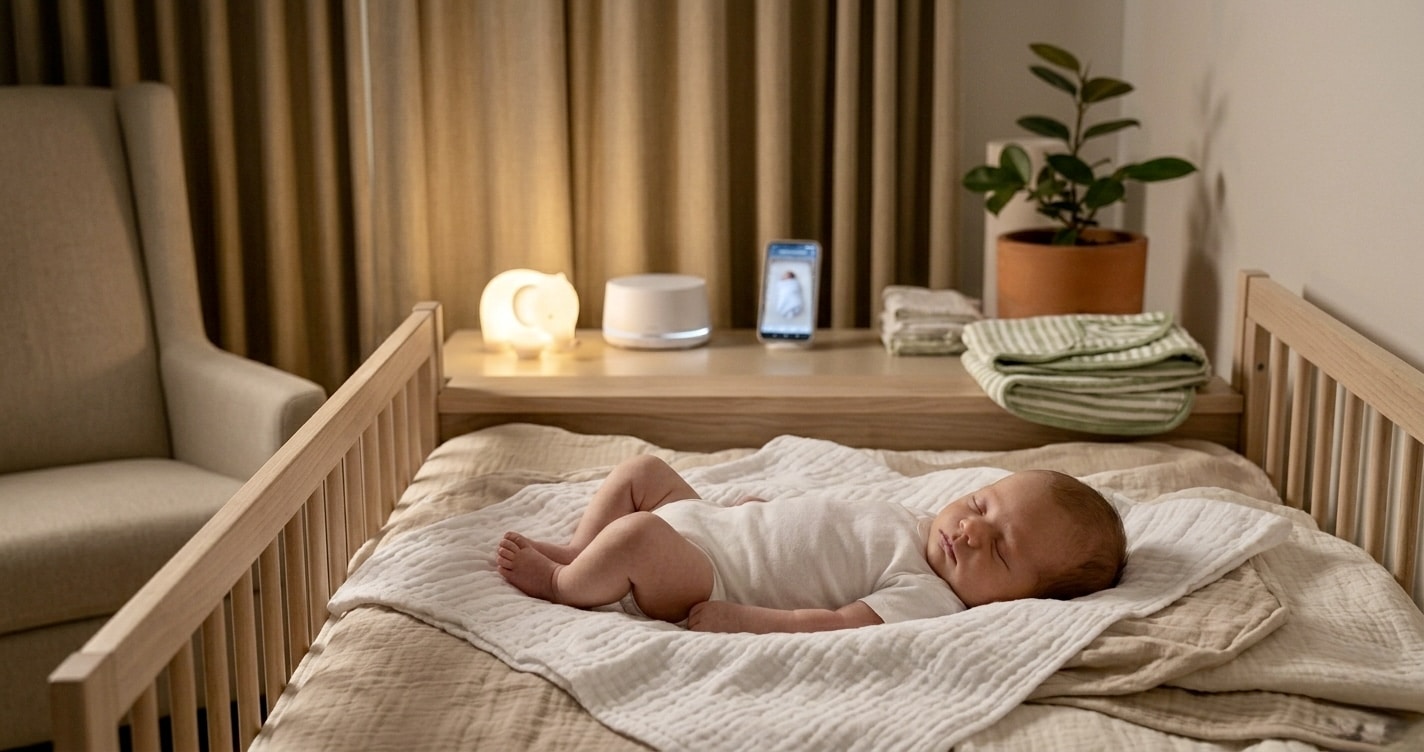
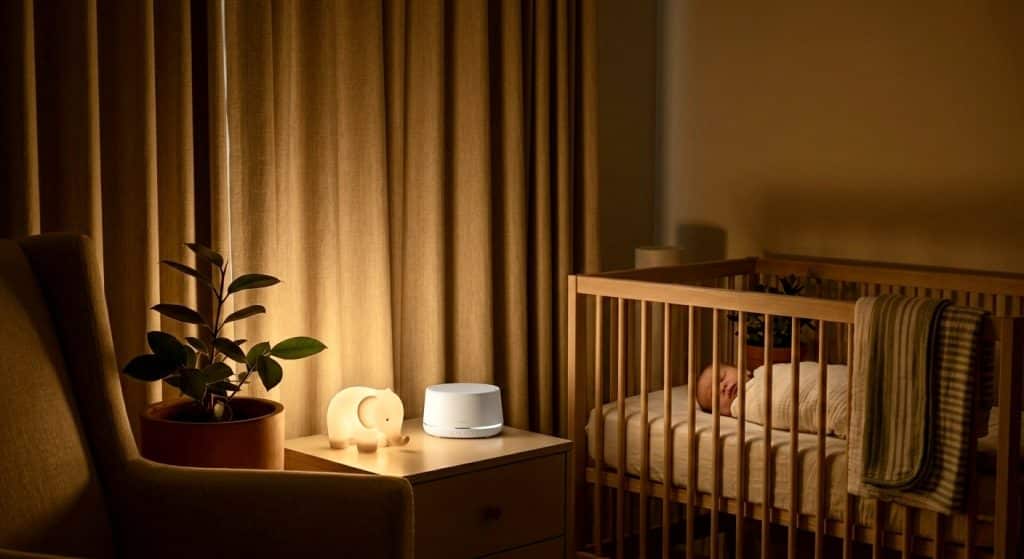
The physical environment of the nursery is one of the most controllable factors in infant sleep quality, and optimizing it costs less than most parents expect. The combination of temperature, light, and sound management addresses the three most common environmental causes of infant sleep disruption. An optimized sleep environment does more than help your baby fall asleep faster, it supports infant sleep development by reducing the number of partial arousals that would otherwise interrupt deep sleep cycles throughout the night.
It also plays a quieter role in secure attachment baby development: a nursery that feels calm and predictable becomes part of the same sense of safety your baby associates with being held and responded to during the day. Getting temperature, light, and sound right isn’t about buying every gadget on the market, it’s about removing the handful of environmental triggers most likely to pull your baby out of restorative sleep.
Room Conditions That Support Longer, Deeper Infant Sleep
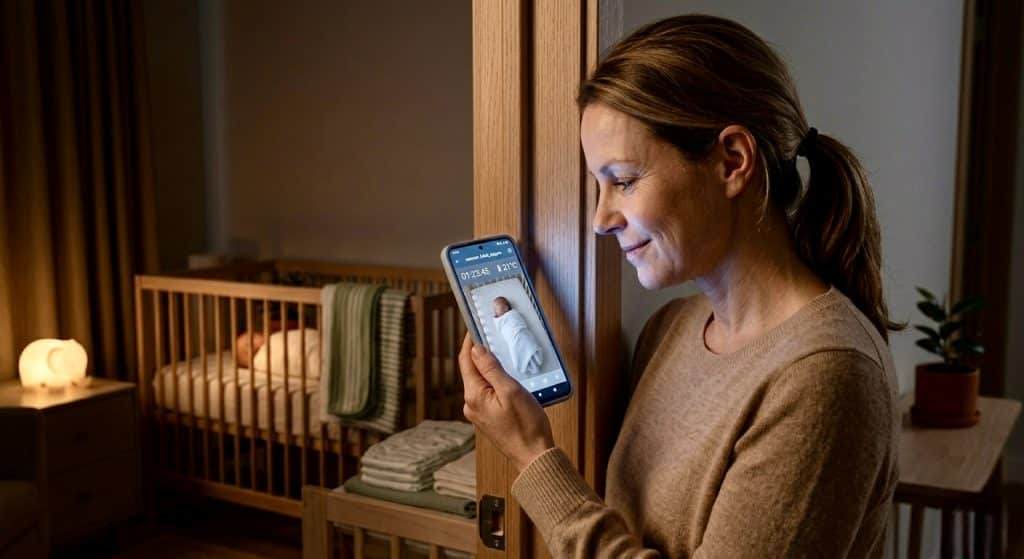
Room temperature between 68°F and 72°F (20°C to 22°C) is the range the American Academy of Pediatrics identifies as optimal for infant sleep safety. Temperatures above this range are associated with increased arousal frequency and, at extreme levels, elevated SIDS risk. A reliable room thermometer, particularly one connected to a monitoring app, removes the guesswork from this equation entirely.
Blackout curtains are one of the highest-return investments in baby sleep environment optimization. Melatonin production in infants is highly sensitive to light, and even the ambient light of early summer mornings or streetlights through standard curtains is sufficient to suppress melatonin and trigger early waking. Complete darkness during sleep periods supports both nap quality and overnight sleep duration.
For a complete guide to the monitors, thermometers, and humidifiers that work best with these baby sleep techniques, see our complete baby gear guide with expert product recommendations for every budget.
9. Navigating Sleep Regressions Without Losing Progress
Sleep regressions are temporary periods of disrupted sleep that coincide with major developmental leaps, typically occurring around 4, 8, 12, and 18 months. Understanding them as a normal, expected part of infant sleep development rather than a sign that something has gone wrong is the first step to getting through them without dismantling all of your established baby sleep techniques. Sleep regressions are also a moment where secure attachment baby development quietly does its job. A baby who has experienced consistent, responsive care during the easier stretches tends to recover from a regression faster, because the extra fussiness of a developmental leap isn’t compounded by uncertainty about whether comfort will come.
What Causes Sleep Regressions and How Long They Last
During a developmental leap, the brain is reorganizing at a rapid pace, which increases neural activity and makes the transition between sleep cycles more prone to full arousal. The four-month regression is often considered the most significant because it coincides with a permanent change in sleep architecture, where babies shift from the simpler two-stage sleep of the newborn period to the more complex multi-stage sleep of older children and adults.
Most regressions last between two and four weeks when managed consistently. The most effective strategy is to maintain your established bedtime routine without major changes, offer extra comfort during the day to address the developmental needs driving the regression, and avoid introducing new sleep associations that you will need to remove once the regression passes.
When to Consult a Pediatric Sleep Specialist
Knowing when your approach to infant sleep development is sufficient and when professional support is needed is itself an important part of confident parenting. Most families resolve their infant sleep challenges through consistent application of the approaches in this guide. However, certain patterns signal that home strategies alone may not be enough and warrant professional evaluation rather than continued home-based intervention.
Consult your pediatrician or a certified pediatric sleep specialist if your baby is waking more than five times per night consistently after six months of age despite consistent implementation of sleep techniques. Other indicators include snoring, labored breathing during sleep, or pauses in breathing, which can indicate sleep-disordered breathing requiring medical evaluation. Extreme difficulty falling asleep across all contexts, even with feeding, holding, and white noise, may also signal a medical issue such as reflux that is disrupting sleep from within.
Conclusion
The nine baby sleep techniques in this guide work best when applied as a connected system rather than isolated strategies. A consistent bedtime routine anchors the day. Age-appropriate wake windows prevent overtiredness. A well-optimized sleep environment removes physical barriers to rest.
Responsive, attachment-informed parenting is the foundation of secure attachment baby development, and it makes every other technique on this list more effective over time. Holding your baby is never the mistake you were warned it would be. The mistake is doubting your own instincts under pressure from outdated advice.
Start with one or two techniques this week. Build from there. Your baby’s sleep, and your own, will follow.
Looking for comprehensive guidance on caring for your baby? Our book ‘How to Care for Children: From Birth to Age 2’ combines professional childcare expertise with evidence-based child development research. Written by Kelly and Peter, this guide provides clear, reliable advice rooted in real-world childcare. Available in English, Spanish, and Portuguese on Amazon.
Click the link below your preferred language to get your copy!



1. Can baby sleep techniques really make a difference?
Yes, and the evidence is substantial. Consistent implementation of age-appropriate baby sleep techniques has been shown in multiple peer-reviewed studies to reduce night waking frequency, extend sleep duration, and improve sleep quality in infants. The key word is consistent, a technique applied occasionally won’t produce reliable results, and most parents who stay consistent see meaningful improvement within one to two weeks.
2. Is holding my baby too much really a myth?
No. The research of Dr. Alan Sroufe and colleagues at the University of Minnesota, drawn from a 45-year longitudinal study, shows that consistent responsive caregiving in infancy, including holding and prompt response to crying, produces securely attached children who develop greater independence over time, not less. Responsive holding can create short-term sleep associations that need gradual adjustment as babies grow, but that transition is a normal developmental process, not a consequence of spoiling.
3. When is the right age to start baby sleep training methods?
Most pediatric sleep specialists recommend waiting until at least four months of adjusted age before introducing formal baby sleep training methods. Before this age, babies lack the neurological development required for self-settling, and attempting it earlier is unlikely to be effective and may be unnecessarily stressful for both baby and parents. For premature babies, the four-month guideline applies to adjusted age, so a baby born eight weeks early should wait until six months chronological age at the earliest. Always discuss timing with your pediatrician if your baby has medical conditions affecting feeding, breathing, or neurological development.
4. Which baby sleep training method is right for my family?
The right baby sleep training method is the one you can implement consistently for at least two full weeks without abandoning it mid-night. Parental follow-through matters more than the specific method chosen, so pick one whose level of crying you and your co-parent can both tolerate and commit to as a team. The graduated extinction method is the most widely researched starting point; the chair method suits parents who need to stay in the room. If multiple methods haven’t worked, a certified pediatric sleep consultant can help.
5. What is the best newborn sleep routine for babies under 3 months?
The most effective newborn sleep routine for babies under three months is short, consistent, and calm: a warm bath two to three times a week, a feeding in a dimly lit room, brief rocking or holding, white noise, and placement in the crib, all within 20 to 30 minutes. The goal at this stage isn’t independent sleep but consistent cues the brain begins to associate with rest, full independent sleep isn’t realistic until closer to four months.
6. How do secure attachment and baby sleep techniques work together?
Secure attachment and baby sleep techniques are complementary, not competing. A baby who experiences consistent responsive care enters sleep with lower cortisol and a higher baseline sense of safety, which directly supports falling and staying asleep. Research on secure attachment baby development shows children who form secure attachments have better emotional self-regulation, including managing the mild stress of falling asleep independently. Responsive parenting early on doesn’t undermine sleep training later, it builds the foundation that makes it work.
7. Do these techniques differ for breastfed vs. formula-fed babies?
Baby sleep techniques apply broadly regardless of feeding method, though breastfed babies typically have shorter sleep stretches early on since breast milk digests faster, which is normal and not a sign of low supply. The dream feed, white noise, swaddling, and wake window management all work equally well for breastfed and formula-fed babies. The main difference is timeline: breastfed babies may consolidate overnight sleep one to two months later, still within the normal range.
8. What if my baby’s sleep suddenly gets worse?
A sudden regression after good sleep almost always points to a developmental leap, an illness, a change in environment, or a new motor skill like rolling. None of these require abandoning your established routine, keep your bedtime routine exactly as is, offer extra daytime comfort, and avoid introducing new sleep associations. Most regressions resolve within two to four weeks; if it persists longer or comes with fever, ear pulling, or feeding changes, consult your pediatrician.
9. Are there baby sleep techniques that work without any crying?
Yes, though they typically take more time. The chair method involves a gradual physical retreat from your baby’s sleep space over one to two weeks, letting your baby learn self-settling with decreasing parental presence. Bedtime fading, moving bedtime later until sleep comes quickly then shifting it earlier, is another low-crying approach. Most transitions still involve some protest crying even with gentle methods, the goal is minimizing sustained distress, not eliminating crying entirely. Expect progress over weeks, not nights.
10. How many hours should my baby be sleeping at each age?
Sleep needs vary by age: newborns typically sleep 14 to 17 hours in short cycles, three-month-olds 14 to 16 hours with longer overnight stretches, six-month-olds 12 to 15 hours with two to three naps, and 12-month-olds 11 to 14 hours, transitioning to one nap. These are American Academy of Sleep Medicine ranges, not prescriptions, a baby at the lower end who wakes happy and feeds well is getting enough. Watch instead for significant fussiness, poor feeding, or trouble staying awake during wake windows.
