

Medical note: This article is for education only and does not replace medical advice from your pediatrician. Read our Medical Disclaimer.
Baby milestones are exciting markers of growth in your child’s first year, from first smiles to first steps, showing how quickly their development unfolds.
Your baby’s first year is full of incredible changes that will amaze and delight you every day. From the first smile to the first steps, each baby milestone marks an important stage in development that reflects the remarkable growth happening in your little one’s brain and body. While every baby is unique and may reach these milestones at their own pace, understanding common baby development stages helps parents track baby growth and support their child’s progress with confidence and appropriate expectations. Tracking your baby’s growth this first year gives you a roadmap for understanding their development and shows when extra support might help.
Supporting baby development starts with these small, everyday moments, long before any big milestone arrives.
Disclosure: This post contains affiliate links. If you make a purchase through these links, we may earn a small commission at no additional cost to you. This helps us keep providing free, quality content for parents everywhere.
Written by Kelly, Childcare Specialist, and Peter, Researcher and Child Development Advocate.
Table of Contents
Baby Milestones First Year: The 12 Key Stages at a Glance
Before diving into month by month detail, here is a quick, numbered look at the 12 key stages most babies move through during their first year. Every child’s timing is unique, so treat these as a friendly guide, not a countdown.
1. First social smile, around 2 to 3 months
2. Following faces and objects with the eyes, 2 to 4 months
3. Cooing and early vocal sounds, 3 to 4 months
4. Pushing up during tummy time, 3 to 4 months
5. Rolling from tummy to back, 4 to 6 months
6. Sitting with support, then without, 5 to 8 months
7. Reaching for and grasping toys, 5 to 7 months
8. Responding to their own name, 7 to 9 months
9. Crawling or finding another way to move, 7 to 10 months
10. Pincer grasp, picking up small objects, 8 to 10 months
11. Pulling up to stand and cruising along furniture, 9 to 12 months
12. First words and first independent steps, 10 to 14 months
Each of these stages reflects healthy baby growth, even when they arrive a little earlier or later than the range above.
Baby Milestones First Year: Month by Month Overview
Pediatric developmental milestones are evidence-based indicators used by health practitioners and parents to follow a child’s development over several domains: physical development, cognitive development, social development, and emotional development. The American Academy of Pediatrics highlights that developmental milestones are guidelines and not timelines because typical development happens within ranges and not on precise dates.
Science reveals that in the earliest years of life, babies’ brains form more than a million new neural connections every second. This fastpaced building of the brain powers the development of new behaviors and skills that we observe as milestones. This perspective allows parents to better understand and appreciate not only what their baby is doing, but also how much complexity is occurring at a deeper level.
Understanding your baby’s development during this first year means recognizing that physical, cognitive, social, and emotional growth all happen together, not one after another.
Sourced: Center on the Developing Child, Harvard University
Baby Development in Months 1–2: Early Awareness
During the first two months, your baby is adjusting to life outside the womb while beginning to engage with the world around them. This period focuses on establishing basic physiological regulation and early social connections.
These first eight weeks are less about big physical leaps and more about your baby learning that the world is safe and responsive. Every time you meet your newborn’s gaze or respond to a cry, you are building the wiring behind future social and emotional growth. Growth at this stage is quiet but essential, most of the work is happening inside a rapidly developing brain, even when it is not yet visible in movement.

Key Developmental Achievements:
- Visual development: Begins to recognize faces and voices, particularly those of primary caregivers
- Social engagement: Starts making intentional eye contact, especially during feeding and quiet alert periods
- Motor skills: Lifts head slightly during tummy time, showing early neck muscle development
- Sensory processing: Responds to sounds with movement, startling, or changes in crying patterns
- Sleep patterns: Begins to establish longer sleep periods, though still irregular
Your Role as Parent: Offer lots of face-to-face interaction, speaking softly and maintaining eye contact to build connection and trust. This early bonding period establishes the foundation for all future emotional and social development. Respond consistently to your baby’s cues for feeding, sleeping, and comfort to help them develop a sense of security and predictability.
Take a look at this post: ➡️ Baby Gear Guide 2025
Month 3–4: Emerging Social and Physical Development
The second quarter of your baby’s first year brings exciting developments in social interaction and physical capabilities. This is often when parents first see their baby’s personality beginning to emerge, with noticeable changes in baby development and in how their infant interacts and communicates.
This stage often feels like the moment your baby truly starts to interact rather than simply exist alongside you. The social smile that appears here is different from the reflexive smiles of the newborn stage, it is a real response to connection, and it is one of the clearest early signs of healthy social development. Physically, the stronger neck and shoulder muscles built during tummy time now support the head control your baby will need for sitting later on.
Key Developmental Achievements:
- Social milestones: Starts to smile socially in response to interaction, not just reflexively
- Visual tracking: Follows objects with eyes in smooth movements, showing improved coordination
- Physical strength: Pushes up on arms during tummy time, demonstrating core and arm muscle development
- Communication: Begins to coo and make gurgling sounds, the first steps toward intentional communication
- Hand-eye coordination: Shows increased interest in hands and begins bringing them to mouth
Your Role as Parent: Use toys with high contrast colors and patterns to encourage visual development. Talk, sing, and respond to your baby’s vocalizations to promote language development. Provide regular tummy time to strengthen neck, shoulder, and core muscles essential for future motor milestones.
Month 5–6: Rolling and Reaching Milestones
The middle of the first year brings dramatic improvements in motor skills and increased interaction with the environment. Babies become much more active participants in their world. Reaching the halfway point of the first year means your baby is developing greater physical independence and more purposeful movement.
Growth speeds up noticeably in this stretch. A baby who was mostly still a month ago may suddenly be rolling across the room or grabbing everything within reach. This is also a common time to introduce solid foods, which supports both nutritional growth and the fine motor practice of bringing food, and eventually a spoon, to the mouth. None of this happens on a fixed date, some babies roll at 4 months and others at 6, and both are entirely normal.
Baby Developmental Achievements:
- Gross motor skills: Rolls from tummy to back and eventually back to tummy, showing trunk control
- Fine motor development: Reaches for and successfully grabs toys, demonstrating hand-eye coordination
- Postural control: Begins sitting with support, showing improved core strength and balance
- Sensory exploration: Shows increased interest in different textures, temperatures, and materials
- Social awareness: Recognizes familiar people and may show stranger anxiety
- Sleep development: May begin sleeping for longer stretches at night
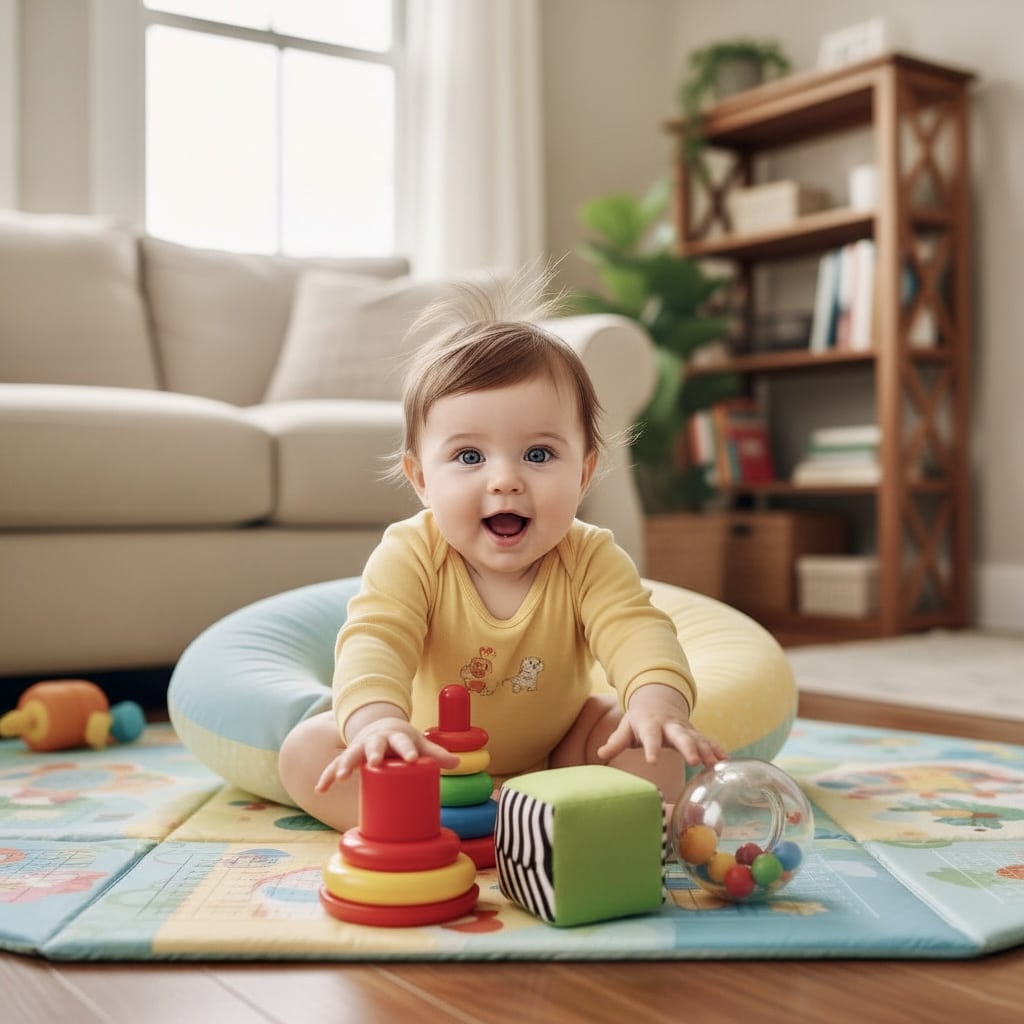
Your Role as Parent: Provide safe floor space for movement and exploration. Offer a variety of safe toys with different textures, weights, and sounds to encourage sensory development. Begin introducing solid foods if recommended by your pediatrician, allowing baby to explore new tastes and textures.
Read too: ➡️ 10 Creating Meaningful Family Traditions New Baby Ideas
Baby Growth Stages 7–9: Independence and Exploration
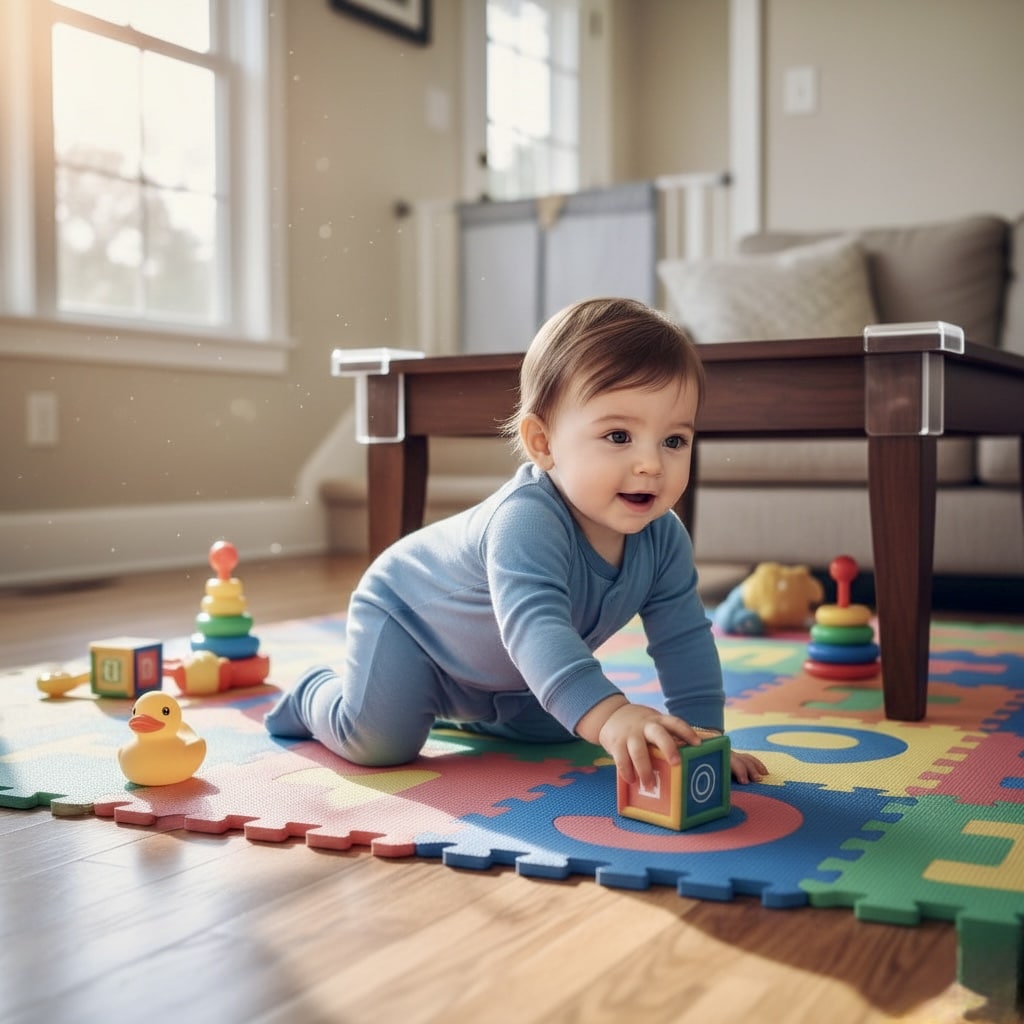
The third quarter brings exciting developments in independence and mobility. Babies become increasingly curious about their environment and develop new ways to explore it, marking a notable stage of baby growth.
This period marks one of the most dramatic transformations in your baby’s growth, as infants shift from stationary observers to active explorers.
This is often the stage parents describe as the turning point, the moment a baby stops being a passenger and starts steering. Crawling, scooting, or any other creative way of getting around all count as valid progress toward mobility. Object permanence, understanding that a toy still exists even after it rolls under the couch, is a cognitive leap that also explains why peek a boo suddenly becomes so much fun.
Key Developmental Achievements:
- Sitting milestone: Sits without support for extended periods, freeing hands for play
- Mobility begins: Begins to crawl, scoot, or find other creative ways to move around
- Language recognition: Responds consistently to their name and familiar words
- Social play: Enjoys interactive games like peek-a-boo and shows delight in mirror play
- Object permanence: Begins to understand that objects exist even when out of sight
- Fine motor refinement: Develops pincer grasp, allowing for more precise manipulation
Your Role as Parent: Encourage movement in a safe, baby-proofed environment. Use games that promote social and emotional skills while supporting cognitive development. Respond enthusiastically to your baby’s attempts at communication to encourage continued language development.
Month 10–12: First Words and Independent Movement
The final quarter of the first year often brings the milestones parents eagerly anticipate: first words and first steps. This period represents the culmination of a year’s worth of skill building.
The milestones in this final stretch tend to be the ones parents wait for the most, first words and first steps. But just as important, and easier to miss, is how much your baby now understands. Following a simple instruction or waving bye bye shows real language comprehension building well ahead of spoken words, a pattern that is completely normal and worth celebrating on its own.
Key Developmental Achievements:
- Gross motor mastery: Pulls to stand using furniture, may take first independent steps
- Language emergence: Says first recognizable words like mama, dada, or simple family terms
- Comprehension: Understands simple instructions like no, come here, or wave bye-bye
- Imitation skills: Copies sounds, actions, and gestures with increasing accuracy
- Social sophistication: Shows preferences for certain people, toys, and activities
- Problem-solving: Demonstrates early problem-solving skills in play and exploration
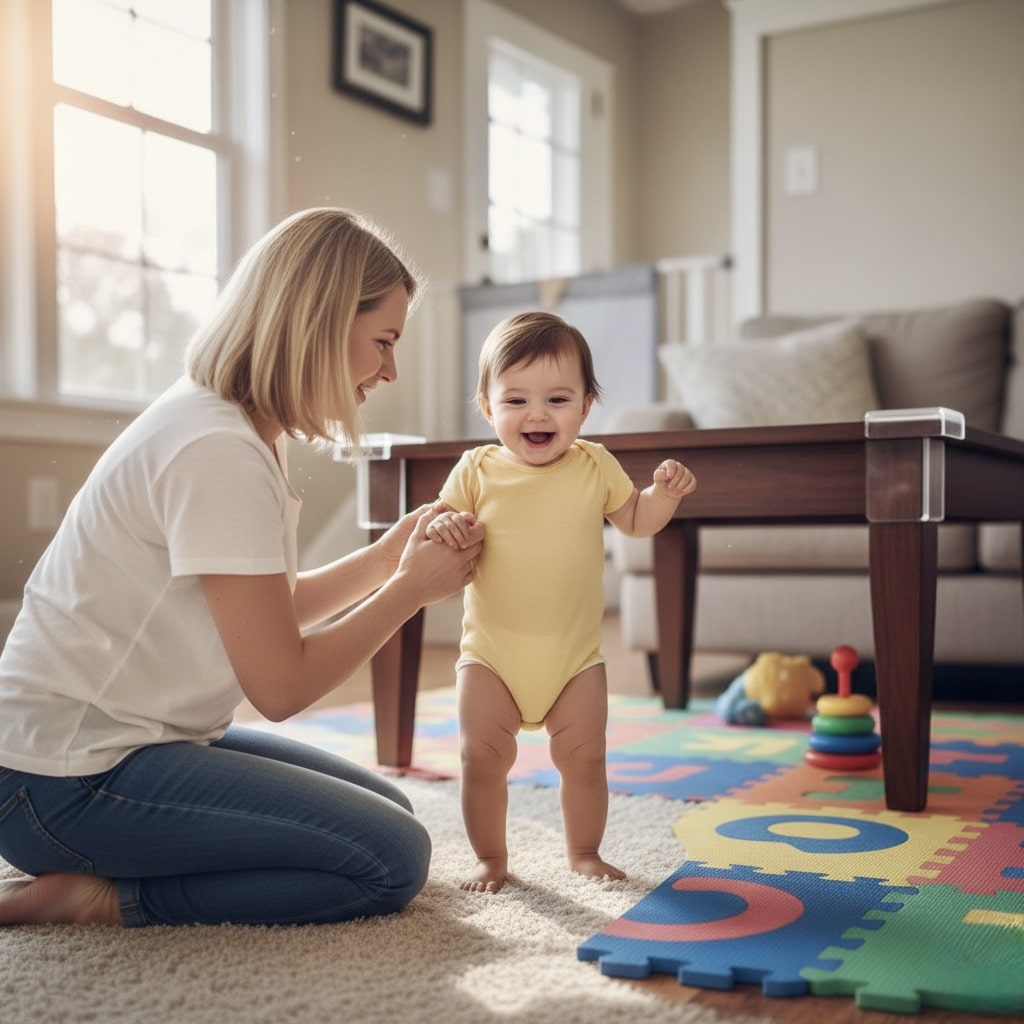
The final months of the first year showcase the remarkable, cumulative progress your baby has made through consistent development across every area.
Tip from another post: ➡️Toddler Safety: Essential Tips to Keep Your Child Safe and Secure
Your Role as Parent: Celebrate progress with enthusiastic praise while maintaining realistic expectations. Respond to your baby’s communication attempts to build language skills and confidence. Provide opportunities for safe cruising and walking practice while baby-proofing your home thoroughly.
Documenting Your Baby’s Milestone Journey
Capturing and recording your baby’s milestones creates both practical benefits and treasured memories that you’ll appreciate for years to come. Creating a comprehensive record of your baby’s growth and development helps you track patterns, share accurate information with healthcare providers, and preserve precious memories of your infant’s rapid progress.
Creating a Milestone Record: Maintain a simple journal or digital log noting when significant developments occur. Include not just the what and when, but also the how and context surrounding each achievement. For example, rather than simply noting first steps on May 15, record took three independent steps from couch to daddy while laughing with excitement. These details bring the memory to life and provide rich context you might otherwise forget.
Photography and Video Documentation: Take regular photos and short videos showing your baby’s development. Monthly milestone photos taken in the same location provide a powerful visual timeline of growth. Videos are particularly valuable for capturing movement milestones like crawling, cruising, and first steps, as well as early language attempts and social interactions. These recordings become precious family history and can also be useful if developmental concerns arise and you need to show healthcare providers examples of your baby’s abilities.
Baby Books and Apps: Whether you prefer traditional baby books or modern milestone tracking apps, having a dedicated system makes documentation consistent and comprehensive. Many apps offer reminders for upcoming typical milestones, developmental activity suggestions, and easy photo integration. Choose whatever method you’ll actually use consistently, perfect documentation in an unused baby book helps no one.
Sharing with Healthcare Providers: Bring your milestone records to well-child visits. This information helps pediatricians assess development comprehensively and can highlight patterns you might not notice day to day. If you have specific concerns, having concrete examples with dates provides much more useful information than vague recollections.
Navigating Social Comparison and Parental Pressure
The pressure to compare baby milestones with other children can undermine the joy of your baby’s unique developmental journey. Remembering that these milestones represent guidelines, not competitive achievements, helps you enjoy your baby’s progress without unnecessary stress.
The Comparison Trap: Social media and parenting groups often showcase early achievers, creating unrealistic expectations and unnecessary anxiety. Remember that parents typically share exceptional achievements, not typical development, creating a skewed perception of normal. A baby walking at 9 months gets celebrated widely, while the equally normal 14-month walker goes unmentioned, creating false impressions about typical timelines.
Understanding Statistical Ranges: When resources say most babies walk by 12 months, many parents mistakenly believe this means their baby should walk at exactly 12 months. In reality, developmental ranges are wide, walking typically occurs anywhere from 9 to 18 months. By 12 months means the statistical midpoint, not a deadline. Your baby walking at 11 months isn’t advanced nor is walking at 15 months delayed, both fall within the broad spectrum of normal development.
Focusing on Your Child’s Progress: Instead of comparing your baby to others, track their individual developmental trajectory. Is your baby making steady progress in their own timeline? Are they building new skills and capabilities? Are they happy, healthy, and engaged? These questions matter far more than whether your neighbor’s baby crawled two months earlier.
Responding to Unwanted Advice: Well-meaning relatives and friends often offer unsolicited milestone-related advice: He should be walking by now, or She’s not talking yet? Prepare simple responses like Our pediatrician is pleased with her development, or Every baby develops at their own pace. You don’t owe anyone detailed explanations about your baby’s development.
Protecting Your Parental Confidence: Trust your instincts and your pediatrician’s guidance over casual opinions. Your baby’s development is a unique journey influenced by genetics, temperament, and environment. Avoid milestone-driven parenting that prioritizes achievement over relationship and joy. The goal isn’t to create the earliest walker or talker, but to support your baby’s development while building a secure, loving relationship that provides the foundation for all future learning and growth.
Red Flags in Baby Milestones and When to Seek Help
Monitoring your baby’s development includes recognizing both typical variation and the signs that may call for a professional evaluation.
These signs are meant to help you know when to loop in your pediatrician, not to cause alarm. Most babies who show one or two of these signs turn out to be perfectly healthy and simply on their own timeline. Trust your instincts, you know your baby better than any list, and a quick conversation with your pediatrician costs nothing but can bring real peace of mind.
While development varies widely among babies, certain delays may warrant professional evaluation:
Potential Concerns by 6 Months:
- No social smiles or eye contact
- Doesn’t respond to sounds or name
- Cannot hold head steady
- Shows extreme muscle stiffness or floppiness
Potential Concerns by 12 Months:
- No crawling or attempts at mobility
- No words or word attempts
- Doesn’t respond to simple instructions
- Loss of previously acquired skills
Always consult your pediatrician if you have concerns about your baby’s development. Early intervention services can provide tremendous support when needed. Most of the time, this is simply baby development taking its own path.
Baby Not Sitting Up at 8 Months? Should You Worry?
If you typed baby not sitting up at 8 months into a search bar late at night, you are far from alone.
If your baby is close to 8 months and still is not sitting without support, take a breath first. Sitting typically develops somewhere between 5 and 8 months, and many healthy babies do not sit steadily on their own until closer to 9 months. A baby who can sit with a little support, like a hand nearby or a cushion behind them, and is actively working on core strength through tummy time and reaching, is usually right on track.
What matters more than the exact month is the direction of progress. Is your baby getting stronger week by week? Are they pushing up on their arms, rolling both ways, and bearing some weight through their legs when held? These are all signs that sitting is coming.
Talk with your pediatrician if, by 9 months, your baby cannot sit even with support, shows very low muscle tone or noticeable stiffness, or has lost a skill they had before. Premature babies are usually assessed using their adjusted age, not their birth date, so ask your doctor which timeline applies. Most babies who are a little behind on sitting catch up completely with time, encouragement, and daily tummy time practice, with no lasting effect on their development.
Supporting baby growth at this stage is mostly about patience and consistent tummy time, not intervention.
Supporting Baby Development with Daily Habits
Supporting your baby’s development does not require special equipment or a rigid schedule. It comes down to a handful of simple habits, repeated daily, that nurture growth across every area at once.
Creating an Enriching Environment:
- Provide age-appropriate toys that encourage exploration
- Read daily to promote language development
- Ensure adequate tummy time for motor development
- Maintain consistent routines for security and predictability
Nurturing Emotional Development:
- Respond consistently to your baby’s cues
- Provide comfort during distress
- Celebrate achievements with enthusiasm
- Create opportunities for social interaction
Promoting Physical Development:
- Encourage movement and exploration in safe spaces
- Provide varied sensory experiences
- Support but don’t rush milestone achievement
- Ensure proper nutrition for healthy growth
None of these habits need to be perfect every single day. What matters most for your baby’s growth is consistency over time and the warmth behind the routine, not flawless execution. This is what supporting baby development looks like in real life, small, repeatable, and forgiving of imperfect days.
The Importance of Individual Variation
Remember that developmental milestones represent ranges, not deadlines. Some babies walk at 9 months, others at 15 months, and both are completely normal. Factors influencing development include:
- Genetics: Family patterns often influence timing
- Temperament: Some babies are naturally more cautious or adventurous
- Environment: Rich, supportive environments promote development
- Health factors: Premature babies may reach milestones on adjusted timelines
Two babies can be raised in nearly identical homes and still reach the same milestone months apart, and both can be perfectly healthy. Supporting your baby’s growth means working with their individual wiring, not against it, and trusting that consistent love and attention matter far more than the calendar. Baby growth is rarely a straight line, and that is exactly how it should be.
Conclusion
Baby milestones are not a race, they’re a beautiful journey of growth that unfolds uniquely for each child. Every smile, every reach, every tentative step represents your baby’s remarkable development and your role as their first and most important teacher.
Celebrate each achievement, support challenges with patience and encouragement, and remember that love, attention, and responsive caregiving are your baby’s most powerful tools for success. The bond you build through supporting their development will last a lifetime and provides the foundation for all future learning and growth.
Trust in your baby’s natural development process while staying attuned to their individual needs and progress. This first year is just the beginning of an incredible journey of discovery for both you and your child.
Take a look at these articles too: ⬇️
- American Academy of Pediatrics (AAP) – pediatric guidelines and recommendations.
- World Health Organization (WHO) – global health and development standards.
- National Institutes of Health (NIH) – medical research and health information.
Looking for comprehensive guidance on caring for your baby? Our book ‘How to Care for Children: From Birth to Age 2’ combines professional childcare expertise with evidence-based child development research. Written by Kelly and Peter, this guide provides clear, reliable advice rooted in real-world childcare. Available in English, Spanish, and Portuguese on Amazon.
Click the link below your preferred language to get your copy!



1. What are the most important baby milestones in the first year?
The most important baby milestones include the first social smile, around 2 to 3 months, rolling over between 4 and 6 months, sitting without support from 6 to 8 months, crawling between 7 and 10 months, standing up from 9 to 12 months, and first words between 10 and 14 months. Each baby reaches these milestones at their own pace, and variations of a few months are completely normal. What matters most is observing continuous baby development across all areas: physical, cognitive, social, and emotional growth.
2. When should I be concerned about delayed baby milestones?
Consult your pediatrician if, by 6 months, your baby doesn’t make eye contact, show social smiles, or hold their head steady. By 12 months, be concerned if there are no crawling attempts or mobility efforts, no words or attempts to speak, inability to follow simple instructions, or loss of previously acquired skills. Remember that premature babies often follow adjusted timelines for these baby milestones. Early intervention is highly effective when needed, so it’s always better to discuss concerns with a healthcare professional rather than waiting.
3. How can I support my baby’s development during the first year?
Supporting baby growth happens through responsive and consistent interaction. Provide plenty of tummy time to strengthen muscles, read daily to promote language development, offer age-appropriate toys that encourage sensory exploration, and maintain predictable routines for security. Most importantly, respond to your baby’s needs with love and attention, create a safe environment for exploration, and celebrate each milestone enthusiastically. The strong emotional bond you build is fundamental to every aspect of baby development and helps your baby reach new milestones with confidence.
4. Are baby milestones the same for all children?
No, baby development milestones represent broad ranges, not rigid deadlines. Some babies walk at 9 months, others at 15 months, and both are completely normal. Factors like genetics, temperament, environment, and health history influence the timing of baby growth. More cautious babies may take longer to walk, while babies focused on motor skills might talk slightly later. What matters is consistent progress and eventual skill acquisition, not the exact speed of development.
5. What should I do if my baby reaches milestones early or late?
If your baby reaches a baby milestone early, celebrate but don’t pressure them to accelerate further. Early development in one area doesn’t guarantee future advantages. If milestones are delayed but there’s steady baby growth, there’s usually no concern. Maintain regular pediatric checkups where baby development will be assessed comprehensively, and share your observations openly with your pediatrician. If there’s significant delay or regression, your pediatrician may recommend a specialized evaluation. Supporting baby progress through early intervention, when necessary, offers excellent outcomes.
Understanding your baby’s milestones empowers you to support their development with confidence, while recognizing that every child’s journey unfolds at their own perfect pace.