

Healthy boundaries in relationships are the foundation of emotional wellbeing and meaningful connections. This comprehensive guide reveals nine transformative boundary setting techniques that protect your mental health, preserve your identity, and create stronger relationships. Whether you’re navigating romantic partnerships, friendships, or family dynamics, these relationship boundaries examples will empower you to build healthier interactions while honoring your needs and values.
According to Mayo Clinic, developing and maintaining healthy boundaries helps you build stronger relationships and avoid the anxiety that comes from taking on responsibility for other people’s emotions, thoughts, and behavior. This is why developing robust emotional boundaries strategies isn’t optional; it’s essential for psychological health and relational success.
The tragic reality is that most people never learn proper boundary setting techniques, leading to relationships characterized by manipulation, guilt, and chronic conflict. This guide will equip you with the tools to create connections that honor both your needs and those of others.
Disclosure: This post contains affiliate links. If you make a purchase through these links, we may earn a small commission at no additional cost to you. This helps us keep providing free, quality content for parents everywhere.
Written by Kelly, Childcare Specialist, and Peter, Researcher and Child Development Advocate.
Table of Contents
The Psychology Behind Every Healthy Boundary
Healthy boundaries in relationships are not something you establish once and forget. They are an ongoing practice that evolves as you and the people around you grow and change.
Boundaries aren’t walls designed to keep people out; they’re bridges that define how healthy relationships function. Dr. Henry Cloud, renowned psychologist and boundary expert, explains that boundaries are property lines that clarify where you end and another person begins.
According to research from the American Psychological Association, individuals who establish clear boundaries report significantly higher levels of psychological wellbeing and relationship satisfaction.
Many individuals struggle with boundary setting because they confuse boundaries with selfishness or cruelty. However, relationship boundaries guide principles actually create safer emotional spaces where authentic intimacy can flourish. When people know what to expect from you, they can trust you more deeply and relate to you more honestly.
The absence of clear emotional boundaries strategies often stems from childhood experiences where boundaries were either non-existent or violated. This creates adults who either become people-pleasers (weak boundaries) or controllers (rigid boundaries), neither of which supports healthy relational dynamics.
9 Relationship Boundaries Examples That Actually Work
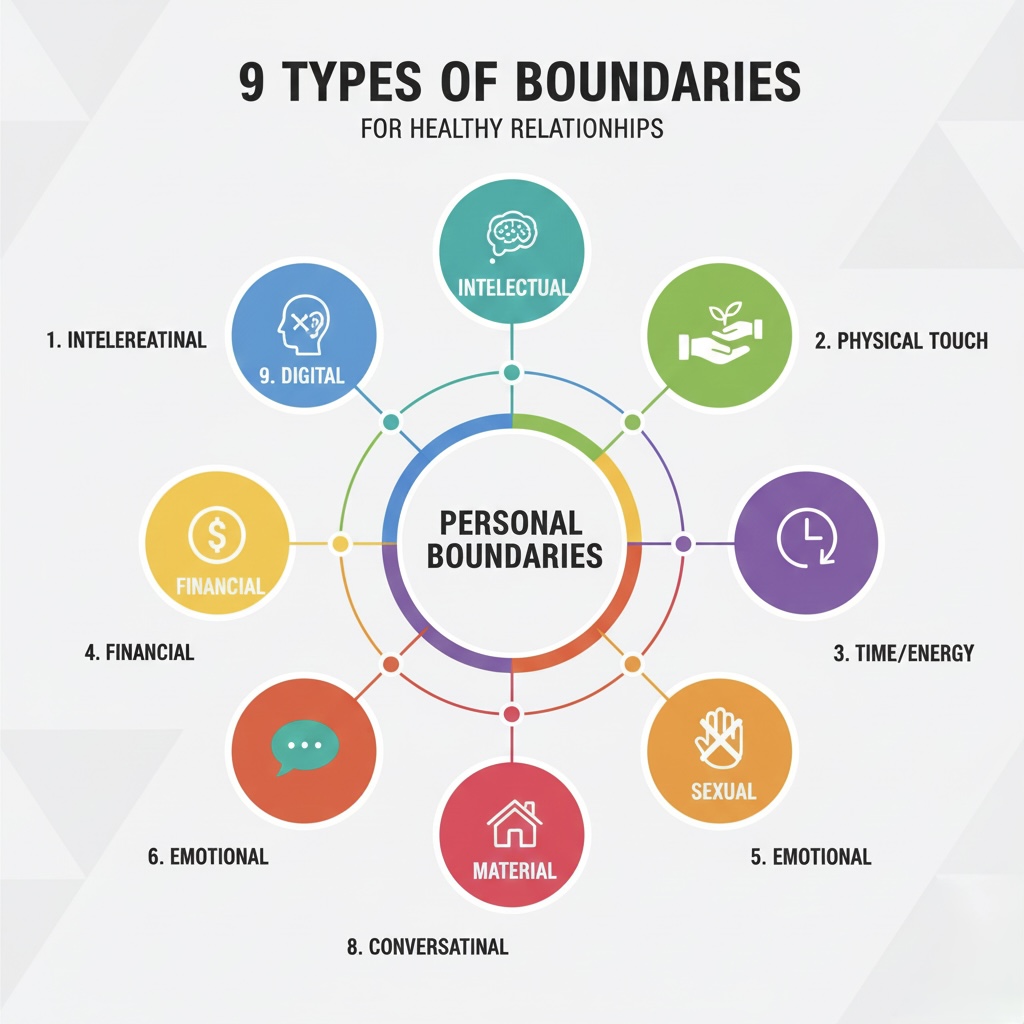
Some of the most effective relationship boundaries examples include limiting phone calls to specific hours, asking for 24 hours before discussing heated topics, and defining which personal decisions do not require a partner’s approval.
1. Emotional Boundaries: Protecting Your Inner World
Emotional boundaries involve recognizing that you are not responsible for managing other people’s feelings, nor are they responsible for managing yours. This fundamental principle forms the foundation of all setting boundaries effectively practices.
Implementation Strategies:
- Stop apologizing for other people’s emotional reactions to your decisions
- Their problem is not automatically your problem to solve
- Practice saying I understand you’re upset, and I’m not willing to change my position
- Guilt-driven conversations rarely lead anywhere productive, so it’s fine to step out of them
Mayo Clinic notes that anxiety and stress often develop specifically when you take on responsibility for other people’s emotions, behaviors, and thoughts, which is exactly what strong emotional boundaries are designed to prevent.
Developing emotional boundaries requires consistent mental clarity and self-awareness. Practical tools like breathing techniques can help you maintain that clarity daily. Discover simple and effective breathing exercises for parents dealing with anxiety that support boundary maintenance through proven stress relief practices.
2. Time Boundaries: Protecting Your Most Limited Resource
Time represents your most precious resource, and protecting it requires deliberate boundary setting techniques. People who struggle with time boundaries often find themselves overwhelmed, resentful, and unable to pursue their own goals and interests.

Effective Time Boundary Practices:
- Learn to say no without extensive explanations or justifications
- Your own priorities deserve a place on the calendar before anyone else’s requests do
- Communicate your availability clearly and stick to those limits
- A little buffer time between commitments goes a long way toward not feeling rushed all day
Just as organizing your physical space creates mental clarity, organizing your time creates emotional freedom. Our guide on meal prep planning for busy parents offers practical strategies that free up time and reduce daily stress, creating more space for the relationships that matter most.
3. Physical Boundaries: Respecting Personal Space
Physical boundaries encompass both intimate physical contact and personal space preferences. Healthy boundaries in relationships require mutual respect for physical comfort levels and consent in all situations.
Physical Boundary Guidelines:
- Communicate your preferences clearly before situations arise
- Someone else’s physical boundary is not a rejection of you
- Practice asking for consent before physical contact, even with family
- If something feels physically uncomfortable, that feeling is worth trusting
Physical boundaries can shift over time, even within the same relationship. A hug that felt comfortable last year might feel like too much during a stressful week, and that’s not a contradiction, it’s a normal part of being human. Checking in periodically, rather than assuming consent is permanent, keeps physical boundaries with family without guilt and with anyone else you’re close to.
4. Digital Boundaries: Reclaiming Your Attention
In our hyperconnected world, digital boundaries have become crucial for maintaining relationship boundaries guide standards. Without clear digital limits, relationships can become invasive and overwhelming through constant connectivity expectations.
Digital Boundary Strategies:
- Establish specific times when you’re unavailable for non-emergency communication
- The first and last hour of the day rarely need a phone in them
- Communicate your digital availability preferences to important people
- Do not disturb is a tool, not something you owe anyone an apology for using
People with clear digital boundaries tend to report better work-life balance and less relationship strain from constant connectivity, since always-on availability leaves little room for the presence real relationships need.
5. Financial Boundaries: Protecting Your Economic Independence
Money often becomes a source of conflict and manipulation in relationships. Setting boundaries effectively around financial matters protects both your economic security and your relational integrity.
Financial Boundary Essentials:
- Never loan money you can’t afford to lose permanently
- Open, early conversations about money prevent most financial resentment later
- Avoid using money as a tool for control or manipulation
- Some degree of financial independence is worth protecting, no matter how stable the relationship feels
Financial boundaries are often the hardest to enforce with the people you love most, especially parents or siblings who assume family means unlimited access to your resources. Being direct about what you can and cannot offer, even when it disappoints someone, protects both your finances and the relationship itself.
6. Intimate Boundaries: Honoring Your Comfort and Consent
Intimate boundaries require ongoing communication and mutual respect. These emotional boundaries strategies ensure that physical intimacy enhances rather than compromises your emotional well-being and self-respect.
Intimate Boundary Principles:
- Communicate preferences and limits clearly and consistently
- Your comfort level is not something to trade away to keep someone else happy
- Respect your partner’s boundaries without pressure or coercion
- A boundary violation addressed right away is far easier to resolve than one left to fester
These boundaries are not fixed once and forgotten. What feels right at one stage of a relationship, or one stage of life, may need to be renegotiated later, and that renegotiation is a sign of a healthy relationship, not a problem within it.
7. Social Boundaries: Protecting Your Energy in Groups
Social situations often pressure individuals to compromise their values or comfort levels. Healthy boundaries in relationships extend to group settings, family gatherings, and social obligations.
Social Boundary Techniques:
- Choose social events based on your values and energy levels
- It’s always acceptable to leave a situation that compromises your well-being or values
- Avoid gossip and negative conversations that drain your energy
- Honesty about your preferences takes less energy in the long run than a string of excuses
Saying no to a social obligation does not require a detailed explanation. A simple ‘I won’t be able to make it’ is a complete sentence, one of the simplest boundary setting techniques there is, and repeating it calmly, without escalating justification, is often the fastest way to have it respected.
8. Value-Based Boundaries: Protecting What You Believe
Your values represent your deepest convictions about what matters most in life. Boundary setting techniques must protect these core beliefs from being compromised or violated by others’ expectations or demands.
Value Protection Strategies:
- Identify your non-negotiable values clearly
- Your values are worth stating out loud when they’re relevant, not hidden to keep the peace
- Make decisions based on value alignment rather than people-pleasing
- The people around you should, at minimum, respect your fundamental beliefs even when they don’t share them
Value-based boundaries are usually the ones people notice last, because they show up quietly, in the friends you stop making time for, or the conversations you start avoiding. Naming your values out loud, even once, makes it much easier to recognize when a relationship is asking you to compromise them, and it works hand in hand with the emotional boundaries you’re already building.
9. Communication Boundaries: Setting the Tone for Respect
How people speak to you sets the tone for the entire relationship. Relationship boundaries guide principles must include standards for respectful communication and consequences for verbal abuse or manipulation.
Communication Boundary Standards:
- Refuse to engage in conversations involving yelling, name-calling, or threats
- A conversation held while emotions are too high rarely goes anywhere good, so rescheduling it is fair
- Practice using I statements to express your needs and feelings
- If a conversation stays disrespectful after you’ve asked for it to change, ending it is a reasonable response, not an overreaction
Consistency is what separates a real communication boundary from an empty threat. If you say a conversation will end when it turns disrespectful, and you don’t follow through the first three times, the boundary stops meaning anything at all, which is why healthy boundaries in relationships depend so much on follow-through, not just the initial conversation.
The Science Behind Effective Boundary Setting
Dr. Daniel Siegel’s work on interpersonal neurobiology explores how relationships and the brain shape one another throughout life. His research suggests that consistent, respectful relationship patterns support healthier brain development and better emotional regulation over time, one more reason setting boundaries effectively is not just a communication skill, but something that supports your brain’s long-term capacity for good relationship choices.
Chronic boundary violations also keep your body in a low-grade state of stress, so protecting your limits is not just an emotional practice; it supports physical health too.
Implementing Healthy Boundaries: A Step-by-Step Guide
Creating healthy boundaries in relationships requires gradual, consistent implementation rather than dramatic overnight changes. Most people need 30-60 days to establish new boundary patterns that feel natural and sustainable.
Implementing boundaries successfully requires consistent daily habits. Our post on morning routines for success shows you how to build the daily discipline and self-awareness needed for maintaining healthy boundaries throughout your day.

Emotional boundaries protect your inner world from being invaded by other people’s moods, reactions, and expectations. Without them, it becomes difficult to distinguish where your feelings end and someone else’s begin.
Week 1-2: Assessment and Awareness
- Identify areas where your boundaries are weak or non-existent
- Notice patterns of resentment, exhaustion, or feeling taken advantage of
- Practice small boundary assertions in low-stakes situations
Week 3-4: Implementation and Adjustment
- Communicate your boundaries clearly to important people in your life
- Expect pushback or testing of your new limits; this is normal
- Stay consistent with your boundaries even when it feels uncomfortable
Week 5-8: Integration and Mastery
- Refine your boundary communication skills based on experience
- Adjust boundaries as needed while maintaining core principles
- Celebrate improvements in relationship quality and personal well-being
Overcoming the Most Common Boundary-Setting Challenges
Among the most practical boundary setting techniques are the use of clear and direct language, the habit of pausing before responding to requests, and the consistent follow-through on consequences when boundaries are crossed.
Challenge: Guilt and Self-Doubt Many people feel selfish when first implementing emotional boundaries strategies. Remember that healthy boundaries benefit everyone by creating clearer expectations and reducing misunderstandings.
Challenge: Resistance from Others People accustomed to your weak boundaries may resist your changes. Stay consistent; this resistance typically decreases as others adapt to your new standards.
Challenge: Fear of Conflict Boundary setting often involves short-term discomfort for long-term relationship health. Practice viewing conflict as an opportunity for deeper understanding rather than something to avoid at all costs.
Challenge: Maintaining Boundaries During Stressful Times
Life’s pressures, such as career changes, family crises, or health challenges, often tempt people to relax their boundaries temporarily. However, abandoning your boundaries during hard times usually backfires, adding relationship stress on top of whatever crisis you’re already managing.
During challenging times, boundaries become even more critical for protecting your limited emotional resources. Communicate your capacity honestly, saying I’m dealing with a lot right now and need to limit my availability creates understanding rather than resentment.
Consider implementing crisis boundaries that acknowledge your temporary limitations while maintaining your core principles. This might include reducing social commitments, delegating responsibilities, or requesting specific types of support that genuinely help rather than drain you.
Challenge: Boundary Setting Across Different Relationship Types
The boundary setting techniques that work in romantic relationships may need adjustment for workplace dynamics, family connections, or friendships. Each relationship type requires nuanced approaches while maintaining consistent core principles.
In workplace settings, professional boundaries protect your time and energy while maintaining collegial relationships. This includes separating work and personal time, declining projects that exceed your role, and addressing disrespectful communication through appropriate channels.
Family boundaries often prove most challenging due to longstanding patterns and emotional complexity. Adult children particularly struggle with establishing boundaries with parents who resist their autonomy. Remember that honoring your parents doesn’t require sacrificing your wellbeing or allowing manipulation. Setting boundaries with family without guilt starts with accepting that disappointing a parent occasionally is not the same as being disrespectful.
Friendship boundaries maintain reciprocity and mutual respect. Healthy friendships involve give and take, where both parties’ needs matter equally. If a friendship consistently drains your energy without reciprocal support, boundary adjustments or even ending the friendship may become necessary for your wellbeing.
The Real Impact of Boundaries on Your Life
When you successfully implement these boundary setting techniques, you’ll notice profound changes in both your relationships and your personal well-being. Healthy boundaries create space for authentic intimacy, reduce chronic stress, and allow you to show up as your best self in all your connections.
Your relationships become based on mutual respect rather than obligation, fear, or manipulation. This shift creates the foundation for deeper trust, better communication, and more satisfying connections that support rather than drain your life energy.
Remember: establishing healthy boundaries in relationships is an ongoing practice, not a one-time event. Be patient with yourself as you develop these skills, and celebrate small victories along the way. Your future self, and your loved ones, will thank you for having the courage to create relationships built on respect, honesty, and genuine care.
The investment you make in developing self-care practices, including proper nutrition and boundary setting skills, will pay dividends across every relationship in your life. Our guide on meal prep for busy parents shows how simple nutritional habits support emotional resilience, creating a legacy of healthier connections that extends far beyond your immediate circle.
How Your Relationships Shape Your Baby’s Emotional World
Long before your child speaks their first word, they are watching how the adults around them relate to one another. Babies and toddlers are extraordinarily sensitive observers. They notice tone of voice, body language, facial expressions, and the general atmosphere of the home. The way you communicate with your partner, your parents, and even yourself becomes their first and most lasting model for how human relationships work.
Research from Harvard University’s Center on the Developing Child confirms that the quality of early relational experiences has a direct impact on brain architecture. When a baby grows up in an environment where adults communicate with respect, express needs clearly, and resolve conflict calmly, their nervous system develops a baseline of safety and trust. This foundation influences how they will navigate friendships, romantic partnerships, and professional relationships decades into the future.
This is why the work you do on yourself, and on your closest relationships, is never separate from the work of parenting. Every time you speak to your partner with patience instead of frustration, you are teaching. Every time you ask for what you need instead of silently resenting its absence, you are teaching. Every time you walk away from a conversation that has become disrespectful and return to it later with calm, you are teaching.
Toddlers in particular are in a critical period for learning how to manage disappointment, frustration, and conflict. When they observe adults navigating disagreements with honesty and mutual respect, they absorb those patterns. When they consistently see one person’s needs dismissed or one person carrying all the emotional weight, they absorb that too.
Practical ways to model healthy relational habits for your young child include:
Speak kindly to yourself out loud. When you make a mistake, say That did not go as I planned. I will try a different approach next time. Children who hear self-compassionate self-talk develop greater emotional resilience than those who only witness self-criticism.
Repair after conflict visibly. If you and your partner have a tense exchange in front of your child, let them see the repair too. A simple We were both frustrated earlier and we talked it through teaches children that conflict is survivable and relationships are repairable.
Name your needs clearly. Say I need ten minutes of quiet before I can give you my full attention rather than pushing through exhaustion silently. This teaches children that needs are normal, nameable, and worth expressing.
The most powerful parenting tool you will ever have is not a sleep schedule or a feeding chart. It is the quality of the relational environment you create every single day. Investing in how you connect, communicate, and repair with the people closest to you is one of the most profound gifts you will ever give your child.
Conclusion
Boundaries are not a wall between you and the people you love. They are the reason those relationships can actually last. The nine types covered in this post, from emotional and time boundaries to digital and value-based ones, all point to the same thing: you cannot show up fully for others if you have never defined what showing up for yourself looks like, which is really the whole point of healthy boundaries in relationships.
Start with the area where you feel the most resentment or exhaustion. That is usually where the clearest boundary is missing. Name it, communicate it simply, and hold it consistently, even when it feels uncomfortable at first. Relationships built on mutual respect are not just healthier. They are the ones worth keeping.
Looking for comprehensive guidance on caring for your baby? Our book ‘How to Care for Children: From Birth to Age 2’ combines professional childcare expertise with evidence based child development research. Written by Kelly and Peter, this guide provides clear, reliable advice rooted in real world childcare. Available in English, Spanish, and Portuguese on Amazon.
Click the link below your preferred language to get your copy!




1. What are healthy boundaries in relationships?
Healthy boundaries are clear guidelines that define acceptable behavior, communication, and expectations between individuals. They protect your emotional wellbeing while fostering mutual respect and authentic connections. They can be emotional, physical, financial, or digital, and they often look different across relationships; the boundary you hold with a coworker rarely looks the same as the one you hold with a parent or partner.
2. How do I start setting personal limits in relationships?
Begin by identifying areas where you feel resentment or exhausted. Communicate your needs clearly using I statements, stay consistent with your limits, and expect some initial resistance as others adjust to your changes. This is especially true when setting boundaries with family without guilt, since long-standing dynamics tend to resist change the most at first.
3. Why is setting boundaries so difficult?
Many people struggle with boundary setting due to fear of conflict, guilt, or childhood experiences where boundaries were violated. Remember that healthy boundaries benefit everyone by creating clearer expectations. For many people, the difficulty isn’t knowing what boundary they need, it’s tolerating the discomfort of enforcing it the first few times, before it becomes familiar.
4. Can boundaries ruin relationships?
Healthy boundaries strengthen relationships by creating mutual respect and reducing resentment. Relationships that cannot tolerate boundaries may have been unhealthy to begin with. A relationship that only works when one person has no limits was never balanced in the first place, and a boundary simply makes that imbalance visible.
5. How long does it take to establish healthy boundaries?
Most people need 30-60 days of consistent practice to establish new boundary patterns that feel natural. Expect initial discomfort and resistance from others as you implement changes, but stay consistent for lasting results. The timeline also depends on how long the old pattern was in place; a lifelong people-pleasing habit usually takes longer to unlearn than a boundary in a newer relationship.
6. What if someone refuses to respect my boundaries?
If someone consistently violates your boundaries despite clear communication, you may need to reduce contact or end the relationship. Healthy relationships require mutual respect, and chronic boundary violations indicate lack of respect for your wellbeing. Before reaching that point, it can help to name the pattern directly, once, clearly, and without over-explaining, since some people genuinely don’t realize a limit has been crossed until it’s spelled out.
7. What are the most effective boundary setting techniques for beginners?
The most effective boundary setting techniques for beginners include starting with low-stakes situations, using clear and direct language without over-explaining, and practicing the pause before responding to any request. Writing down your boundaries before communicating them helps clarify your own needs first. Consistency is the most important factor, because a boundary communicated once and then abandoned teaches others that your limits are negotiable.
8. What are some practical relationship boundaries examples for everyday life?
Some of the most helpful relationship boundaries examples include not answering work messages after a set hour, asking for time alone to recharge without guilt, deciding which personal topics are off-limits in group settings, and agreeing with a partner on financial decisions above a certain amount. These relationship boundaries examples apply across romantic, family, and friendship dynamics and can be adapted as your needs evolve.
Muito bom o site, dicas muito boas e relevantes.
Muito obrigada.