

Baby fever when to go to the ER: this is one of the most important decisions a parent or caregiver will ever face, and making the right call in those anxious nighttime hours can protect your child from serious harm. Every year, thousands of families arrive at emergency departments unsure whether they acted too soon or waited too long. This guide removes that uncertainty by giving you a precise, evidence-based framework rooted in pediatric medicine.
By the end of this post, you will know exactly which signs demand an immediate ER visit, which situations can be safely monitored at home, and how to stay composed enough to take the right action when your baby needs you most.
Disclosure: This post contains affiliate links. If you make a purchase through these links, we may earn a small commission at no additional cost to you. This helps us keep providing free, quality content for parents everywhere.
Written by Kelly, Childcare Specialist, and Peter, Researcher and Child Development Advocate.
Table of Contents
What Is Considered a Fever in Babies?
Before exploring baby fever when to go to the ER, it is essential to establish what a fever actually means in an infant. A fever is not just warmth to the touch. It is a measurable elevation in body temperature indicating the immune system is actively responding to infection or illness.
According to the American Academy of Pediatrics, a rectal temperature of 100.4°F (38°C) or higher is classified as a fever in infants. The rectal method remains the most accurate for babies under 3 months of age, since axillary (armpit) readings can underestimate the true temperature by nearly one degree, which is a clinically significant margin when assessing newborn fever danger and deciding baby fever when to go to the ER.
Key temperature thresholds every caregiver should memorize:
- 100.4°F (38°C) by rectum: fever threshold begins
- 102°F (38.9°C): moderate fever in an infant older than 3 months
- 104°F (40°C) or above: high fever requiring immediate evaluation at any age
A fever is not a disease in itself. It is a biological signal that can indicate anything from a mild viral infection to a life-threatening bacterial illness. The number on the thermometer matters less than the full picture of symptoms surrounding it.
The American Academy of Pediatrics offers detailed guidance on fever thresholds in the Infant Fever Overview
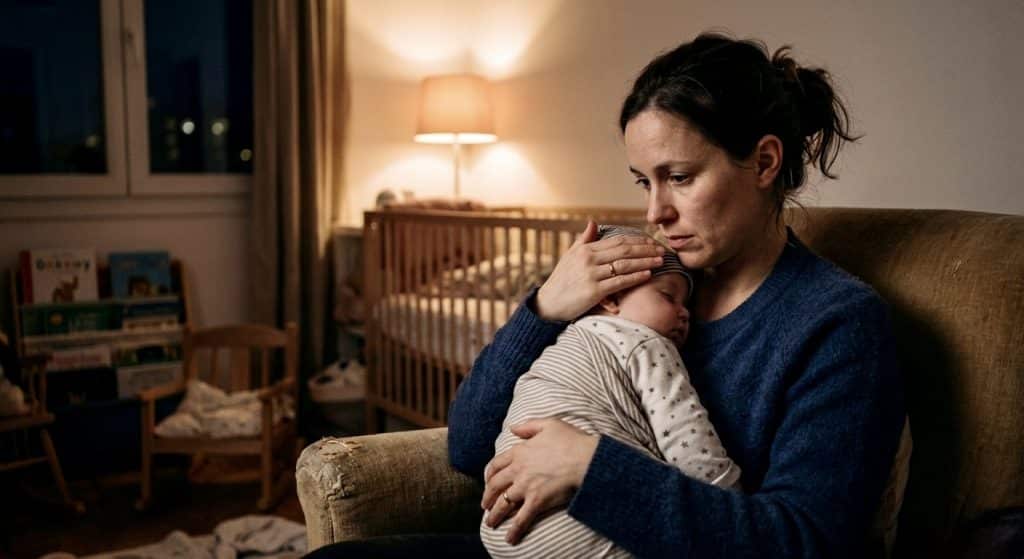
Understanding a Baby High Fever Emergency: What Every Parent Needs to Know Before It Happens
A baby high fever emergency does not always announce itself with dramatic, unmistakable symptoms. In many cases, it unfolds gradually, with subtle changes in behavior, appearance, and responsiveness that a sleep-deprived parent can easily miss or dismiss as normal fussiness. Understanding what this looks like in its true form, how it differs from a manageable fever and what happens inside your baby’s body during that critical window is knowledge that can genuinely save a life.
When a baby’s temperature climbs rapidly, the body is not simply overheating. The hypothalamus, a small structure at the base of the brain that acts as the body’s thermostat, is deliberately raising the core temperature in response to an invading pathogen. Fever is, in most cases, a protective mechanism. However, in infants, especially those under six months of age, the same immune response that is meant to protect can become overwhelming.
The infant’s cardiovascular and respiratory systems are forced to work significantly harder to compensate for the elevated temperature. Heart rate increases, breathing becomes faster, and the body begins drawing fluids away from peripheral tissues to maintain core organ function. This is why dehydration develops so quickly during this kind of emergency and why it can escalate from mild to severe within just a few hours.
One of the most dangerous misconceptions among parents is that this kind of emergency is defined entirely by the number on the thermometer. This is not accurate. A baby with a temperature of 101°F who is unusually limp, not responding to stimulation, breathing rapidly, or showing a rash that does not fade under pressure is in a far more dangerous situation than a baby with a temperature of 104°F who is crying vigorously, feeding normally, and making eye contact.
Clinical pediatricians consistently emphasize that the overall presentation of the child matters far more than the isolated temperature reading. The thermometer gives you one data point. Your observations give you the full picture.
That said, certain temperature thresholds do carry specific clinical weight in infants. Any rectal temperature at or above 100.4°F in a baby under 8 weeks of age is automatically classified as a baby high fever emergency by the American Academy of Pediatrics, regardless of how the baby appears. This is because the newborn immune system lacks the capacity to contain a bacterial infection locally.
What begins as a urinary tract infection, a skin infection, or a respiratory illness can spread to the bloodstream and reach the brain within hours. The absence of alarming symptoms in a newborn does not rule out a serious underlying condition. It is simply the nature of neonatal illness that babies at this age often appear relatively stable right up until they are not.
For babies between 3 and 6 months, this type of emergency is defined by a combination of temperature and clinical signs. A rectal temperature above 102°F alongside any behavioral change, feeding difficulty, breathing irregularity, or skin abnormality warrants immediate evaluation. For babies between 6 and 24 months, the threshold shifts slightly, but a temperature above 104°F or any fever lasting more than 48 to 72 hours without a clear, improving trajectory still constitutes a situation that requires a physician’s assessment.
It is also worth understanding what happens at a systemic level when a baby high fever emergency involves bacterial infection. Bacterial sepsis, one of the most feared complications of infant fever, occurs when bacteria enter the bloodstream and trigger a cascade of inflammatory responses throughout the body. The infection is no longer contained to a single organ or tissue. It becomes systemic, affecting circulation, organ perfusion, and clotting mechanisms simultaneously.
Early sepsis in infants can look deceptively mild. The baby may simply seem quieter than usual, slightly less interested in feeding, or a little pale. Within hours, however, the condition can progress to septic shock, a state in which blood pressure drops, organs begin to fail, and the window for effective intervention narrows dramatically. This progression is precisely why pediatric guidelines instruct parents to treat a baby high fever emergency in young infants as a medical urgency from the very first moment a fever is detected, rather than waiting for the situation to clearly worsen.
Parents should also be aware that this kind of emergency can be triggered by causes beyond the commonly feared bacterial infections. Serious viral illnesses, including herpes simplex virus in newborns, can present with fever and progress rapidly to neurological complications if not identified and treated promptly. Urinary tract infections are another frequently missed cause of fever in infants, particularly in girls and uncircumcised boys, and they carry a meaningful risk of kidney damage if left untreated.
From a practical standpoint, the single most valuable preparation is knowing before it happens exactly what you would do. Keep a reliable rectal thermometer at home, store your pediatrician’s after-hours number and your nearest pediatric ER address in your phone, and have a plan for who will drive so that you are not making decisions under pressure. When you arrive, a written or phone-documented timeline of the fever, including temperatures, times, behavioral changes, and any medications given, helps the emergency team triage your baby accurately and begin the right workup without delay.
Baby Fever When to Go to the ER: 7 Critical Warning Signs
Recognizing a baby high fever emergency goes well beyond checking a thermometer. The following seven signs should prompt an immediate ER visit, regardless of the exact temperature reading.
1. Any Fever in a Newborn Under 2 Months
Newborn fever danger is both real and immediate. In babies under 8 weeks of age, a rectal temperature at or above 100.4°F (38°C) is automatically treated as a medical emergency, without exception. The reason is biological: the newborn immune system does not yet have the capacity to contain a bacterial infection locally. What begins as a urinary tract infection, a respiratory illness, or even an undetected skin infection can reach the bloodstream and travel to the brain within hours.
What makes this age group particularly difficult is that seriously ill newborns often appear relatively calm. They may not cry more than usual, their color may look normal, and they may still be feeding. This apparent stability can mislead parents into a wait-and-see approach that is genuinely dangerous in a baby under 8 weeks.
Do not administer acetaminophen or ibuprofen before the baby is seen. Fever-reducing medication can temporarily lower the temperature and mask the severity of the underlying condition, making accurate clinical assessment significantly harder. Go to the ER immediately.
2. Fever With a Stiff Neck or Bulging Fontanelle
These are among the most critical infant fever warning signs a parent can observe, and they point directly to the possibility of bacterial meningitis, an infection of the membranes surrounding the brain and spinal cord.
A stiff neck means the baby resists or appears to be in pain when you gently try to bring the chin toward the chest. It may be subtle at first, presenting as general irritability when the baby is moved or picked up. A bulging fontanelle, the soft spot on the top of the head, means the tissue appears raised or tense rather than flat or slightly sunken, and it may pulsate visibly. Either sign, in the presence of fever, is a neurological emergency.
Bacterial meningitis in infants can cause permanent hearing loss, brain damage, or death if treatment is delayed even by a few hours. Do not wait to see if the symptoms improve. Call 911 or go to the ER immediately.
3. Difficulty Breathing or Abnormal Breathing Patterns
When baby fever rises and the infection reaches the respiratory tract, the airways can become inflamed and partially obstructed. The body responds by working significantly harder to move air, and the visible signs of that effort are what parents need to recognize.
Watch for nostrils that flare outward with each breath, skin that pulls inward visibly between or below the ribs with each inhale (called retractions), a breathing rate that seems noticeably faster than the baby’s normal, or a persistent grunting sound on exhalation. In infants under 2 months, a resting breathing rate above 60 breaths per minute is abnormally fast. In babies aged 2 to 12 months, the threshold is above 50 breaths per minute. You can count by watching the chest rise for 30 seconds and doubling the number.
Breathing changes during fever in babies treatment at home can escalate quickly, sometimes within the same hour. If any of the above is present, do not monitor at home. Seek urgent evaluation.
Baby Respiratory Recovery and When Breathing Changes Need Urgent Care
4. Extreme Lethargy or Unresponsiveness
A sick baby will naturally be fussier, quieter, or sleepier than usual, and that is expected. The distinction that matters is between a baby who is resting more than usual but still responds normally when touched or spoken to, and a baby who cannot be meaningfully roused.
Signs of true lethargy include: the baby does not react to your voice at normal volume, does not turn toward your face, appears limp or floppy when lifted, or seems to look through you rather than at you. The eyes may be partially closed or glassy. Some parents describe it as the baby simply not being there in a way that feels immediately wrong.
This is one of the most important infant fever warning signs because it can indicate that the infection has affected the central nervous system or that the baby is in the early stages of septic shock. A lethargic infant is not simply a tired infant. Go to the ER.
5. Rash That Does Not Fade Under Pressure
A non-blanching rash is one of the most urgent signs in all of pediatric medicine. To perform the glass test, press a clear glass firmly and flatly against the rash. If the spots or dots remain clearly visible under the glass rather than fading or disappearing, the rash is non-blanching.
This type of rash, called petechial or purpuric depending on the size of the spots, can indicate meningococcal septicemia, a bacterial infection that spreads through the bloodstream and can cause organ failure within hours. The spots may start as a few small red or purple dots anywhere on the body and spread rapidly.
In babies with darker skin tones, the rash may be easier to see on the palms, soles, inner lips, or the whites of the eyes. Do not wait to see if it spreads. This specific baby high fever emergency requires calling 911 immediately, not driving to the ER, so that oxygen and IV access can be established en route.
6. Persistent Vomiting or Signs of Severe Dehydration
Fever increases the body’s fluid loss through sweating and faster breathing, and infants have very small fluid reserves to begin with. When fever in babies treatment at home involves repeated vomiting, feeding refusal, or diarrhea alongside the elevated temperature, dehydration can develop within a few hours rather than over a day.
Signs of significant dehydration in a febrile infant include: no wet diaper for six or more hours, a dry or sticky mouth and lips, no tears when the baby cries despite clearly being distressed, a sunken fontanelle (the soft spot appears concave rather than flat), and skin that looks pale, mottled, or takes longer than two seconds to return to its normal color after you gently press and release it (poor skin turgor).
Dehydration in a febrile infant is a compounding problem: it reduces the body’s ability to regulate temperature, thickens the mucus the respiratory system needs to clear, and stresses the kidneys and heart at a time when both are already working harder. Do not try to rehydrate at home with plain water. If your baby shows two or more of the above signs alongside fever, seek in-person evaluation.
7. Fever Lasting More Than 24 Hours in Any Infant Under 2 Years
Even when none of the six emergency signs above are present, time itself becomes a warning sign in very young children. Most viral fevers in healthy infants improve noticeably within 24 to 48 hours. A fever that holds steady or worsens beyond that window, without a clear, improving trajectory, is the body’s signal that something may need laboratory investigation to identify.
Fever in babies treatment at home is appropriate for short windows in infants over 3 months who have mild symptoms, are feeding, and are alert. But the threshold for how long that home monitoring is safe is lower than most parents assume. Bacterial infections such as urinary tract infections frequently present with fever alone in infants, with no other obvious symptoms. They require antibiotic treatment and will not resolve on their own.
Knowing baby fever when to go to the ER is ultimately about understanding that some causes of fever cannot be identified or treated without a blood test, urinalysis, or clinical examination. A fever that simply does not improve is reason enough to go.
For a broader overview of when to seek care, the Mayo Clinic’s guide on sick babies is a trusted reference.
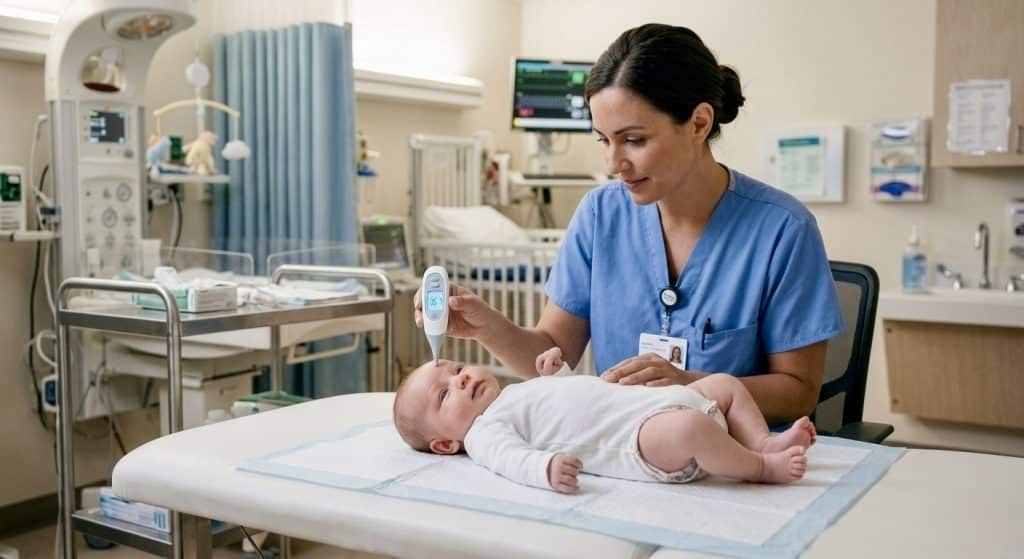
Baby Fever When to Go to the ER: Age-by-Age Guide
Understanding how urgent a baby high fever emergency is depends significantly on your child’s age. The same temperature reading carries very different clinical weight depending on whether your baby is 10 days old or 10 months old.
Newborns: 0 to 3 Months
This is the highest-risk group. Newborn fever danger stems from an immature immune system that cannot mount a controlled, localized response to infection. Any rectal temperature at or above 100.4°F requires an immediate ER visit. In most cases, the hospital will perform a comprehensive sepsis evaluation, including blood cultures, urinalysis, and possibly a lumbar puncture, to rule out the most serious causes.
Do not administer acetaminophen or ibuprofen before the baby is seen. Fever-reducing medication can temporarily lower the temperature and mask the severity of the underlying condition, making clinical assessment less accurate.
Infants: 3 to 6 Months
At this age, fever in babies treatment can sometimes begin at home for a short window, but newborn fever danger has not fully passed, and the threshold for going to the ER remains low. If your baby has a rectal temperature above 102°F alongside any of the seven warning signs, do not wait. If the temperature is below 102°F and your baby is alert, feeding normally, making eye contact, and producing wet diapers, call your pediatrician first. If the fever persists beyond 24 hours or your baby’s condition deteriorates, go to the ER.
Babies: 6 to 24 Months
By 6 months, most babies carry stronger immune defenses, and the risk profile for this type of emergency is lower than in the newborn period. Even so, a fever above 104°F, any of the seven emergency signs, or a fever lasting more than 48 to 72 hours without improvement requires professional evaluation. Trust your instincts. If something feels wrong, seeking medical care is never an overreaction.
Infant Fever Warning Signs You Should Never Ignore
Beyond the seven major emergency indicators covered in this baby fever when to go to the ER guide, there are subtler infant fever warning signs that are easy to overlook but should prompt an urgent call to your pediatrician or a same-day clinic visit.
These include a fever that disappears for 24 hours and then returns, a baby who refuses two or more consecutive feedings, unusual high-pitched or inconsolable crying, swelling or redness around any joint or limb, and a fever appearing in a newborn under 2 months following a recent vaccination.
One important clarification: teething does not cause a true fever. A slight temperature elevation to around 99°F can occur due to gum inflammation, but any reading at or above 100.4°F should be treated as a genuine fever with an independent medical cause that needs investigation.
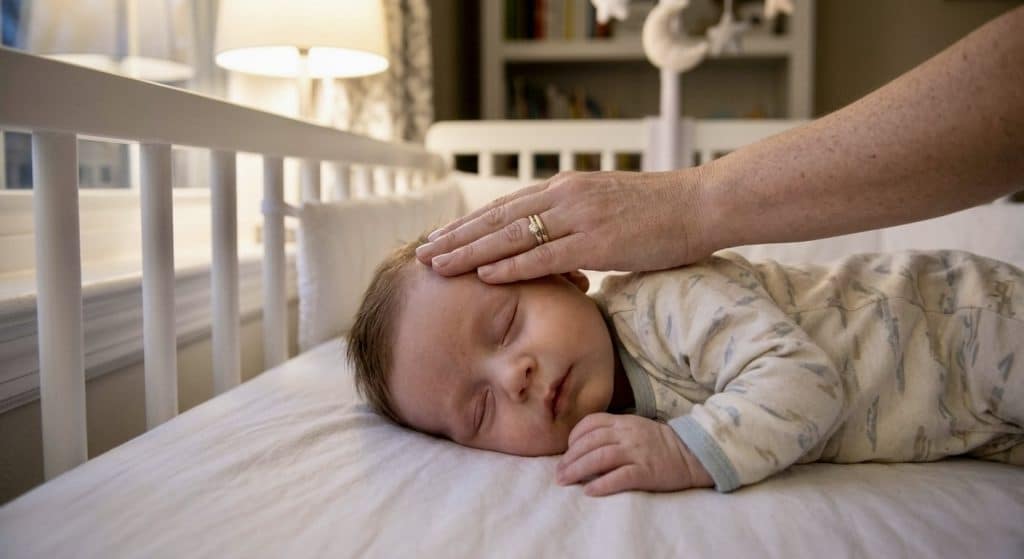
Fever in Babies Treatment at Home vs. the ER
For babies older than 3 months who have mild fever and no alarming symptoms, fever in babies treatment at home focuses on comfort and hydration. Maintain a comfortable room temperature, dress your baby in a single light layer, and offer frequent feedings. Breast milk provides both hydration and immune-supporting antibodies that actively support your baby’s recovery. For a detailed look at how these benefits work during illness, see our post on how breastfeeding supports your baby’s immune system.
For babies older than 2 months, your pediatrician may recommend weight-appropriate infant acetaminophen to reduce discomfort. Do not use ibuprofen before 6 months of age, and never give aspirin to a child at any age, as it is associated with Reye’s syndrome.
Avoid alcohol rubs, cold baths, and ice packs. These approaches cause rapid skin cooling that can trigger shivering, which actually raises core temperature and increases metabolic stress on a small body.
When monitoring at home is appropriate, check the temperature every few hours and document the readings, your baby’s behavior, and feeding patterns. This timeline will be valuable to the emergency team if the situation escalates and you need to go to the ER.
What to Expect at the ER
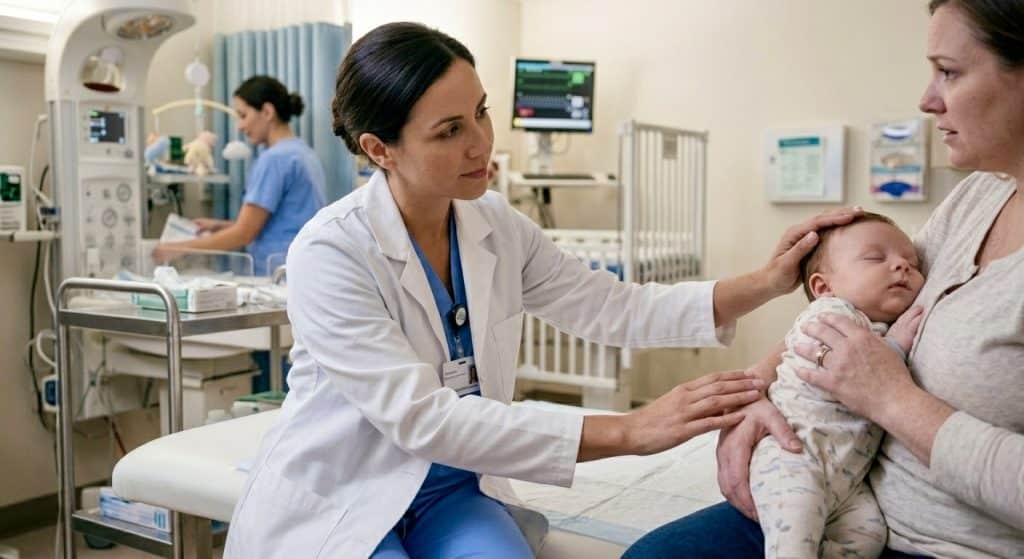
Arriving at a pediatric emergency room with a febrile infant can feel overwhelming, especially when baby fever when to go to the ER was not a clear-cut decision. Understanding what happens next can ease some of that anxiety.
The triage nurse will measure your baby’s temperature, heart rate, breathing rate, and oxygen saturation within minutes of arrival. For babies under 3 months, the evaluation is almost always comprehensive. Blood, urine, and possibly cerebrospinal fluid samples may be collected to screen for bacterial infection, and an IV line may be placed for fluids or antibiotics while results are pending.
For older infants, the assessment is guided by the specific infant fever warning signs present. The physician will examine the ears, throat, chest, abdomen, and skin to identify the source of infection.
Be ready to share your baby’s full vaccination history, any medications recently given, known illness exposures, and the complete timeline of the fever. This information directly shapes the clinical decisions made on your child’s behalf.
Conclusion
Knowing baby fever when to go to the ER is a skill that belongs in every caregiver’s toolkit, alongside a reliable thermometer and your pediatrician’s after-hours contact. The seven warning signs in this post are your guide for the high-stakes moments when clarity and speed matter most.
Follow evidence-based fever in babies treatment at home when appropriate, and never hesitate to seek care when your instincts tell you something is wrong. For additional guidance on caring for your baby during illness at night, read our post Baby Sleep Schedule by Age 0 to 24 Months: Amazing Guide
When in doubt, going to the ER is never the wrong choice. No physician will question a parent for taking newborn fever danger or a baby high fever emergency seriously. Your child’s safety is always worth the trip.
Looking for comprehensive guidance on caring for your baby? Our book ‘How to Care for Children: From Birth to Age 2’ combines professional childcare expertise with evidence based child development research. Written by Kelly and Peter, this guide provides clear, reliable advice rooted in real world childcare. Available in English, Spanish, and Portuguese on Amazon.
Click the link below your preferred language to get your copy!



1. Can a high fever cause brain damage in babies?
Brain damage from fever alone is extremely rare and generally does not occur unless body temperature exceeds 107.6°F (42°C), a threshold almost never reached with typical childhood illness. Febrile seizures occur in approximately 2 to 5 percent of children between 6 months and 5 years, and while alarming to witness, simple febrile seizures do not cause brain damage.
2. Is 103°F dangerous for a 6-month-old?
A temperature of 103°F in a 6-month-old is significant. If it is accompanied by any of the baby high fever emergency signs in this post, go to the ER. If your baby is alert, hydrated, and responding normally, your pediatrician may advise home monitoring with close follow-up.
3. Should I wake my baby to check temperature?
If your baby appears unusually flushed, is breathing abnormally, or is difficult to rouse during sleep, yes. The risk of missing a serious condition outweighs the disruption to sleep, especially at night, when deciding baby fever when to go to the ER matters most.
4. What is the most accurate way to take a baby’s temperature?
Rectal measurement is the gold standard for infants under 3 months. For older babies, temporal artery (forehead) or axillary thermometers can be used as a screening method, but rectal confirmation is recommended when the reading is elevated.
5. Can I give fever medication before going to the ER?
For babies under 2 months, no. For older babies, consult your pediatrician by phone if possible. Administering medication does not replace emergency evaluation and can complicate the clinical picture by temporarily reducing the temperature.
6. What is the difference between a febrile seizure and a serious emergency?
A febrile seizure occurs when a rapid rise in body temperature triggers a brief, generalized convulsion. It typically lasts less than five minutes, involves stiffening or rhythmic jerking of the limbs, and is followed by a period of drowsiness. While frightening to witness, simple febrile seizures do not cause brain damage and do not indicate epilepsy. They occur in approximately 2 to 5 percent of children between 6 months and 5 years.
However, a seizure lasting more than five minutes, a seizure that affects only one side of the body, or any seizure in a baby under 6 months requires an immediate 911 call. After any febrile seizure, even a brief one, the baby should be evaluated by a physician to identify the cause of the fever and rule out meningitis or other serious underlying conditions.
7. My baby feels hot but the thermometer reads below 100.4°F. Should I still be concerned?
Yes, in some situations. A baby who feels warm but reads below the fever threshold can still be unwell. Axillary (armpit) readings underestimate true temperature by approximately one degree, so a reading of 99.5°F in the armpit may correspond to a rectal temperature at or above the fever threshold. If your baby is under 3 months and feels warm, confirm with a rectal reading before concluding there is no fever.