

Childcare basics healthy child development are among the most important foundations any parent, nanny, or childcare professional can learn. The early years of a child’s life, from birth through age five, represent a period of extraordinary neurological growth that shapes the trajectory of everything that follows: emotional resilience, cognitive ability, physical development, and the capacity to form meaningful relationships.
Understanding what quality childcare truly means goes far beyond feeding schedules and nap times. It means creating a safe, stimulating, and emotionally responsive environment where every interaction, every routine, and every moment of exploration contributes to a child’s long-term well-being. According to the American Academy of Pediatrics, approximately 90 percent of a child’s brain growth occurs during these early years, which makes consistent, loving, and developmentally informed care absolutely essential.
Whether you are a parent caring for your own baby, a professional nanny supporting a family, or a daycare provider responsible for a group of children, the seven foundations covered in this guide will equip you with the knowledge and strategies to provide care that truly makes a difference. This guide covers every dimension of childcare basics healthy child development you need to provide care that truly makes a difference.
Every strategy in this guide supports consistent daily routines for young children and the broader goal of raising healthy, secure individuals.
Table of Contents
- Building a Safe Environment for Children at Home
- Emotional Bonding Between Caregivers and Children
- Encouraging Learning Through Play in Early Childhood
- Consistent Daily Routines for Young Children
- Nutrition and Hygiene for Child Growth
- Open Communication as a Childcare Foundation
- When to Seek Professional Guidance
- Frequently Asked Questions
1. Building a Safe Environment for Children at Home
Creating a safe environment for children at home is the first and most non-negotiable step in quality childcare. Infants and toddlers are naturally curious and developmentally unable to recognize danger, which means the responsibility of identifying and eliminating hazards falls entirely on the caregiver.
Begin with a thorough childproofing assessment of every room the child can access. Cover all electrical outlets with safety plugs or sliding plate covers. Anchor bookshelves, dressers, and television sets to wall studs using anti-tip straps. Furniture tip-overs are among the leading causes of serious injury in children under five, and they happen faster than most caregivers anticipate. Store all cleaning products, medications, vitamins, and sharp objects in locked cabinets placed well above the child’s reach.
In the kitchen, turn pot handles toward the back of the stove while cooking and install stove knob covers to prevent accidental ignition. Keep hot beverages and liquids away from table and counter edges. Never leave a young child unattended in or near the kitchen when cooking is in progress. Every modification you make reinforces a safe environment for children at home that grows with the child.
Stairways require safety gates at both the top and the bottom. For the top of a staircase, always use a hardware-mounted gate, which is significantly more secure than a pressure-mounted one. Balcony railings and windows must have secure guards or locks that prevent a child from opening them more than four inches. In the bathroom, install a toilet lid latch, set the water heater thermostat to no higher than 120 degrees Fahrenheit to prevent scalding, and never leave a child unattended near a bathtub or bucket of water.
Choking hazards require constant vigilance. Inspect floor surfaces and play areas regularly for small objects such as coins, button batteries, deflated balloons, small toy components, and pen caps. These items are often invisible to adults but immediately accessible to a crawling infant or exploring toddler. Button batteries in particular are extremely dangerous if swallowed and can cause life-threatening injuries within two hours.
If you work in a licensed daycare or childcare center, ensure that your setting meets all standards established by your state’s childcare licensing authority. Proper adult-to-child ratios, current first aid and CPR certification for all staff, clear emergency exit plans, and regular facility inspections are all components of a professionally safe childcare environment.
Outdoor safety is equally critical. Inspect playground equipment regularly for broken or corroded parts, sharp edges, and loose fasteners. Ensure that play surfaces beneath climbing equipment are covered with impact-absorbent material such as rubber mulch, sand, or poured-rubber tiles. Apply age-appropriate sunscreen before outdoor time, even on overcast days, and choose insect repellents formulated for the child’s age group.

2. Emotional Bonding Between Caregivers and Children
Emotional bonding between caregivers and children is the cornerstone of healthy psychological development. Decades of research confirm that children who experience secure, consistent attachment in their earliest years are significantly more likely to develop emotional resilience, strong social skills, academic competence, and positive mental health outcomes throughout their lives.
The scientific foundation for this understanding comes largely from the work of British psychiatrist John Bowlby, who first formalized attachment theory, and Mary Ainsworth, who expanded it through her landmark “Strange Situation” experiments in the 1970s. Their findings established that the quality of the relationship between a child and their primary caregiver serves as a developmental template for all future relationships.
Responding consistently and sensitively to a child’s needs is the most effective way to build this bond. When a baby cries, a prompt and calm response teaches them, through lived experience, that the world is safe and that their needs will be met. This is not spoiling a child. It is the precise mechanism through which trust, emotional security, and neural pathways for self-regulation are built. Delayed or inconsistent responses, by contrast, produce stress hormones that, when chronic, can interfere with healthy brain development.
Beyond responding to distress, the cumulative weight of small, daily acts of warmth shapes emotional bonds profoundly. Maintain frequent eye contact during feeding and play. Use a warm, gentle tone of voice when speaking to children of any age. Physical affection such as cuddling, rocking, skin-to-skin contact for newborns, and gentle infant massage all stimulate the release of oxytocin in both caregiver and child, deepening the sense of connection and safety.
Narrating daily activities to a child simultaneously strengthens the bond and builds language development. Saying “Now I am going to change your diaper, and then we will wash your hands together” invites the child into a shared experience, communicates presence and predictability, and establishes communication as a natural part of caregiving. This narration also reduces the startle response in infants because they learn to anticipate what comes next.
A properly childproofed home is the foundation of every safe environment for children at home.
Read more: Childcare Basics for Healthy Child Development: 7 TipsAmerican Academy of Pediatrics
Harvard Center on the Developing Child
Building Emotional Bonds With Toddlers Through Validation
For children in the toddler stage, emotional bonding between caregivers and children extends into the domain of emotional recognition and validation. Acknowledge a toddler’s feelings explicitly by saying things such as “I can see that you are frustrated right now” or “It is okay to feel sad when something disappoints you.” This practice, known as emotional coaching, teaches children emotional literacy and reinforces the message that their inner experience is recognized, named, and valued.
Professional caregivers caring for children outside the family home should prioritize building individualized bonds with each child in their care. Using a child’s name frequently, learning and respecting their individual preferences and fears, and celebrating their small achievements with genuine enthusiasm creates a sense of being truly seen, which is foundational to healthy self-esteem.

3. Encouraging Learning Through Play in Early Childhood
Encouraging learning through play in early childhood is one of the most thoroughly supported principles in developmental science. Play is not a break from learning. It is the primary vehicle through which children under six make sense of the world around them, build neural connections, and develop the cognitive, social, and emotional skills that formal education will later build upon.
The American Academy of Pediatrics issued a landmark clinical report confirming that play promotes brain architecture, executive function, and social-emotional competence. Pediatricians across the United States are now encouraged to prescribe play as part of well-child visits, which reflects how central it is to childhood health and development.
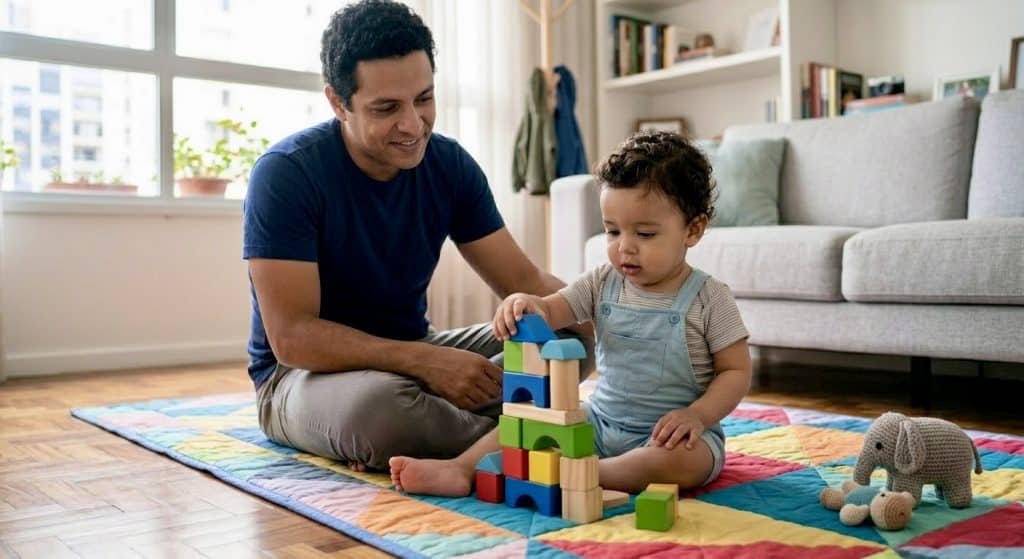
Different categories of play serve specific developmental purposes. Sensory play, such as exploring wet sand, water, textured fabrics, or finger paint, stimulates neural connections in the sensory cortex and builds tolerance for varied textures and experiences. Constructive play, such as building with blocks, nesting cups, or simple puzzles, develops spatial reasoning, cause-and-effect understanding, and early problem-solving skills. Dramatic or pretend play, where children act out scenarios such as cooking a meal, going to the doctor, or caring for a doll, builds language skills, empathy, narrative thinking, and social understanding.
Reading aloud is one of the most developmentally powerful forms of play available to caregivers. From birth, shared reading builds vocabulary, comprehension, print awareness, and a lifelong orientation toward literacy. Use books with high-contrast images and simple shapes for infants. Move to board books with single words and rhymes for babies approaching six months, and progressively more complex picture books and stories as the child’s language and attention develop.
Outdoor play deserves particular emphasis in any quality childcare routine. Time spent in natural environments has been consistently linked in research to lower cortisol levels, improved attention span, greater creativity, and stronger physical coordination in young children. Simple outdoor activities such as collecting leaves, observing ants, digging in a sandbox, or rolling down a gentle grassy slope provide rich sensory experiences that indoor environments cannot replicate.
The Role of Unstructured Play in Early Childhood Learning
Equally important to planned activities is unstructured, child-directed play. When adults step back and allow children to choose their own activities, children develop autonomy, self-regulation, creative thinking, and intrinsic motivation. A toddler playing alone with a pile of pots, wooden spoons, and a plastic bowl is engaged in meaningful sensory, creative, and independent learning. Resist the urge to over-schedule, over-direct, or constantly entertain children. Boredom, followed by self-initiated play, is developmentally valuable.
Limit screen time in accordance with the guidelines established by the American Academy of Pediatrics. For children under 18 months, avoid all screen use except video calling with family members. For children between 18 months and 2 years, introduce high-quality programming gradually and always watch together with the child to facilitate conversation and connection. For children aged 2 to 5, limit total screen time to one hour per day of high-quality, age-appropriate content.
Encouraging learning through play in early childhood does not require elaborate planning. It requires space, time, and a caregiver who trusts the process.
4. Consistent Daily Routines for Young Children
Consistent daily routines for young children provide the neurological and emotional scaffolding that supports healthy development across every domain. When children know what to expect throughout their day, they are better equipped to manage transitions, regulate their emotions, cooperate with caregivers, and engage meaningfully with the activities around them.
An important distinction: routines are not rigid, minute-by-minute schedules. They are predictable sequences of events that signal to a child what comes next. A morning routine might include waking, diaper change or bathroom visit, washing hands and face, breakfast, and a short play session before the day’s main activities begin. An evening routine might include dinner, a warm bath, a quiet activity such as reading or coloring, and then the bedtime ritual that signals sleep is approaching.
Sleep is the most critical element of any childcare routine, and sleep needs vary significantly by age. Newborns between 0 and 3 months require 14 to 17 hours of sleep per day across multiple sleep periods. Infants between 4 and 11 months need 12 to 15 hours. Toddlers between 1 and 2 years need 11 to 14 hours. Preschoolers between 3 and 5 years need 10 to 13 hours. Consistent sleep schedules aligned with these developmental needs support brain consolidation, immune function, mood regulation, and physical growth.
Mealtime routines are equally important in establishing a sense of order and physical well-being. Eating at consistent times each day helps regulate hunger cues, supports healthy digestion, and reduces the likelihood of erratic eating behavior. Sitting together as a family or small group during meals also provides critical social interaction and models the healthy relationship with food that children are meant to develop naturally.
Read more: Childcare Basics for Healthy Child Development: 7 TipsBaby Sleep Schedule by Age 0 to 24 Months: Amazing Guide
Using Transition Cues to Support Consistent Routines
Transitions between activities are often the most challenging moments in a child’s day, particularly for toddlers and preschoolers whose developing prefrontal cortices make impulse control and flexibility genuinely difficult. Giving a verbal warning five minutes before ending an activity, using a consistent phrase such as “Almost time to clean up,” or using a visual timer are all effective evidence-based strategies for helping young children navigate transitions without distress.
When routines are disrupted by illness, travel, holidays, or major life changes, maintain as many familiar elements as possible. Even preserving a single consistent bedtime ritual during an irregular period can significantly reduce a child’s anxiety and the behavioral challenges that often accompany it.
Consistent daily routines for young children are among the most protective factors in early childhood development.
5. Nutrition and Hygiene for Child Growth
Nutrition and hygiene for child growth are two of the most foundational responsibilities in childcare. What a child eats and how a child learns to care for their own body directly impacts immune function, physical growth, energy levels, cognitive development, and long-term health. This foundation is inseparable from maintaining a safe environment for children at home at every stage of development.
During the first six months of life, breast milk or iron-fortified infant formula provides all the nutrition a baby needs. The World Health Organization recommends exclusive breastfeeding for the first six months, followed by the gradual introduction of complementary foods beginning around six months of age, while continuing breastfeeding until at least two years or beyond, based on the preferences of mother and child.
When solid foods are introduced, prioritize variety and nutrient density over convenience. Begin with single-ingredient pureed vegetables and fruits, iron-rich foods such as pureed meat or well-cooked and mashed legumes, and iron-fortified single-grain cereals. Avoid adding salt, sugar, or honey to any food prepared for infants under 12 months. Honey specifically poses a risk of infant botulism, a serious and potentially life-threatening illness.
For toddlers and preschoolers, aim for a balanced and colorful plate at each meal. Fill roughly half the plate with a variety of fruits and vegetables, one quarter with lean protein sources such as chicken, fish, eggs, or beans, and one quarter with whole grains such as brown rice, oats, whole wheat bread, or barley. Dairy products including whole milk for children under 2, and low-fat milk for children 2 and older, cheese, and plain yogurt provide calcium and vitamin D essential for strong bones and teeth.
Read more: Childcare Basics for Healthy Child Development: 7 TipsWorld Health Organization breastfeeding guidelines
10 Baby Dehydration Signs: How to Recognize and Act Fast?

Teaching Hygiene Habits That Last a Lifetime
Hygiene habits, when introduced early and reinforced consistently, become lifelong practices that protect a child’s health at every stage. Begin teaching handwashing with soap and water as soon as a child can participate in the activity, emphasizing key moments such as before meals, after using the bathroom, after playing outside, and after contact with animals.
Make handwashing engaging by singing a short song while lathering. “Happy Birthday” sung twice takes approximately 20 seconds, which is the minimum recommended duration for effective handwashing according to the Centers for Disease Control and Prevention.
Oral hygiene should begin even before a child’s first tooth appears. Wipe the gums with a clean, damp cloth after feedings. Once the first tooth erupts, brush twice daily using a smear of fluoride toothpaste no larger than a grain of rice for children under 3 years, and a pea-sized amount for children 3 and older. Schedule the first dental visit by age one or within six months of the first tooth appearing, whichever comes first.
Bathing frequency for healthy infants does not need to be daily. Two to three baths per week are sufficient, provided that diaper areas and skin folds are cleaned thoroughly during each diaper change to prevent irritation, rash, and infection. As children become more active and begin eating independently, daily bathing becomes increasingly appropriate.
Regular well-child visits with a pediatrician are the single most important tool for monitoring growth milestones, administering vaccines on schedule, and identifying developmental concerns early. Keep an updated immunization record and follow the vaccine schedule recommended by the Centers for Disease Control and Prevention and the American Academy of Pediatrics.
6. Open Communication as a Childcare Foundation
Open communication is one of the most powerful and often underestimated childcare basics. From the earliest days of a child’s life, every word spoken, every tone of voice used, and every facial expression observed shapes the developing brain and establishes the foundations of language, emotional understanding, and cognitive thinking.
Research from neuroscientist Patricia Kuhl at the University of Washington demonstrates that infants are extraordinary statistical learners of language. By six months of age, babies have already begun mapping the phonetic patterns of their native language, tracking which sounds appear most frequently in their environment and building the auditory architecture that will support speech production. This means that the language environment a baby inhabits from birth is not incidental. It is neurologically formative.
Talk to your child continuously throughout the day. Narrate your actions, describe the environment, and introduce new vocabulary naturally. “I am slicing the bananas now. Can you see how yellow they are? They smell sweet, do they not?” These narrations expose children to thousands of additional words per day and contribute to what Hart and Risley, in their foundational research, identified as a significant predictor of later school achievement: the sheer volume of words a child hears in their early years.
Ask open-ended questions appropriate to the child’s developmental stage. For infants, this looks like speaking warmly and pausing for their gurgling, gazing, and expressive responses, which are the early precursors to conversation. For toddlers, try asking “What do you think will happen if we pour the water here?” or “How does the playdough feel when you squeeze it?” These questions engage curiosity, encourage verbal expression, and support early logical thinking.
Language Expansion Techniques That Accelerate Communication Skills
Responsive conversations where the caregiver follows the child’s communicative lead are far more developmentally beneficial than one-directional narration. The technique known as language expansion or recasting involves taking what a child says and building on it with additional vocabulary and complexity. If a toddler points to a dog and says “Doggie,” the caregiver responds: “Yes! That is a big brown dog. He looks friendly, does he not? I wonder if he likes to run.” This simple exchange doubles the child’s exposure to connected language and models how thoughts are elaborated into full sentences.
Nonverbal communication is equally important. Getting down to the child’s eye level when speaking, using expressive and warm facial expressions, and demonstrating active listening through nodding, making eye contact, and responding to cues all reinforce the foundational message that the child is worth listening to and that their communication matters.
The cumulative effect of open communication, emotional bonding between caregivers and children, and encouraging learning through play in early childhood cannot be overstated.
7. When to Seek Professional Guidance in Childcare Basics
Even the most experienced and attentive caregivers encounter situations that require professional support. Knowing when to seek that support is not a sign of failure. It is a hallmark of responsible, child-centered caregiving.
If a child shows signs of delayed developmental milestones, persistent behavioral challenges that do not respond to consistent strategies, chronic sleep disruption, recurring feeding difficulties, or unusual patterns of movement or social engagement, consult a pediatrician or developmental specialist promptly. Early intervention is consistently more effective than delayed support across virtually every area of child development, from speech and language disorders to motor delays to sensory processing challenges.
If you care for a child who was born prematurely, experienced complications at birth, or has a diagnosed or suspected medical condition, work closely with a multidisciplinary healthcare team. This team may include a neonatologist, physical therapist, speech and language pathologist, occupational therapist, or developmental pediatrician, depending on the child’s specific needs.
Finally, caregiver mental health is inseparable from quality childcare. Burnout, isolation, chronic sleep deprivation, and emotional depletion are real and widespread among caregivers of infants and young children. If you or a parent you support is experiencing these symptoms, encourage seeking support from a licensed mental health professional, a pediatric family support program, or a trusted community resource. A caregiver who is emotionally well and supported is far better equipped to provide the consistent, loving, and attentive care every child deserves.
Read more: Childcare Basics for Healthy Child Development: 7 TipsRSV in Babies: 7 Critical Warning Signs Every Parent Must Know
How These Childcare Basics Shape Healthy Child Development?
Understanding childcare basics healthy child development means recognizing that safety, emotional bonding between caregivers and children, encouraging learning through play in early childhood, and consistent daily routines for young children are not isolated practices. They form an integrated foundation that shapes every dimension of a child’s growth. A truly safe environment for children at home encompasses physical safety, emotional security, and developmental support in equal measure.
Conclusion
These seven foundations are not a checklist to complete once and set aside. They are a living, evolving practice that adapts to each stage of a child’s growth and each family’s unique context. From building a safe environment for children at home to nurturing the emotional bonding between caregivers and children, from encouraging learning through play in early childhood to maintaining consistent daily routines for young children, every element in this guide works in concert to support the whole child.
Nutrition and hygiene for child growth and open, responsive communication are not optional additions to quality care. They are the core threads woven through every meaningful interaction between a caregiver and a child. Whether you are a parent, a professional nanny, or a childcare educator, applying these six foundations with consistency, patience, and love creates an environment where children feel safe, understood, and free to grow into the confident and capable individuals they are born to become.
The early years pass quickly. The investment you make in them lasts a lifetime. Every caregiver who commits to childcare basics healthy child development is making an investment that compounds over a lifetime.
Read more: Childcare Basics for Healthy Child Development: 7 TipsBaby Fever When to Go to the ER: 7 Critical Warning Signs
Looking for comprehensive guidance on childcare basics healthy child development? Our book ‘How to Care for Children: From Birth to Age 2’ combines professional nanny experience with evidence based child development research.



1. What are the most important childcare basics for newborns?
The most critical safe environment for children at home begins with establishing a safe sleep environment, ensuring responsive and timely feeding, providing skin-to-skin contact to promote emotional bonding between caregivers and children, and protecting the baby from respiratory infections and environmental hazards. The American Academy of Pediatrics recommends placing newborns on their backs on a firm, flat surface, in a crib or bassinet free of soft bedding, pillows, bumpers, and loose items.
2. How early should I start building a safe environment for children at home?
Childproofing the home should ideally begin before the baby is born or at the very latest before the child begins to roll, crawl, or pull to standing, which typically occurs between four and seven months of age. Safety modifications must continue and evolve as the child grows, because each new developmental milestone introduces a new category of hazard. A walking toddler who can open drawers and climb furniture faces entirely different risks than a newborn.
Building a safe environment for children at home is an ongoing commitment that evolves with every developmental stage. Revisiting and updating your safe environment for children at home as the child reaches new milestones is equally important.
3. What does emotional bonding between caregivers and children look like in daily care?
Emotional bonding between caregivers and children is built through hundreds of small interactions every single day. It looks like making sustained eye contact during feeding, responding calmly and promptly to crying, using the child’s name with warmth and frequency, narrating daily activities with an engaged tone, and genuinely celebrating small developmental achievements. Consistency and sensitivity across these interactions over time build the secure attachment that research links to lifelong emotional health, social competence, and academic success.
4. How can I encourage learning through play in early childhood without expensive toys?
Encouraging learning through play in early childhood does not require expensive toys or elaborate setups. Everyday household objects such as stacking pots, wooden spoons, cardboard boxes, fabric swatches, and measuring cups provide rich sensory and imaginative play opportunities. Reading aloud every day, setting up open-ended art activities with simple crayons and paper, exploring the natural environment on walks, and allowing extended periods of child-directed, unstructured play are among the most developmentally powerful investments a caregiver can make.
5. Why are consistent daily routines for young children linked to better behavior?
Consistent daily routines for young children reduce ambient anxiety by giving children a reliable map of what to expect from their day. When the sequence of events is predictable, the child’s nervous system does not need to stay on alert in anticipation of the unknown. This freed cognitive and emotional capacity allows the child to cooperate more readily, transition between activities with less resistance, and engage more deeply in learning. Research in developmental psychology consistently shows that predictable caregiving environments produce children with stronger self-regulation skills and fewer behavioral challenges.
Consistent daily routines for young children are one of the most evidence-based tools available to any caregiver.
6. When should I consult a professional about my child’s nutrition and hygiene?
Consult a pediatrician if a child consistently refuses most foods, shows signs of weight loss or inadequate growth, displays symptoms of dehydration such as reduced urinary output, dry lips, or unusual fatigue, or has persistent skin, gum, or nail concerns related to hygiene that do not resolve with improved care practices. A registered dietitian who specializes in pediatric nutrition can also provide personalized guidance for children who are selective eaters or who have food sensitivities or allergies.
7. How does open communication in early childhood affect academic outcomes later?
Open communication directly builds the neural architecture of a child’s brain during the most sensitive and receptive window of language development. Children raised in rich verbal environments develop significantly larger functional vocabularies, stronger reading comprehension, more sophisticated narrative skills, and greater capacity for abstract reasoning compared to children raised in language-sparse environments.
These advantages translate into measurable academic gains that persist throughout formal schooling. Open communication also reduces frustration-driven behavioral challenges, because children who can express their needs verbally are far less likely to resort to physical or disruptive behaviors. This is precisely why childcare basics healthy child development must be treated as a long-term commitment rather than a short-term checklist.
