

Baby sleep schedule by age 0 to 24 months is one of the most searched topics among new parents, and for very good reason. Sleep deprivation in the early months of parenthood is real, it is exhausting, and it can feel endless when you have no framework to guide you. The reassuring truth is that infant sleep follows predictable biological patterns that shift at specific developmental stages, and understanding those patterns gives you the tools to build routines that genuinely work.
This guide covers every stage from birth through 24 months, making it the most complete baby sleep schedule resource for busy parents, giving you realistic sleep totals, nap structures, wake windows, and practical routine-building strategies grounded in pediatric sleep science. Whether you have a newborn who sleeps around the clock or a toddler resisting every nap, this is the reference you will come back to again and again. If your baby is already experiencing significant sleep difficulties, our post on 8 critical baby sleep problems parents always miss is a strong companion to this guide.
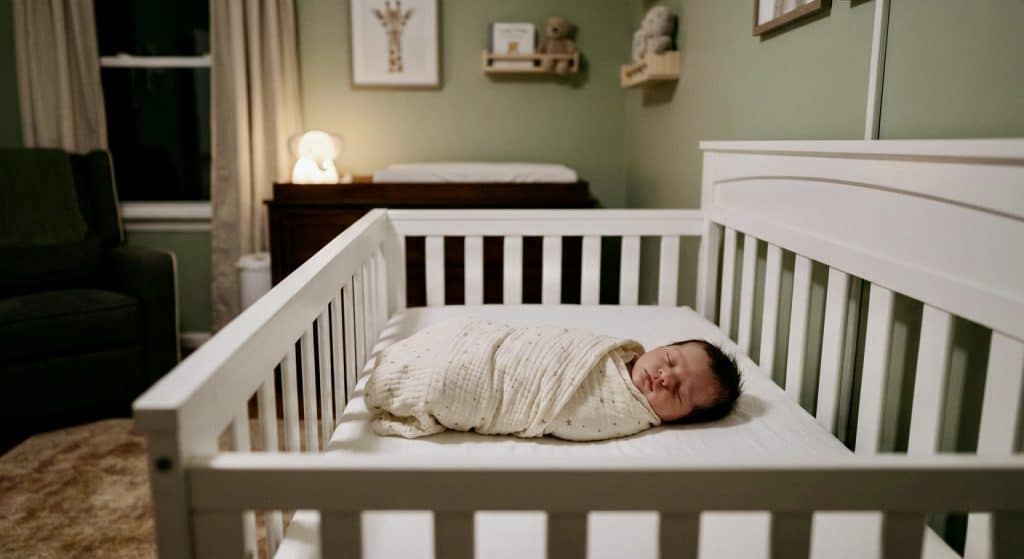
How Many Hours Should a Baby Sleep by Age: What the Research Actually Says
Before diving into each stage, it is important to understand why a baby sleep schedule by age 0 to 24 months works differently than adult sleep. Infant sleep architecture is fundamentally different from adult sleep. Newborns spend a much higher proportion of their sleep in active REM sleep, which is lighter and more easily disrupted. As the brain matures, sleep cycles lengthen, consolidate, and gradually shift toward the adult pattern of longer nighttime blocks and fewer daytime naps.
According to the American Academy of Pediatrics, total sleep needs by age are as follows:
- Newborns (0 to 3 months): 14 to 17 hours per 24-hour period
- Infants (4 to 11 months): 12 to 16 hours including naps
- Toddlers (1 to 2 years): 11 to 14 hours including naps
These are total sleep targets, distributed across both day and night. No baby, regardless of schedule, will sleep all of those hours consecutively in the early months, and that is completely normal. Understanding how many hours a baby should sleep by age removes unnecessary anxiety and gives you a realistic benchmark to measure progress against, rather than comparing your baby to idealized sleep standards that rarely reflect reality.
It is also worth noting that individual variation is significant. Two babies at the same age, in the same household, with the same routine may have meaningfully different sleep totals and patterns. Temperament, feeding method, developmental pace, and health all influence sleep. The goal of a baby sleep schedule by age 0 to 24 months is to provide a supportive structure, not to force every baby into the same mold. For families navigating this journey, having a reliable baby sleep schedule by age 0 to 24 months as a reference removes much of the guesswork and reduces unnecessary anxiety during an already demanding season of life.
Newborn Sleep Schedule First 3 Months: What to Expect
The newborn sleep schedule first 3 months is the least structured of all stages, and that is intentional. A newborn’s circadian rhythm, the internal biological clock that regulates day and night, has not yet developed. Melatonin production is minimal, and the sleep-wake cycle is driven primarily by hunger, not by light or time of day.
Total sleep: 14 to 17 hours per 24-hour period. Night sleep: typically fragmented, with wake windows every 2 to 3 hours for feeding. Naps: 4 to 6 naps per day, ranging from 20 minutes to 2 hours each. Wake windows: 45 to 90 minutes between sleep periods.
Building a Gentle Rhythm in the Newborn Sleep Schedule First 3 Months
At this stage, the goal is not a fixed schedule. It is a flexible rhythm that honors your baby’s hunger and sleep cues. A sample pattern might look like this:
- 7:00 am: wake, feed
- 8:30 am: nap 1
- 10:00 am: wake, feed
- 11:30 am: nap 2
- 1:00 pm: wake, feed
- 2:30 pm: nap 3
- 4:00 pm: wake, feed
- 5:30 pm: nap 4
- 7:00 pm: feed, begin wind-down
- 8:00 pm: bedtime (often a catnap follows within 1 to 2 hours)
- Night: feeds every 2 to 3 hours as needed
The single most impactful thing you can do in this stage is to begin distinguishing day from night. Keep daytime environments bright and stimulating, and keep nighttime feeds calm, quiet, and dimly lit. This environmental contrast begins training the circadian rhythm weeks before it fully matures, laying the foundation for the more structured baby sleep schedule by age 0 to 24 months that develops in the months ahead.
Breastfeeding and sleep are closely linked in the newborn period because breast milk contains tryptophan and melatonin precursors that vary by time of day, actively supporting the gradual development of your baby’s own sleep-wake cycle. You can explore this connection further in our post on how breastfeeding supports your baby at night.
Common Newborn Sleep Challenges in the First 3 Months
Day-night confusion is the most universal challenge in the newborn sleep schedule first 3 months. Babies who were more active at night in the womb often continue this pattern after birth, sleeping long stretches during the day and waking frequently at night. The remedy is consistent environmental reinforcement: bright light and gentle stimulation during daytime wake windows, and darkness with minimal interaction during nighttime feeds.
Contact napping, where your baby only sleeps while held, is also extremely common and developmentally normal in this stage. While it is not a habit that needs to be urgently broken in the early weeks, beginning to offer the crib for at least some naps by 6 to 8 weeks helps your baby gradually build comfort with independent sleep surfaces.
Baby Nap Schedule by Month: 3 to 6 Months
Between 3 and 6 months, the baby nap schedule by month begins to take real shape. The circadian rhythm starts to emerge, night sleep consolidates into longer stretches, and naps become more predictable. This is the stage where a consistent schedule begins to pay dividends.
Total sleep: 14 to 16 hours per 24-hour period. Night sleep: 10 to 12 hours, with 1 to 3 nighttime feeds. Naps: 3 to 4 naps per day. Wake windows: 1.5 to 2 hours between sleep periods.

The 4-Month Sleep Regression and Your Baby Nap Schedule by Month
This stage includes one of the most disruptive developmental events in infant sleep: the 4-month sleep regression. Around this time, sleep architecture permanently shifts to include more cycles of light sleep, and babies who previously slept in longer stretches begin waking more frequently. This is neurological maturation, not a step backward, and it does not reverse.
The best response to the 4-month regression is to strengthen the infant sleep routine. A consistent pre-nap and pre-bed sequence, such as feeding, a brief calm activity, dimming the lights, and white noise, helps signal to the brain that sleep is coming, making it easier for your baby to transition through lighter sleep cycles without fully waking.
Sample Baby Nap Schedule by Month at 4 to 5 Months
- 7:00 am: wake, feed
- 8:30 am: nap 1 (45 to 60 minutes)
- 10:30 am: wake, feed
- 12:00 pm: nap 2 (1 to 1.5 hours)
- 2:00 pm: wake, feed
- 3:30 pm: nap 3 (30 to 45 minutes, catnap)
- 5:30 pm: feed
- 7:00 pm: bedtime routine begins
- 7:30 pm: bedtime
Baby Sleep Schedule by Age 0 to 24 Months: 6 to 9 Months
At 6 months, most babies are developmentally ready to consolidate from 3 naps to 2 naps. This transition marks a significant shift in the baby nap schedule by month and often results in noticeably longer night sleep stretches. Many families experience their first true full night of sleep during this window.
Total sleep: 13 to 15 hours per 24-hour period. Night sleep: 10 to 12 hours, with 0 to 2 nighttime feeds. Naps: 2 naps per day (morning and afternoon). Wake windows: 2 to 3 hours between sleep periods.
Sleep Environment at 6 to 9 Months
A critical element at this stage is the sleep environment. Blackout curtains are no longer optional for most babies. As the brain becomes more aware of light and environmental cues, a dark room during naps dramatically improves both duration and consistency of sleep. White noise at a consistent volume of around 65 decibels also helps mask household sounds that become more disruptive as babies move through lighter sleep cycles.
Sample Schedule at 6 to 8 Months
- 7:00 am: wake, feed
- 9:00 am: nap 1 (1 to 1.5 hours)
- 10:30 am: wake, feed, play
- 12:30 pm: feed
- 1:00 pm: nap 2 (1 to 1.5 hours)
- 2:30 pm: wake, feed, play
- 5:30 pm: feed
- 6:30 pm: bedtime routine begins
- 7:00 pm: bedtime
Baby Nap Schedule by Month: 9 to 12 Months
Between 9 and 12 months, the baby nap schedule by month holds steady at 2 naps, but wake windows extend significantly. Babies at this age are far more socially aware and cognitively active, which means they also become more prone to overtiredness if wake windows are pushed too far.
Total sleep: 12 to 15 hours per 24-hour period. Night sleep: 10 to 12 hours. Naps: 2 naps per day. Wake windows: 2.5 to 3.5 hours between sleep periods.

Separation Anxiety and the Baby Nap Schedule by Month
This is also a common stage for separation anxiety to emerge, which can temporarily disrupt even the most established infant sleep routine. A baby who previously fell asleep independently may suddenly protest at bedtime or wake more frequently seeking reassurance. This is developmentally normal and typically resolves within a few weeks with consistent, warm responses.
If you notice behavioral changes alongside sleep disruption at this age, our post on baby health warning signs parents always miss can help you distinguish developmental phases from signs that warrant medical attention.
Sample Schedule at 10 to 11 Months
- 7:00 am: wake, feed
- 9:30 am: nap 1 (1 to 1.5 hours)
- 11:00 am: wake, feed, play
- 2:00 pm: nap 2 (1 hour)
- 3:00 pm: wake, feed, play
- 6:00 pm: dinner, bath, wind-down
- 7:00 pm: bedtime
How to Build an Infant Sleep Routine: 12 to 18 Months
The 12 to 18 month window brings the most significant nap transition in the entire first two years: the shift from 2 naps to 1 nap. Understanding how to build an infant sleep routine through this transition is one of the most valuable skills a parent can develop, because this shift rarely happens cleanly. Babies at this stage frequently need 2 naps on some days and only 1 on others, which can make the baby sleep schedule feel unpredictable for several weeks.
Total sleep: 11 to 14 hours per 24-hour period. Night sleep: 10 to 12 hours. Naps: transitioning from 2 to 1 nap per day.Wake windows: 4 to 6 hours between sleep periods.

Signs Your Baby Is Ready to Drop to 1 Nap
- Consistently taking 30 minutes or more to fall asleep for the second nap
- The second nap is pushing bedtime too late
- Night sleep is disrupted on 2-nap days
- Your baby is at least 13 to 14 months old
The transition to 1 nap usually means shifting that single nap to midday, around 12:00 to 12:30 pm, with a target duration of 1.5 to 2.5 hours. Bedtime often needs to move earlier during this transition to prevent overtiredness, which is one of the most counterintuitive but consistently effective strategies in infant sleep management.
Sample Schedule at 14 to 15 Months
- 6:30 am: wake, breakfast
- 12:00 pm: lunch
- 12:30 pm: nap (1.5 to 2.5 hours)
- 3:00 pm: wake, snack, play
- 6:00 pm: dinner
- 7:00 pm: bedtime routine begins
- 7:30 pm: bedtime
How Many Hours Should a Baby Sleep by Age: 18 to 24 Months
By 18 months, most toddlers are settled into a single midday nap and a predictable night routine. Knowing how many hours a baby should sleep by age at this stage, and what to do when those hours are being missed, is essential for managing toddler behavior and development.
Total sleep: 11 to 14 hours per 24-hour period. Night sleep: 10 to 12 hours. Naps: 1 nap per day (midday). Wake windows: 5 to 6 hours.
Bedtime Resistance at 18 to 24 Months
This is the stage when bedtime resistance and stall tactics begin in earnest. Toddlers at this age have sufficient language and cognitive development to negotiate, delay, and test boundaries at bedtime. The most effective response is a short, consistent bedtime routine of no more than 20 to 30 minutes, a firm but warm response to stall requests, and a predictable sequence that your toddler can anticipate and find comfort in.
Consistency is the operative word. A toddler who experiences different responses to bedtime resistance on different nights will continue testing because the outcome is unpredictable. When the response is always the same, calm, brief, and loving, most toddlers adapt within 1 to 2 weeks. Returning to the principles of the baby sleep schedule by age 0 to 24 months framework at every stage, including this one, helps parents stay grounded when daily challenges make the routine feel difficult to maintain.
Sample Schedule at 18 to 24 Months
- 6:30 to 7:00 am: wake, breakfast
- 12:00 pm: lunch
- 12:30 pm: nap (1 to 2 hours)
- 2:30 pm: wake, snack, outdoor play
- 5:30 pm: dinner
- 7:00 pm: bath, books, wind-down
- 7:30 to 8:00 pm: bedtime
How to Build an Infant Sleep Routine That Actually Works
Regardless of the specific stage your baby is in, knowing how to build an infant sleep routine is the single most evidence-backed strategy for improving sleep quality. Research published in the journal Sleep Medicine consistently shows that babies with predictable pre-sleep routines fall asleep faster, sleep longer, and wake less frequently than babies without established routines.
An effective routine does not need to be elaborate. It needs to be consistent, calm, and sequential. A simple structure for any age might include:
- A bath or warm wipe-down
- Feeding (for younger babies)
- A short calm activity such as reading or gentle singing
- Dimming the lights and starting white noise
- Placing your baby in the crib drowsy but awake
That final point, drowsy but awake, is the cornerstone of independent sleep skills. When a baby falls asleep in the crib rather than in arms, they develop the capacity to return to sleep independently when they cycle into lighter sleep at night, which dramatically reduces nighttime waking over time.
Why Wake Windows Are the Foundation of Any Baby Nap Schedule by Month
Wake windows are the periods of time a baby can comfortably stay awake between sleep periods before becoming overtired. Staying within the appropriate wake window for your baby’s age prevents the cortisol spike that comes with overtiredness, which paradoxically makes falling asleep harder and increases nighttime waking.
Following wake windows consistently is one of the most effective tools in building a realistic baby nap schedule by month, because it aligns the schedule with your baby’s actual biological readiness for sleep rather than forcing sleep at arbitrary clock times.
The Role of the Sleep Environment in How to Build an Infant Sleep Routine
The sleep environment is not a secondary consideration. For many babies, optimizing the environment produces faster and more dramatic improvements than any schedule adjustment. The three most impactful environmental factors are darkness, sound, and temperature.
Darkness signals melatonin release. For babies older than 3 to 4 months, a room that is dark enough that you cannot see your hand clearly in front of your face is the target. Sound masking with white noise at around 65 decibels prevents partial arousals from household noise. Room temperature between 68 and 72°F (20 to 22°C) keeps your baby in the thermal comfort zone for optimal sleep, without the risk of overheating.
Why Following a Baby Sleep Schedule by Age 0 to 24 Months Changes Everything
Parents who commit to a baby sleep schedule by age 0 to 24 months consistently report not only improved infant sleep but also meaningful reductions in their own stress and exhaustion. When your baby’s body learns when to expect sleep, the process of falling asleep becomes easier, faster, and more predictable for the entire household. The structure provided by a baby sleep schedule by age 0 to 24 months also supports healthy brain development, emotional regulation, and growth hormone release, all of which occur predominantly during sleep in the first two years of life.
Pediatric sleep researchers consistently find that babies following age-appropriate schedules show better mood, improved attention during wake windows, and stronger feeding patterns than babies without structured routines. Whether you are in the newborn stage or approaching your child’s second birthday, returning to the principles of a baby sleep schedule by age 0 to 24 months at every transition point gives you a reliable compass for navigating the inevitable changes ahead.
Safe Sleep: The Non-Negotiables in Every Baby Sleep Schedule by Age 0 to 24 Months
Any discussion of a baby sleep schedule by age 0 to 24 months must include safe sleep practices, because where and how a baby sleeps is as important as when. According to the CDC and the American Academy of Pediatrics, safe sleep guidelines include:
- Always place your baby on their back to sleep, for every sleep until 12 months
- Use a firm, flat sleep surface with a fitted sheet and no loose bedding, pillows, or bumpers
- Keep the crib free of stuffed animals, blankets, and positioners
- Room-share without bed-sharing for at least the first 6 months
- Avoid overheating; dress your baby in a single sleep layer appropriate for room temperature
These guidelines apply to every nap and every nighttime sleep, without exception and regardless of what schedule you are following.
Conclusion
Understanding the baby sleep schedule by age 0 to 24 months transforms one of the most stressful aspects of parenting into a manageable, science-backed process. Sleep needs change dramatically across the first two years, and what works at 6 weeks will look completely different at 6 months or 16 months. The key is knowing what to expect at each stage, knowing how to build an infant sleep routine around those expectations, and giving your baby the environment and the repetition they need to develop healthy sleep habits.
Every baby is different, and every family’s life looks different. Use this guide as a framework, not a rigid prescription, and adjust based on your baby’s cues, temperament, and your family’s rhythms. The goal is sustainable, restorative sleep for your baby and for you. This baby sleep schedule by age 0 to 24 months is your most reliable starting point.
Sources: American Academy of Pediatrics ,
Centers for Disease Control and Prevention
Looking for comprehensive guidance on caring for your baby? Our book ‘How to Care for Children: From Birth to Age 2’ combines professional nanny experience with evidence based child development research. Written by Kelly and Peter, this guide provides clear, reliable advice rooted in real world childcare. Available in English, Spanish, and Portuguese on Amazon.
Click the link below your preferred language to get your copy!




1. How many hours should a 3-month-old sleep?
A 3-month-old needs approximately 14 to 16 hours of total sleep per 24-hour period, distributed across 4 to 5 naps and nighttime sleep. Night stretches of 4 to 6 hours are common at this age, though many babies still wake 2 to 3 times for feeding.
2. When do babies start sleeping through the night?
Most babies develop the capacity to sleep through the night, defined as a 6 to 8 hour stretch, between 4 and 6 months of age. However, this varies widely. Developmental readiness, feeding method, sleep environment, and individual temperament all influence the timeline. Sleeping through the night by 3 months is the exception, not the rule.
3. Is it okay to wake a sleeping baby to feed?
In the newborn period (0 to 4 weeks), yes. Newborns should not go more than 3 to 4 hours without feeding to support adequate weight gain. After 4 weeks, if your baby is gaining weight well, your pediatrician may clear you to stop waking for feeds and follow your baby’s hunger cues instead.
4. What is a wake window and why does it matter?
A wake window is the period of time a baby can comfortably stay awake between sleep periods before becoming overtired. Staying within the appropriate wake window prevents the cortisol spike that comes with overtiredness, which paradoxically makes falling asleep harder. Following wake windows is one of the most effective tools in building a realistic baby nap schedule by month.
5. Should I use a strict schedule or a flexible routine?
For babies under 3 months, a flexible rhythm based on hunger and sleep cues is more appropriate than a rigid clock-based schedule. From 3 to 4 months onward, a structured but adaptable schedule works best. The goal is predictability without rigidity, so that your baby’s body learns when to expect sleep while leaving room for real-life variation.
6. When should my baby drop from 2 naps to 1?
Most babies transition from 2 naps to 1 nap between 13 and 18 months of age. Signs of readiness include consistent difficulty falling asleep for the second nap, late bedtimes caused by the second nap, and generally happy behavior on days with only 1 nap.
7. How do I know if my baby is getting enough sleep?
The clearest indicator is daytime behavior. A baby who is getting adequate sleep will be alert, engaged, and generally content during wake windows. A consistently fussy, difficult-to-settle baby who falls asleep easily in any environment, including the car or stroller, is likely running a sleep deficit. Cross-referencing your baby’s actual sleep totals with the how many hours a baby should sleep by age guidelines in this post gives you an objective baseline to work from.
8. Can I follow a baby sleep schedule by age 0 to 24 months if my baby was premature?
Yes, but with an important adjustment. For premature babies, always use their corrected age rather than their chronological age when applying a baby sleep schedule by age 0 to 24 months. A baby born 8 weeks early who is now 4 months old has a corrected age of 2 months, and their sleep needs and wake windows should reflect that corrected age. Most premature babies catch up to typical developmental sleep milestones by 12 to 18 months of corrected age. Always consult your pediatrician before implementing any structured sleep schedule for a premature infant.
9. How does illness affect a baby sleep schedule by age 0 to 24 months?
Illness almost always disrupts sleep temporarily, and that is a normal and expected part of the first two years. When your baby is sick, the priority shifts from maintaining the baby sleep schedule by age 0 to 24 months to providing comfort, hydration, and rest on demand. Extra night wakings, shorter or longer naps, and earlier bedtimes are all common during illness. Once your baby recovers, most will return to their established routine within 3 to 5 days with gentle consistency from caregivers. Avoid making permanent schedule changes based on temporary illness disruptions.
