
A meal prep plan for busy parents is not about becoming a professional chef on Sunday afternoon. It is about making one strategic decision at the beginning of the week that removes dozens of smaller, exhausting decisions from every single day that follows.
If you have ever stood in front of the refrigerator at 6 PM with a hungry toddler pulling at your leg, a baby on your hip, and absolutely no idea what to cook for dinner, this article was written specifically for you.
Parenting is relentless. The feeding responsibilities alone, from breastfeeding and bottle prep to baby purees, toddler snacks, and full family dinners, can consume hours of mental and physical energy every single day. Research consistently shows that decision fatigue is one of the leading contributors to poor nutritional choices in parents of young children. When you are exhausted, you default to whatever is fastest, not whatever is healthiest.
A well-designed meal prep plan for busy parents solves this problem at the root. In this complete guide, you will find a practical 6-day plan, easy meal prep recipes for exhausted parents, a full grocery strategy, storage and reheating guidelines, and the time-saving meal prep strategies that actually work in real family life.
Table of Contents
- Why a Meal Prep Plan for Busy Parents Changes Everything
- The Science Behind Meal Prepping and Family Nutrition
- What You Need Before You Start
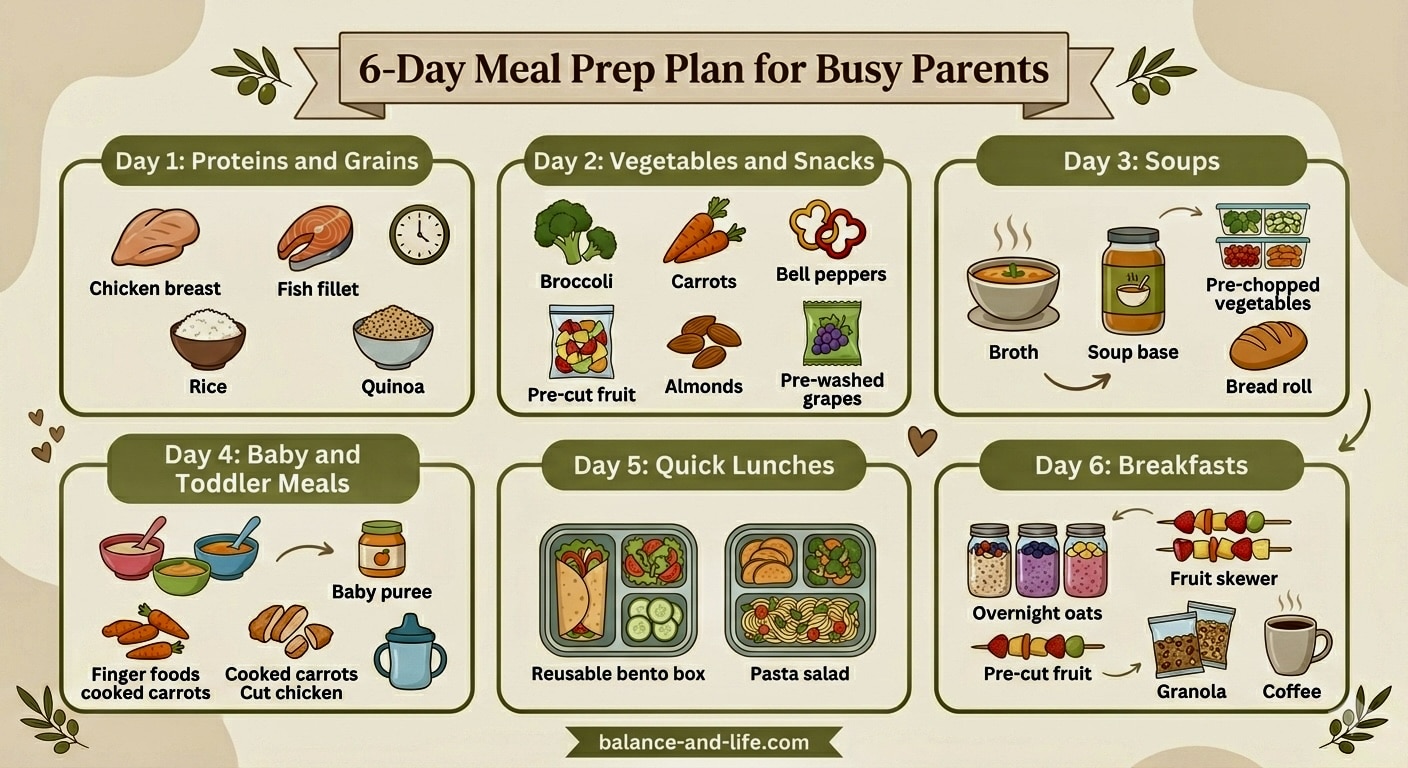
- The 6-Day Healthy Meal Prep Plan
- Day 1: Proteins and Grains
- Day 2: Vegetables and Snacks
- Day 3: Soups and Stews
- Day 4: Baby and Toddler Meals
- Day 5: Quick Lunches and Wraps
- Day 6: Breakfasts and Energy Bites
- Time-Saving Meal Prep Strategies for New Parents
- How to Store and Reheat Everything Safely
- Common Mistakes to Avoid
- Conclusion
- FAQs
Why a Meal Prep Plan for Busy Parents Changes Everything
Most parents understand, in theory, that meal prepping is a good idea. The barrier is never knowledge. The barrier is always time, energy, and the overwhelming feeling that adding one more task to an already impossible schedule will break something.
The key insight that changes everything is this: meal prepping does not add time to your week. It consolidates time. Instead of spending 30 to 45 minutes cooking every single evening, you invest two focused hours once or twice per week and recover that time every other day of the week.
For a family with two young children, that consolidation translates to approximately three to four hours saved per week, every single week. Over the course of a year, that is between 150 and 200 hours returned to your family.
Beyond time savings, a consistent meal prep plan for busy parents produces measurable improvements in family nutrition. A 2022 study published in the International Journal of Behavioral Nutrition and Physical Activity found that families who engaged in regular meal preparation at home consumed significantly more vegetables, whole grains, and lean proteins than families who cooked spontaneously each evening.
For parents specifically, the mental health benefits are equally significant. Knowing that dinner is already handled eliminates an entire category of daily stress that accumulates invisibly but powerfully over time.
The Science Behind Meal Prepping and Family Nutrition
Before diving into the practical plan, it is worth understanding what happens nutritionally when families shift from reactive cooking to intentional weekly meal preparation.
When parents cook spontaneously under time pressure, several nutritional patterns consistently emerge. Portion sizes increase. Processed convenience foods appear more frequently. Vegetables are skipped because they require preparation. Protein sources default to whatever cooks fastest, which is often not the most nutritious option.
Weekly meal prep tips for parents with young children address all of these patterns by design. When proteins are already cooked, grains are already portioned, and vegetables are already washed and cut, the path of least resistance becomes the nutritious choice rather than the convenient one.
For families with babies and toddlers, this matters even more. The nutritional habits established in the first three years of life have lasting effects on food preferences, gut microbiome composition, and metabolic health. A meal prep plan for busy parents that includes intentionally designed baby and toddler portions ensures that your youngest family members benefit from the same nutritional intentionality as the adults.
The American Academy of Pediatrics recommends that families prioritize whole foods, diverse vegetables, quality proteins, and minimally processed ingredients from the moment complementary foods are introduced. Batch cooking makes this recommendation achievable even on the most demanding parenting schedules.
What You Need Before You Start
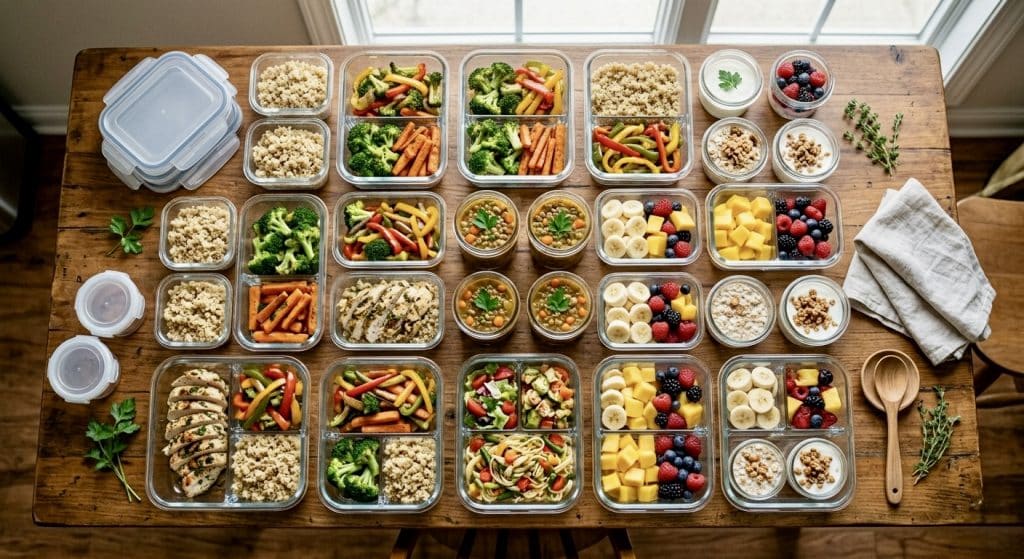
Implementing healthy meal prep ideas for busy families does not require an expensive kitchen overhaul. The following items represent the practical minimum for executing this plan efficiently.
Storage containers: Invest in a set of glass or BPA-free plastic containers in three sizes: small (for individual portions and baby food), medium (for lunch portions and snacks), and large (for full family meals). Having at least twelve containers total prevents the plan from stalling mid-prep.
A quality sheet pan: A heavy rimmed baking sheet allows you to roast multiple proteins and vegetables simultaneously, which is the single most efficient cooking method for batch preparation.
An instant pot or slow cooker: Soups, stews, grains, and legumes can all be cooked hands-free while you prepare other components. This doubles your effective output during a single prep session.
A sharp chef’s knife and cutting board: More than any other factor, the quality of your cutting tools determines how quickly vegetable preparation goes. A dull knife makes meal prep feel like a chore. A sharp one makes it fast and almost meditative.
A printed or digital grocery list organized by store section: Shopping without a section-organized list adds unnecessary time to the grocery trip. Organize your list by produce, proteins, dairy, grains, and pantry items before you leave the house.
The 6-Day Healthy Meal Prep Plan
This plan is designed to be executed over one focused prep session of approximately two hours, ideally on a Sunday or whatever day precedes your busiest week. Each day builds on components prepared during the initial session.
Day 1: Proteins and Grains
The foundation of any effective meal prep plan for busy parents is a reliable protein base. On Day 1, you will use the components prepared during your weekly prep session to assemble complete, balanced meals in under ten minutes.
Prep components used: Baked chicken breast, hard-boiled eggs, cooked quinoa, roasted sweet potato cubes.
Breakfast: Quinoa breakfast bowl with sliced hard-boiled egg, avocado, and a handful of berries. This takes three minutes to assemble from prepped components and provides sustained energy through a demanding morning.
Lunch: Sliced chicken breast over mixed greens with roasted sweet potato, olive oil, and lemon. Total assembly time: four minutes.
Dinner: Chicken and quinoa grain bowl with steamed broccoli (fresh or frozen, microwaved in three minutes) and tahini drizzle. A complete, nutritionally balanced family dinner in under eight minutes of active time.
Toddler adaptation: Dice the chicken breast finely, serve with soft quinoa and mashed sweet potato. No additional cooking required.
Baby adaptation: Pureed sweet potato stored from the prep session. Add a small amount of breastmilk or formula to achieve the desired consistency for your baby’s current stage.
Day 2: Vegetables and Snacks
Easy meal prep recipes for exhausted parents always prioritize vegetables because they require the most preparation time when done fresh but become effortless when prepped in advance.
Prep components used: Roasted bell peppers, washed and cut celery and carrot sticks, hummus (store-bought or batch-prepared), energy bites (oats, peanut butter, honey, rolled together and refrigerated).
Breakfast: Whole grain toast with hummus, sliced roasted bell pepper, and two hard-boiled eggs from Day 1’s prep.
Lunch: Vegetable and hummus wrap with leftover quinoa, roasted peppers, shredded carrots, and a protein of choice. Takes five minutes to assemble.
Snacks: Carrot and celery sticks with hummus, energy bites. These are the most underestimated component of a family meal prep system. Having clean, ready-to-eat snacks prevents the mid-afternoon convenience food spiral that many parents fall into.
Dinner: Sheet pan roasted vegetables with salmon (fresh, cooked in 15 minutes while you manage bath time) served over leftover grains.
Day 3: Soups and Stews
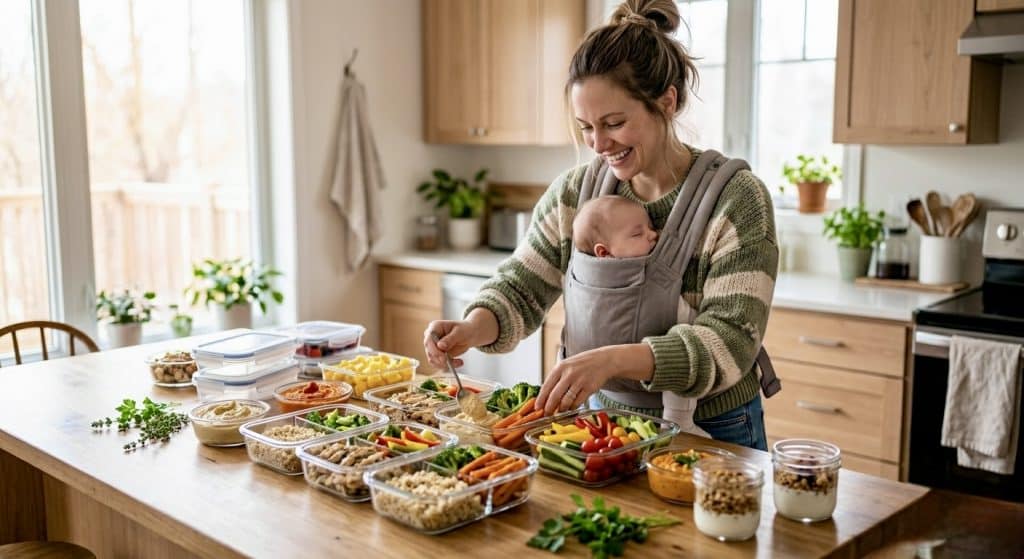
Weekly meal prep tips for parents with young children consistently highlight soups and stews as the highest-value batch cooking investment. A single large pot produces four to six family servings, reheats in under three minutes, and provides complete nutrition in one dish.
Prep components used: Slow cooker lentil soup (lentils, diced tomatoes, carrots, celery, onion, garlic, vegetable broth, cumin), pre-portioned into individual containers.
Breakfast: Overnight oats prepared the previous evening. Layer rolled oats, chia seeds, milk of choice, and fresh fruit in a jar. Ready to eat cold, directly from the refrigerator.
Lunch: Lentil soup with a slice of whole grain bread. This lunch requires zero active cooking time and provides exceptional protein and fiber for sustained afternoon energy.
Dinner: Lentil soup for the family, with a side of crusty bread and a simple green salad assembled in three minutes.
Toddler adaptation: Blend the lentil soup to a thicker consistency. Serve with soft bread torn into small pieces.
Baby adaptation: Blend a portion of the lentil soup with additional broth to achieve a smooth puree. Lentils are an excellent early iron source for babies transitioning to solid foods.
Suggestion Reading: Starting Solid Foods: 8 Proven Steps for Your Baby
Day 4: Baby and Toddler Meals
A complete meal prep plan for busy parents must include dedicated preparation for the youngest members of the family. Time-saving meal prep strategies for new parents with babies and toddlers reduce the daily mental load of feeding children at different developmental stages simultaneously.
Prep components used: Batch-prepared baby purees (sweet potato, butternut squash, pea and spinach, apple and pear), portioned into ice cube trays and frozen, then transferred to labeled freezer bags.
Baby puree batch prep instructions:
Steam or bake each vegetable until completely soft. Blend with cooking water or breastmilk to desired consistency. Pour into ice cube trays. Freeze for four hours, transfer to labeled freezer bags. Each cube is approximately one ounce, allowing precise portion control as your baby’s appetite develops.
Toddler meal prep: Mini oatmeal muffins baked in batches of 24. Ingredients: rolled oats, mashed banana, egg, milk, and cinnamon. These freeze beautifully and can be defrosted overnight or microwaved for 30 seconds. They serve as breakfast, snack, or lunchbox addition throughout the week.
Family meals on Day 4: Use this lighter prep day to enjoy a simple family dinner of eggs, roasted vegetables from Day 2, and whole grain toast. Breakfast for dinner is one of the fastest, most nutritious family meals and children universally enjoy it.
Day 5: Quick Lunches and Wraps
By Day 5, the meal prep plan for busy parents begins to pay its most visible dividends. The refrigerator contains prepped proteins, grains, vegetables, and sauces that can be combined in dozens of ways without any additional cooking.
Prep components used: All remaining prepped proteins, grains, and vegetables. Pre-portioned wraps and pita pockets.
Breakfast: Greek yogurt parfait with granola and fresh fruit. Zero preparation required.
Lunch: Chicken and vegetable wrap using roasted bell peppers, hummus, quinoa, and diced chicken. This lunch travels well in a lunchbox and requires only two minutes of assembly.
Dinner: Stir-fry using any remaining proteins and vegetables, served over leftover grains. A stir-fry is the ideal Day 5 dinner because it uses components that need to be consumed before the weekend and requires only ten minutes of active cooking.
Snacks: Remaining energy bites, fruit, and a small handful of mixed nuts.
Suggestion reading: Balanced Diet for Lifelong Wellness: 5 Steps to Eat Healthy Every Day
Day 6: Breakfasts and Energy Bites
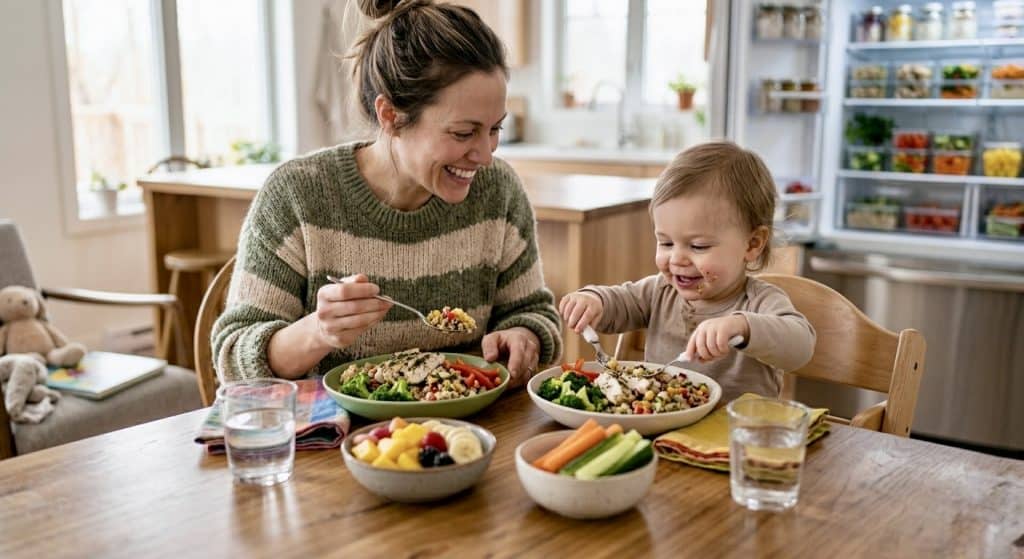
The final day of the 6-day meal prep plan for busy parents focuses on breakfast preparation for the coming week, ensuring that mornings, which are often the most chaotic part of a family’s day, begin with nutrition already handled.
Prep session for next week (30 minutes): Hard-boil a batch of eggs. Prepare overnight oats in individual jars. Bake a tray of egg muffins (eggs, diced vegetables, cheese, baked in a muffin tin at 180 degrees Celsius for 20 minutes). Portion fruit into small containers.
Day 6 meals: Use any remaining prepped components creatively. A frittata made from leftover vegetables and eggs is an excellent Day 6 dinner that requires minimal effort and produces a beautiful, complete meal.
Transition to the new week: By Sunday evening, your refrigerator should contain fresh hard-boiled eggs, overnight oats for Monday morning, portioned fruit, and the beginnings of the next cycle’s prep. The system is self-perpetuating once established.
Time-Saving Meal Prep Strategies for New Parents
Beyond the 6-day plan itself, these time-saving meal prep strategies for new parents will help you sustain the system long-term without burning out.
Double every recipe: When a recipe serves four, make it serve eight. The additional active cooking time is minimal, but the returns are doubled. Freeze the second batch for a week when you simply cannot prep.
Prep while the baby sleeps: The first or second nap of the day is often the best prep window for parents of infants. Even 20 minutes of vegetable washing and chopping during a morning nap dramatically reduces the evening prep burden.
Involve toddlers in safe tasks: Children as young as two can rinse vegetables, tear lettuce, and place items into containers. Beyond saving small amounts of time, this builds a lifelong positive relationship with food and cooking.
Use the sheet pan method for everything: Roasting multiple proteins and vegetables simultaneously on a sheet pan at 200 degrees Celsius is the most time-efficient cooking method available. You can prep three to four components in the oven simultaneously while managing other household tasks.
Prepare a master grocery template: Create a reusable grocery list organized by section that covers 80 percent of your weekly needs. Each week, you only need to add or adjust the remaining 20 percent. This reduces shopping time significantly.
A well-maintained meal prep plan for busy parents becomes easier each week as the system becomes familiar and the habits become automatic.
Suggestion reading: 12 Incredible Toddler Activities That Boost Development Through Play Every Single Day
How to Store and Reheat Everything Safely
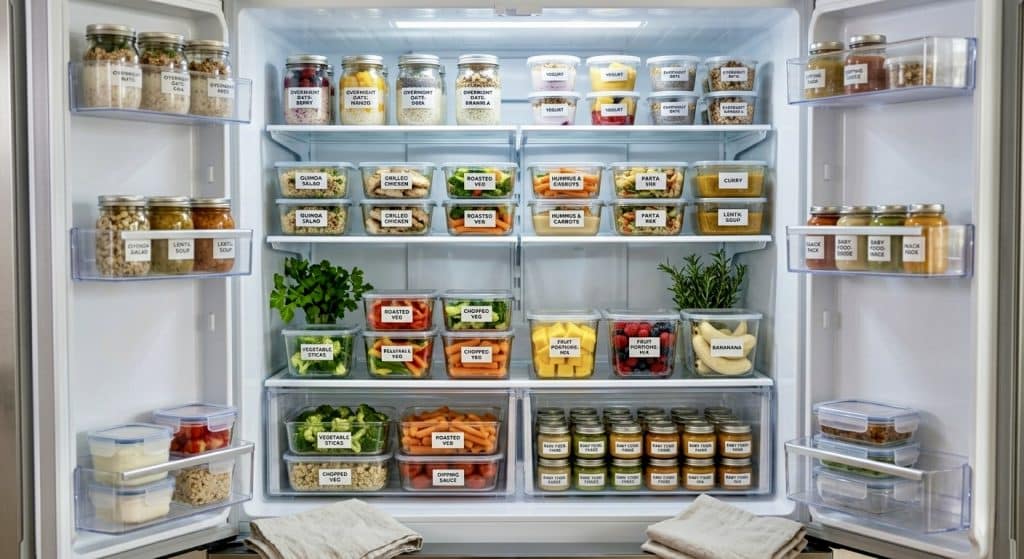
Proper storage is the element most often overlooked in healthy meal prep ideas for busy families, and improper storage is the reason most meal prep systems fail within the first two weeks.
Refrigerator storage guidelines: Cooked proteins last three to four days in airtight containers. Cooked grains last four to five days. Roasted vegetables last four to five days. Soups and stews last four to five days. Baby purees last two to three days in the refrigerator or up to three months in the freezer.
Freezer storage guidelines: Cooked chicken and turkey last up to three months. Cooked grains last up to two months. Soups and stews last up to three months. Baby purees in ice cube trays last up to three months. Egg muffins and mini oatmeal muffins last up to two months.
Reheating guidelines: Always reheat proteins and grains to an internal temperature of at least 74 degrees Celsius (165 degrees Fahrenheit). For baby food, ensure that reheated purees are thoroughly stirred before serving to eliminate hot spots. Never reheat baby food directly in the storage container if it is not microwave-safe.
Labeling system: Use masking tape and a permanent marker to label every container with the contents and the date prepared. This takes ten seconds per container and eliminates the daily mystery of what is in each container and whether it is still safe to eat.
Common Mistakes to Avoid
Even the most carefully designed easy meal prep recipes for exhausted parents can fail if these common mistakes are present.
Prepping too much variety: The goal of meal prep is simplicity, not variety. Preparing eight different dishes in one session creates complexity and increases the chance of food waste. Start with three to four core components and expand as the system becomes second nature.
Skipping the planning step: Walking into a prep session without a clear plan of what you are making, in what quantity, and in what order is the fastest way to waste an entire afternoon. Spend ten minutes planning before you begin cooking.
Using containers that are too large: Oversized containers make it difficult to see what you have and encourage larger portions. Right-sized containers aligned to actual meal portions make the system work effortlessly.
Not adapting the plan to your family’s real preferences: The best meal prep plan for busy parents is the one your family will actually eat. If your toddler refuses quinoa, do not batch-cook quinoa. Build the plan around your family’s real eating patterns, then gradually introduce new foods on the side.
Trying to be perfect from week one: The first prep session will take longer than expected. The second will be faster. By the fourth, the system will feel natural. Give yourself three to four weeks before evaluating whether the approach is working.
Conclusion
A meal prep plan for busy parents is one of the highest-return investments you can make in your family’s daily quality of life. The two hours you commit each week return to you in the form of calmer evenings, healthier meals, reduced decision fatigue, and the quiet confidence of knowing that your family is fed well, no matter how demanding the week becomes.
The 6-day plan in this article is designed to be realistic, not perfect. You do not need to execute every component every week. You do not need a beautiful kitchen or a culinary background. You need a grocery list, two hours, and the willingness to try for four consecutive weeks until the system becomes second nature.
Your children will eat better. You will feel less overwhelmed at dinnertime. And the refrigerator that used to trigger anxiety at 6 PM will become one of the most reassuring sights in your home.
Suggestion reading: 10 Self Care Overwhelmed Parents Secrets That Actually Save Your Sanity
Internal link suggestion:
Link the phrase “family nutrition” or “feeding your baby” to your post Essential Baby Care for New Parents: 7 Vital Secrets here.
Essential Baby Care for New Parents: 7 Vital Secrets
Looking for comprehensive guidance on caring for your baby? Our book ‘How to Care for Children: From Birth to Age 2’ combines professional nanny experience with evidence based child development research. Written by Kelly and Peter, this guide provides clear, reliable advice rooted in real world childcare. Available in English, Spanish, and Portuguese on Amazon.
Click the link below your preferred language to get your copy!




1. How long does a full meal prep session take for busy parents?
A complete meal prep plan for busy parents takes approximately two to two and a half hours for a family of three to four people. The first session may take up to three hours as you learn the system. By the third or fourth week, most parents complete their full weekly meal prep plan in under two hours, including cleanup. The time investment compounds positively: the more consistent you are, the faster and more efficient each session becomes.
2. Can I follow a meal prep plan for busy parents if I have a baby under six months?
Yes. For families with babies under six months who are exclusively breastfed or formula-fed, the meal prep plan for busy parents focuses entirely on the parents and any older siblings. As your baby approaches the six-month mark and you begin preparing for solid food introduction, you can start incorporating simple single-ingredient purees into your prep session. Starting early with puree preparation builds the habit before the feeding complexity increases.
3. What are the easiest meal prep recipes for exhausted parents on very limited time?
The three highest-value components for parents with extremely limited time are hard-boiled eggs, which take 12 minutes completely hands-free; roasted vegetables, which take 25 minutes completely hands-free in the oven; and overnight oats, which take three minutes to assemble the evening before. These three components alone provide breakfast and snack options for three to four days with virtually no active cooking time. For parents who want to expand from this minimum, adding one batch of cooked grains completes a full meal prep plan for busy parents in under 45 minutes total.
4. How do I adapt healthy meal prep ideas for busy families when my toddler is a picky eater?
The most effective strategy for picky eaters within a meal prep plan for busy parents is to separate components rather than combining them during prep. Store proteins, grains, and vegetables in individual containers and assemble plates at mealtime according to each child’s preferences. This gives you the efficiency of meal prep while preserving the flexibility to serve each family member what they will actually eat. Over time, exposure to prepped whole foods increases toddler acceptance of new ingredients naturally.
5. How many containers do I need for a weekly meal prep plan for busy parents?
A practical starting point for healthy meal prep ideas for busy families is twelve medium containers, six small containers for baby food and snacks, and four large containers for soups and stews. Glass containers are preferable for reheating and longevity. BPA-free plastic containers are a practical and lighter alternative, particularly for lunchboxes and toddler portions. Investing in a consistent container system is one of the most impactful upgrades you can make to your weekly routine.
6. Are time-saving meal prep strategies for new parents different from general meal prep advice?
Yes, significantly. General meal prep advice often focuses on variety, aesthetic presentation, and elaborate recipes that are impractical for sleep-deprived new parents. Time-saving meal prep strategies for new parents prioritize simplicity, hands-free cooking methods, baby and toddler integration, and systems that can be maintained consistently. A meal prep plan for busy parents is built around the reality of parenting life, not around ideal conditions that rarely exist in households with young children.
7. Can I meal prep if I have a very small kitchen or limited equipment?
Absolutely. The minimum equipment required for this meal prep plan for busy parents is a sheet pan, a large pot, a sharp knife, a cutting board, and airtight containers. A single oven rack and a stovetop burner are sufficient to execute the full plan. Small kitchen constraints are almost never the actual barrier. The barrier is almost always the planning and the initial commitment to trying the system.
8. What is the best day of the week for a meal prep session for busy parents?
Sunday is the most commonly recommended day because it precedes the typical Monday-to-Friday work and school week. However, the best day for your family is whichever day reliably gives you two uninterrupted hours. For some families, Wednesday evening works better as a mid-week refresh session that supplements a smaller Sunday prep. Experiment with the timing during the first month to find what fits your specific schedule.
9. How do I keep a meal prep plan for busy parents interesting week after week?
The most effective way to prevent meal prep fatigue is to rotate one or two components each week while keeping the core structure the same. Keep your protein base consistent, for example chicken and eggs, but rotate the grains between quinoa, brown rice, and farro. Rotate your vegetables seasonally. Change your sauces and dressings weekly. A meal prep plan for busy parents does not need to reinvent itself entirely each week. Small variations within a reliable structure produce both nutritional variety and long-term sustainability.
10. Is a meal prep plan for busy parents cost-effective compared to buying takeout?
Significantly. The average family of four spending on takeout or restaurant meals three to four times per week typically spends between 150 and 250 dollars more per month than a family following a structured weekly meal prep plan. Healthy meal prep ideas for busy families rely heavily on whole ingredients purchased in bulk, which are among the most cost-efficient foods available. Batch-cooked grains, legumes, and seasonal vegetables cost a fraction of their prepared equivalents. Over the course of a year, a consistent meal prep plan for busy parents can save a family between 1,500 and 3,000 dollars in food costs alone.
11. Can I follow easy meal prep recipes for exhausted parents if I have dietary restrictions in the family?
Absolutely. The modular structure of this plan makes it exceptionally adaptable to dietary restrictions. Gluten-free families can substitute quinoa or rice for all grain components. Dairy-free families can replace all dairy with plant-based alternatives without affecting the plan’s structure. Vegetarian families can replace animal proteins with legumes, tofu, and eggs throughout. The key principle of easy meal prep recipes for exhausted parents is that the system adapts to your family’s needs, not the other way around.
12. What should I do when the meal prep plan for busy parents does not go as planned?
Every experienced meal-prepping parent has weeks when the prep session does not happen, the grocery delivery is late, or the plan simply falls apart. The most important time-saving meal prep strategy for new parents in those moments is to default to a minimum viable prep: hard-boil a dozen eggs, wash and cut vegetables, and cook one pot of grains. These three components take 30 minutes total and provide the foundation for three to four days of assembled meals. A partial prep is always better than no prep. The goal is not perfection. The goal is consistency over time.
