
Breathing exercises for parents are not a wellness trend reserved for yoga studios or meditation retreats. They are one of the most clinically validated, immediately accessible tools available to any parent who has ever felt their chest tighten during a toddler meltdown, a sleepless night, or an overwhelming afternoon when everything seems to fall apart at once.
If you have ever stood in your kitchen, heart racing, completely unsure how to regain your composure before walking back into the room where your child needs you, this article was written specifically for you.
Parenthood is one of the most rewarding experiences in human life. It is also one of the most physiologically and emotionally demanding. The chronic low-grade stress that many parents carry every single day activates the body’s threat response in ways that simple willpower cannot resolve. But controlled breathing can, and the research behind it is compelling.
In this complete guide, you will discover six proven breathing exercises to reduce anxiety in parents, the neuroscience behind why they work, step-by-step instructions for each technique, and a realistic framework for building a daily practice even when your schedule leaves almost no room for yourself.
Table of Contents
- Why Breathing Exercises for Parents Are More Powerful Than You Think
- The Science Behind Breathwork and Anxiety Relief
- 6 Breathing Exercises to Reduce Anxiety in Parents
- Exercise 1: Box Breathing
- Exercise 2: 4-7-8 Breathing
- Exercise 3: Diaphragmatic Breathing
- Exercise 4: Alternate Nostril Breathing
- Exercise 5: Pursed Lip Breathing
- Exercise 6: Physiological Sigh
- How to Build a Daily Breathing Practice as a Parent
- Common Mistakes Parents Make When Trying to Breathe Through Anxiety
- FAQs
- Final Thoughts
Why Breathing Exercises for Parents Are More Powerful Than You Think
Most parents dismiss breathwork as something passive or overly simple. If breathing were enough to manage stress, they reason, it would already be working.

The problem is not that breathing fails. The problem is that under stress, most people stop breathing correctly. They breathe shallowly into the chest, using only a fraction of their lung capacity, which signals the nervous system to remain in a state of alert. This creates a physiological loop in which anxiety triggers poor breathing, and poor breathing amplifies anxiety.
Breathing exercises for parents interrupt that loop with precision. They activate the parasympathetic nervous system, which is the branch responsible for rest, digestion, and recovery. Unlike medication, supplements, or external interventions, breathwork requires nothing but your own lungs. It can be done in under five minutes, without special equipment, in a car, a bathroom, a nursery, or anywhere else you happen to need it.
For parents specifically, this matters enormously. You rarely have an hour for self-care. You almost never have complete silence. But you almost always have three minutes and a breath.
The Science Behind Breathwork and Anxiety Relief
Before learning each technique, it helps to understand what is actually happening in your body when you practice mindful breathing for overwhelmed parents.
The vagus nerve is the longest cranial nerve in the human body. It runs from the brainstem down through the heart, lungs, and digestive system, and it plays a central role in regulating the stress response. When you breathe slowly and deeply, particularly when your exhale is longer than your inhale, you stimulate the vagus nerve and increase what researchers call vagal tone.
Higher vagal tone is directly associated with reduced cortisol levels, lower heart rate, improved emotional regulation, and greater resilience to stress. A 2023 review published in Frontiers in Psychology found that slow-paced breathing at approximately six breaths per minute produced significant reductions in self-reported anxiety and measurable decreases in physiological stress markers in healthy adults.
For parents dealing with chronic stress rather than acute crisis, this means that consistent breathing exercises for parents produce cumulative benefits over time. You are not just calming yourself in the moment. You are literally retraining your nervous system to return to baseline faster after stressful events.
6 Breathing Exercises to Reduce Anxiety in Parents
Each of the following quick breathing techniques for stressed parents has been selected for its clinical backing, its practicality in a real parenting environment, and its effectiveness even when practiced for only a few minutes at a time.
Exercise 1: Box Breathing
Box breathing, also known as four-square breathing, is one of the most widely researched and commonly used anxiety relief breathing exercises for moms and dads, as well as military personnel, surgeons, and athletes. Its simplicity is precisely what makes breathing exercises for parents so accessible during acute moments of stress.
How to practice it:
Inhale through your nose for a count of four. Hold your breath for a count of four. Exhale slowly through your mouth for a count of four. Hold the exhale for a count of four. Repeat this cycle four to six times.
When to use it:
Box breathing works exceptionally well immediately before a difficult conversation, during a moment of parenting frustration, or any time you feel your sympathetic nervous system beginning to activate. It takes approximately two minutes and can be practiced standing, sitting, or lying down.
Why it works:
The equal ratio of inhale, hold, exhale, and hold creates a rhythmic pattern that pulls the nervous system out of reactive mode. The breath holds specifically allow carbon dioxide to accumulate slightly, which paradoxically calms the brain’s threat detection center, the amygdala.
Exercise 2: 4-7-8 Breathing
Developed and popularized by Dr. Andrew Weil, the 4-7-8 technique is one of the most recommended breathing exercises to reduce anxiety in parents, particularly for those who struggle with falling asleep after stressful evenings.
How to practice it:
Place the tip of your tongue against the ridge of tissue just behind your upper front teeth. Exhale completely through your mouth, making a whoosh sound. Close your mouth and inhale quietly through your nose for a count of four. Hold your breath for a count of seven. Exhale completely through your mouth, again making a whoosh sound, for a count of eight. This is one full breath cycle. Begin with four cycles and increase gradually.
When to use it:
This technique is most powerful at bedtime, after a particularly overwhelming day, or during the first quiet moment after the children are asleep. Many parents report falling asleep before completing their fourth cycle.
Why it works:
The extended exhale of eight counts activates the parasympathetic response more powerfully than an equal inhale-exhale ratio. The seven-count hold increases carbon dioxide tolerance and deepens the relaxation effect.
Exercise 3: Diaphragmatic Breathing
Diaphragmatic breathing, sometimes called belly breathing, is the foundation of virtually all mindful breathing for overwhelmed parents. It corrects the shallow chest breathing pattern that makes breathing exercises for parents less effective when stress accumulates over time.
How to practice it:
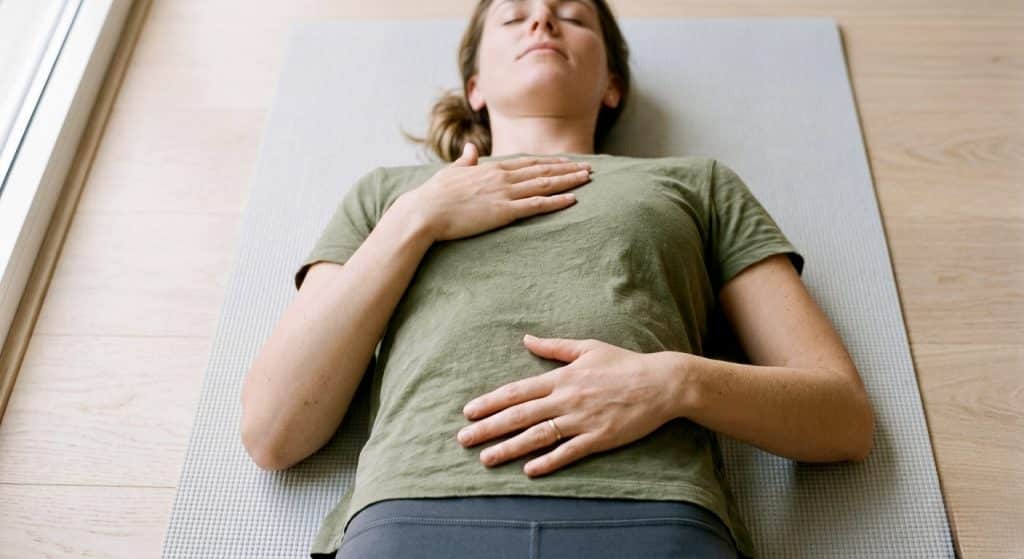
Sit or lie in a comfortable position. Place one hand on your chest and one hand on your belly. Inhale slowly through your nose, focusing on pushing your belly outward rather than lifting your chest. Your hand on your chest should remain relatively still while your hand on your belly rises. Exhale slowly through pursed lips. Practice for five to ten minutes daily.
When to use it:
Diaphragmatic breathing is ideal as a morning practice before the household wakes up, or as a reset during a quiet moment in the afternoon. It is also an excellent technique to model in front of children, as it teaches them emotional regulation through observation.
Why it works:
Breathing into the diaphragm engages the full lung capacity and massages the vagus nerve directly through the mechanical movement of the diaphragm. This produces an immediate reduction in heart rate and blood pressure.
Exercise 4: Alternate Nostril Breathing
Rooted in the yogic tradition of pranayama, alternate nostril breathing is one of the more advanced quick breathing techniques for stressed parents. Research published in the Journal of Clinical and Diagnostic Research found that regular practice significantly improved cardiovascular function and reduced perceived stress in adults.
How to practice it:
Sit comfortably with your spine upright. Rest your left hand on your left knee. Bring your right hand to your nose. Use your right thumb to close your right nostril. Inhale slowly through your left nostril. Close your left nostril with your right ring finger, releasing your thumb. Exhale through your right nostril. Inhale through your right nostril. Close it with your thumb. Exhale through your left nostril. This completes one cycle. Repeat for five to ten cycles.
When to use it:
This technique is particularly effective during mid-afternoon energy slumps, before important parenting moments that require patience and clarity, or as a midday reset between work and family responsibilities.
Why it works:
Alternate nostril breathing balances the activity of the brain’s two hemispheres, reduces cortisol levels, and has been shown to improve focus and emotional stability in multiple controlled studies.
Exercise 5: Pursed Lip Breathing
Pursed lip breathing is one of the simplest anxiety relief breathing exercises for moms and dads and one of the most immediately accessible. It is one of the breathing exercises for parents that requires no instruction beyond the basic movement and can be performed without anyone around you noticing.
How to practice it:
Relax your neck and shoulders. Inhale slowly through your nose for two counts, keeping your mouth closed. Pucker your lips as if you are about to whistle or blow out a candle. Exhale slowly through your pursed lips for four counts. Repeat for ten to twenty breath cycles.
When to use it:
This technique is ideal in public situations, during school pickups, in waiting rooms, or any environment where a more elaborate technique would feel conspicuous. It is also particularly helpful during moments of physical exertion, such as carrying a baby for an extended period while managing stress.
Why it works:
Pursed lip breathing slows the breathing rate, keeps the airways open longer, and forces the exhale to be longer than the inhale, which is the physiological trigger for parasympathetic activation.
Exercise 6: Physiological Sigh
The physiological sigh is arguably the most powerful single breathing technique in this list for acute anxiety relief. It is the breathing pattern your body spontaneously generates when it is overwhelmed, but practiced intentionally, it becomes one of the most effective mindful breathing tools for overwhelmed parents.
How to practice it:
Take a full, deep inhale through your nose. Without exhaling, take a second, shorter sniff of air on top of the first to fully inflate your lungs. Then exhale everything, slowly and completely, through your mouth. One to three repetitions is typically sufficient for an immediate effect.
When to use it:
Use the physiological sigh at the precise moment anxiety peaks: at the start of a conflict, when you feel tears or anger rising, when you receive unexpected bad news, or when you simply need to reset within seconds.
Why it works:
The double inhale reinflates the alveoli in your lungs, the tiny air sacs that begin to collapse under shallow breathing. The extended exhale that follows offloads a large volume of carbon dioxide rapidly, which is the body’s fastest signal to the nervous system that the threat has passed.
This technique was extensively studied at Stanford University by Dr. Andrew Huberman and Dr. David Spiegel, whose 2023 research demonstrated that cyclic sighing practiced for five minutes per day produced the most significant reductions in anxiety among all breathwork techniques tested.

How to Build a Daily Breathing Practice as a Parent
Knowing the techniques is only part of the work. The real transformation happens when breathing exercises for parents become a consistent daily habit rather than an emergency measure.
The most effective approach for busy parents is what behavioral scientists call habit stacking: attaching your breathing practice to an existing daily routine so it requires no additional decision-making.
Here are four practical entry points that work even in the most demanding parenting schedules.
Before you get out of bed: Spend two minutes practicing diaphragmatic breathing before your feet touch the floor. This primes your nervous system for a calmer morning before the day’s demands begin.
During your first cup of coffee or tea: Practice box breathing for four cycles while your coffee brews or steeps. This takes approximately two minutes and creates a brief moment of deliberate calm before the household fully activates.
During the afternoon reset: Many parents experience a stress spike in the late afternoon as work responsibilities overlap with school pickup, homework, and dinner preparation. Using the 4-7-8 technique for three to five minutes during this window can significantly reduce cumulative tension.
After the children are asleep: The physiological sigh or alternate nostril breathing in the first quiet minutes of the evening helps decompress the nervous system and prepares the body for restorative sleep.
When it comes to breathing exercises for parents, consistency matters more than duration. Five minutes of daily breathwork practiced every day for thirty days produces measurable neurological changes. Forty-five minutes of breathwork practiced once a week does not.
Read more: 6 Proven Breathing Exercises for Parents That Instantly Reduce AnxietyRestorative Sleep: Baby Sleep Schedule by Age 0 to 24 Months
Self-Care For Parents: 10 Self-Care Overwhelmed Parents Secrets That Save Sanity
Common Mistakes Parents Make When Trying to Breathe Through Anxiety
Even the best breathing exercises to reduce anxiety in parents can underperform if practiced incorrectly. These are the most common errors and how to avoid them.

Breathing too quickly: The effectiveness of every technique in this article depends on a slower-than-normal breathing rate. If you are completing cycles too fast, slow down deliberately.
Stopping at the first sign of discomfort: Breath holds and extended exhales can feel slightly uncomfortable at first, particularly if your body is accustomed to shallow breathing. This discomfort is normal and passes within a few sessions.
Waiting until the crisis peaks: Quick breathing techniques for stressed parents work best when initiated early in the stress response. Practicing at a 3 out of 10 on the anxiety scale is far more effective than waiting until you reach a 9.
Treating it as a one-time intervention: A single session of breathing exercises for parents can produce immediate relief. But the lasting benefits, including reduced baseline anxiety, improved emotional regulation, and greater stress resilience, only emerge with consistent daily practice.
Practicing incorrectly and giving up: If a technique does not produce results in the first session, the issue is almost always timing or execution rather than the technique itself. Review the instructions, practice in a calm moment rather than a crisis, and give each method at least five to seven sessions before evaluating its effectiveness.
Conclusion
Breathing exercises for parents are not a luxury and they are not a supplement to real mental health care. Breathing exercises for parents are a direct, evidence-based intervention that is available to you every single moment of every single day, regardless of your schedule, your budget, or your circumstances.
The six techniques in this article, box breathing, 4-7-8 breathing, diaphragmatic breathing, alternate nostril breathing, pursed lip breathing, and the physiological sigh, cover the full spectrum of parental anxiety: from the slow accumulation of daily stress to the acute moments when you need to reset within seconds.
You do not need to master all six at once. Start with one. Practice it every day for two weeks. Then add a second. Over time, you will build a personal toolkit that serves you through the full range of demands that parenthood places on your nervous system.
Your children do not need a perfect parent. They need a regulated one. And regulation, it turns out, begins with a single breath.
Learn about:
Vagal Nerve From The Cleveland Clinic article.
More suggestion to learn:
Emotional Regulation: 5 Critical Signs That Tell Baby Blues vs Postpartum Depression Apart.
Life Transitions: 9 Stress Management Life Transitions Secrets That Work
Looking for comprehensive guidance on caring for your baby? Our book ‘How to Care for Children: From Birth to Age 2’ combines professional nanny experience with evidence based child development research. Written by Kelly and Peter, this guide provides clear, reliable advice rooted in real world childcare. Available in English, Spanish, and Portuguese on Amazon.
Click the link below your preferred language to get your copy!



1. How long do breathing exercises take to reduce anxiety in parents?
Most breathing exercises to reduce anxiety in parents produce a noticeable shift in physiological state within two to five minutes. The physiological sigh can reduce acute anxiety in as little as thirty to sixty seconds. For lasting reductions in baseline anxiety, a consistent daily practice of five to ten minutes over thirty days is the general clinical recommendation.
2. Can I practice these breathing exercises while breastfeeding or holding my baby?
Yes. Diaphragmatic breathing, pursed lip breathing, and the physiological sigh can all be practiced while holding or feeding a baby. Box breathing and the 4-7-8 technique require slightly more focus but can also be adapted to those situations with practice.
3. Are there breathing exercises that are safe to teach my child?
Diaphragmatic belly breathing and box breathing are both safe, age-appropriate, and beneficial for children as young as four or five years old. Teaching your child these techniques alongside your own practice creates a shared emotional regulation tool for the entire family.
4. I have asthma. Can I still practice these techniques?
Most breathing exercises for parents are safe for individuals with mild to moderate asthma, but breath holds may be contraindicated in some cases. Consult your physician before beginning any breathwork practice if you have a respiratory condition.
5. What is the difference between breathing exercises and meditation?
Breathing exercises focus specifically on manipulating the breath to produce a physiological response. Meditation is a broader mental practice that may or may not include breathwork. Both are effective for reducing anxiety, and they complement each other well. Breathing exercises are generally faster to learn and produce more immediate physical results.
6. How do I know which breathing technique is right for me?
The best technique is the one you will actually practice consistently. Start with diaphragmatic breathing to build the foundation, add box breathing for acute stress moments, and experiment with the 4-7-8 technique at bedtime. Use the physiological sigh as your emergency reset. Over two to four weeks, your body will naturally gravitate toward the methods that work best for your nervous system.
7. How often should parents practice breathing exercises to see real results?
The most consistent finding across breathwork research is that daily practice produces significantly better results than occasional use. Breathing exercises for parents practiced for just five to ten minutes every day create measurable changes in baseline anxiety within two to four weeks. Even two to three sessions per day of two minutes each produce cumulative benefits. The key variable is not duration but consistency.
8. Can breathing exercises for parents replace therapy or medication for anxiety?
Breathing exercises for parents are a powerful complementary tool, but they are not a replacement for professional mental health treatment in cases of clinical anxiety or postpartum mood disorders. If your anxiety is significantly impacting your daily functioning, your relationship with your child, or your ability to sleep and eat normally, please consult a licensed mental health professional. Breathwork works best as part of a broader wellness strategy that may include therapy, lifestyle adjustments, and medical guidance when necessary.
9. What are the best breathing exercises for parents dealing with postpartum anxiety?
Diaphragmatic breathing and the physiological sigh are particularly well suited for postpartum anxiety because they require no special posture, no quiet environment, and no extended time commitment. Quick breathing techniques for stressed parents in the postpartum period work best when practiced during feeding sessions, during baby’s naps, or in the first few minutes after waking. The 4-7-8 technique is also highly effective for postpartum parents who struggle with nighttime anxiety and disrupted sleep.
10. Do breathing exercises for parents work during panic attacks?
Yes, but the approach matters. During a full panic attack, attempting complex techniques like alternate nostril breathing can increase frustration. The physiological sigh and pursed lip breathing are the most effective anxiety relief breathing exercises for moms and dads during acute panic because they are simple enough to execute even when the mind is overwhelmed. Box breathing can be introduced as the initial panic subsides and the nervous system begins to regulate.
11. Are there apps that can guide parents through breathing exercises?
Several well-regarded apps offer guided breathwork sessions that complement the techniques described in this article. Insight Timer, Calm, and the Wim Hof Method app all include structured breathing programs. However, the mindful breathing for overwhelmed parents described in this guide requires no technology and no subscription. Starting with unguided practice builds a deeper awareness of your own breathing patterns and produces stronger long-term results.
12. Can breathing exercises help parents manage anger, not just anxiety?
Absolutely. Anger and anxiety share the same physiological root: activation of the sympathetic nervous system and a surge of cortisol and adrenaline. Breathing exercises for parents interrupt that activation regardless of whether the trigger is fear or frustration. Box breathing and the physiological sigh are particularly effective for anger management because they slow the heart rate rapidly and create a brief pause between stimulus and response, which is precisely the space where better parenting decisions are made.